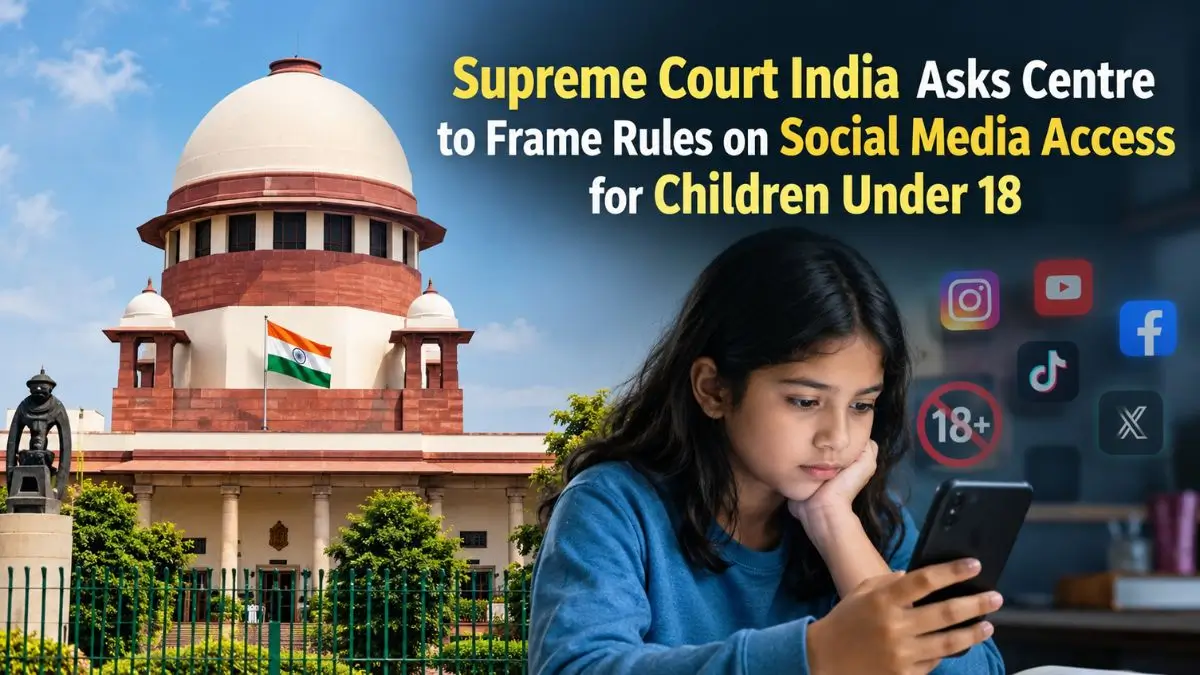
On September 28th 2026, the Supreme Court has directed the Centre to look into the question of formulating rules regulating the use of social media by children, such as the need for parental consent before opening an account for anyone below the age of 18. This has been raised in a public interest litigation case brought forth by the Just Rights for Children Alliance regarding protection of children from the menace of cyber world.
What Was Discussed in the Supreme Court?
The case regarding the protection of minors while accessing social media platforms was heard by a bench led by the Chief Justice of India, Surya Kant, and two other Justices, namely Joymalya Bagchi and V. Mohana. The petition highlights the need for measures which will allow the social media platform to obtain consent of the parent/guardian before a child opens an account.
According to the Solicitor General Tushar Mehta, during the hearing, the government will study if there is any provision under the Digital Personal Data Protection (DPDP) Act regarding the same or any new provision needs to be made.
Why is the Court Increasing the Age Limit of 18 Years?
The case revolves around the legal nature of the agreement made by the minors with the social media intermediary. According to the petitioner, the creation of an account involves accepting the terms of services of the particular platform whereas the minor cannot make any agreement in accordance with Indian law.
The court opined that it was necessary to see whether such a legal position can be used as the basis for formulating a policy that mandates the parents’ permission for the social media account. Additionally, Justice Bagchi pointed out that the membership conditions should match the legal position in India.
Petition Calls for Parental Consent, Other Measures
The Just Rights for Children Alliance is requesting modifications to the Information Technology Rules, 2021 or guidelines that would regulate children’s usage of social media platforms and digital platforms.
These protective measures include,
- Consent by parent or legal guardian before opening an account.
- Verification of the parent or guardian where necessary.
- Control over social media intermediaries.
- Protection against online grooming and sexual abuse.
- Protection against cyberbullying and privacy infringement.
- Prevention from being exposed to inappropriate digital content.
The petition highlights platforms which allow users aged around 13 years to open accounts through their platform policy.
Safe-Harbour Provisions under IT Act
This case has also brought into sharp relief section 79 of the Information Technology Act, 2000. This provision offers safe-harbour protection to intermediaries from liability for third-party information, data or communication which might be hosted by them, provided they satisfy certain conditions.
The Chief Justice made it clear that the Court might issue directions with respect to intermediaries if the regulatory aspect is not sorted out. The Solicitor General stated that the government will look into it and that the issue of application of existing provisions of law will have to be considered.
Thus, there is an interplay between the issues related to protection of children and intermediaries’ regulation laws.
Use of the Digital Personal Data Protection Framework
The Solicitor General cited the Digital Personal Data Protection Act, 2023, during the hearing. This piece of legislation provides a framework for the processing of digital personal data and has provisions specifically related to children’s personal data.
It is to be noted from the petition’s side that the applicable DPDP framework was not fully operational during the hearing. Thus, the hearing revolved around whether provisions relating to children’s data can be provided within the applicable framework or if further rules are needed based on other laws.
The case brings to light the convergence of child protection, personal data protection, contractual capacity, and intermediary regulation.
Regulation of Social Media for Children in India
The Supreme Court hearing takes place in the context of discussions regarding social media age limits. This is due to the introduction of age limits by Australia regarding children’s access to social media below the age of 16.
Indian Prime Minister Narendra Modi had said in July 2026, at the India-Australia leaders engagement, that India was learning lessons from Australia’s model. But nothing like a countrywide ban or something similar for under-16 kids had been declared by such a statement.
In the case of Karnataka and Andhra Pradesh states of India, there have also been discussions on age limits regarding access to social media by children.







 PM-VBRY Scheme: EPFO Offers Up to ₹15,...
 Global Hunger Index 2026: India Ranks 10...
 Sudhakar Dalela Appointed as India’s N...