
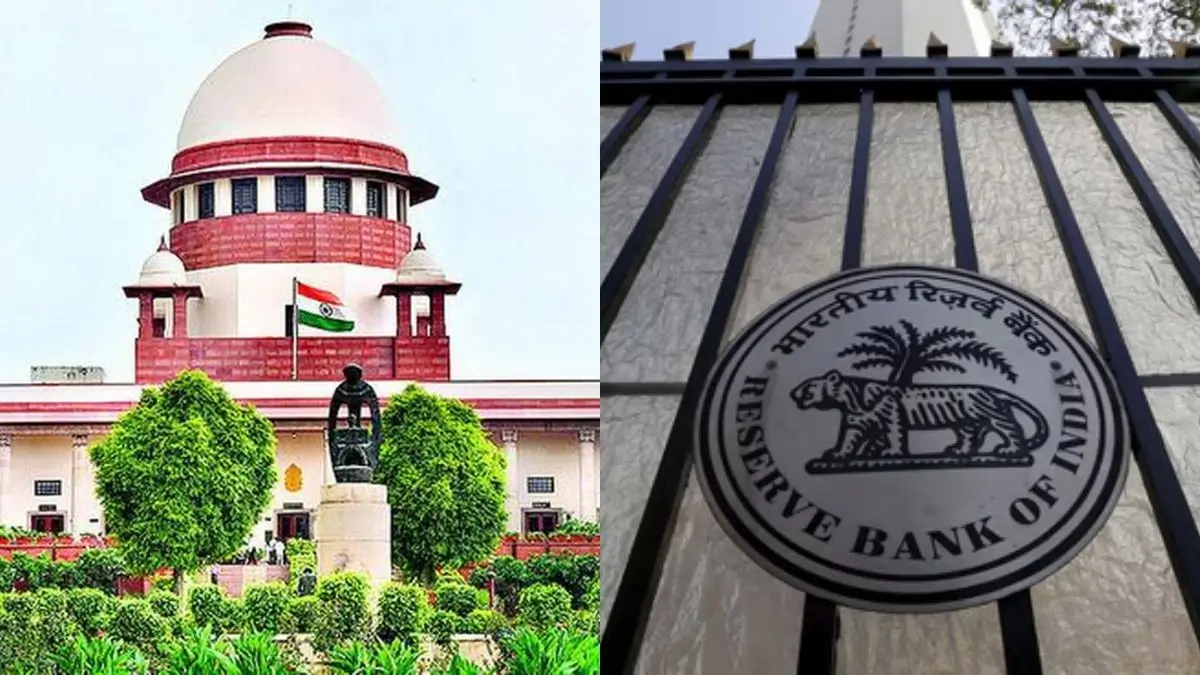
The Supreme Court of India has directed RBI to make sure that its new system for dealing with arrests through digital means or cybercrime includes provisions that hold banks responsible in cases where their systems fail to provide enough security or due diligence is not done, resulting in loss to their customers. At the time of hearing held on October 29, 2026, the Bench demanded a provision of liability as well as at least compensation to the extent of the amount lost by the victim.
What Instructions Did the Supreme Court Give to the RBI?
The bench consisting of Chief Justice of India Surya Kant and Justices Joymalya Bagchi and V. Mohana were hearing a suo motu case regarding a digital fraud with fake court documents.
The case originated from the case of the elderly couple who allegedly lost Rs. 1.05 crore to fraudsters who pretended to be officials using fake orders from the court.
The Court instructed the RBI to make sure that the proposed regulatory framework contained all the provisions that can be enforced against any financial institution not exercising due diligence. It underlined that the compensation must be not less than the amount that was lost by the customer if it is proved that the fraud was the result of the institution not exercising due diligence.
Key Safeguards Suggested by the Court
Suggested safeguard and It’s Objective
- Compensation: Maintain compensation to victims when the due diligence failure of a financial institution results in fraud
- Suspension of abnormal transactions: Prevent any suspicious transfer which is drastically different from normal transactions for that account
- Automatic Alerting of the suspicious transaction for necessary actions
- Verification: Ensure whether the suspicious transaction or high value transaction is legitimate or not
- Alerting police facilitates quick action for the verification of suspicious transactions possibly related to the online arrest scam
- Accountability: Provide punishment for financial institutions not adhering to the necessary safety measures
The Court emphasized that banks should aim at preventing suspicious transactions rather than just investigating after the disappearance of money.
What do you understand by a Digital Arrest Scam?
A digital arrest scam refers to a cyber fraud method wherein offenders pretend to be law enforcement officers, investigative agencies, judges, or any other government employee while communicating over telephone or through video calls.
Swindlers accuse their targets of being engaged in criminal acts, money laundering, etc. They also resort to using threats of arrest and fake legal documents to spread panic and compel people to send them money.
In certain cases, offenders use fake documents from the Supreme Court or any other court of law to substantiate their claims.
Why Should Banks Be Made Accountable?
Banks and other financial institutions have information on the transaction history of the customers and they can check for unusual activity in the accounts. The Court wondered why such institutions should not act upon a situation where there was an anomaly in the transactions of their clients.
In one instance, an unusually large sum of money being transferred from an elderly client’s account would need further investigation in order to confirm that this kind of transaction did not take place under pressure or deceit.
Technology and AI were mentioned as useful tools for detecting suspicious transactions. The Court raised its concern over what they called mule accounts, which are used by the criminals to transfer and hide illegally obtained funds.
Proposed Cyber-Fraud Framework Timeline by the RBI
During the proceedings, the Attorney General of India, R. Venkataramani, told the court that the RBI was making efforts to frame regulatory measures along with technical integration to tackle digital fraud.
This timeline shared during the proceedings was as mentioned below:
- November 30th 2026: Proposed the announcement of the regulatory directions.
- December 31st 2026: Proposed enforcement of the framework.
- Next date of hearing: The Court directed that the list of the authorized financial institutions and other details about the proposed measures.
These dates were indicative of the timeline deliberated before the bench, and not of the fact that the rules have already been announced or implemented.
Why Do Banks Need to Be Held Accountable?
Both banks and other financial institutions have information about the history of transactions of their customers and can spot any suspicious activities in the accounts. It became a question to the Court why the institutions do not intervene when there is some anomaly found in the transactions of their customers.
For example, when there is an unexpectedly large amount of money that is going to be transferred from the account of an elderly customer, there is a need to investigate it more in order to make sure that this transaction was done voluntarily.
Both technology and AI were suggested as good ways of spotting suspicious transactions. Mule accounts were also brought up by the Court as one of the issues concerning money laundering.








 Bihar Museum Ranks 9th Globally, Tops As...
 Ministry of Jal Shakti Launches Punah Bh...
 Centre Approves 3% DA Hike for Central G...