
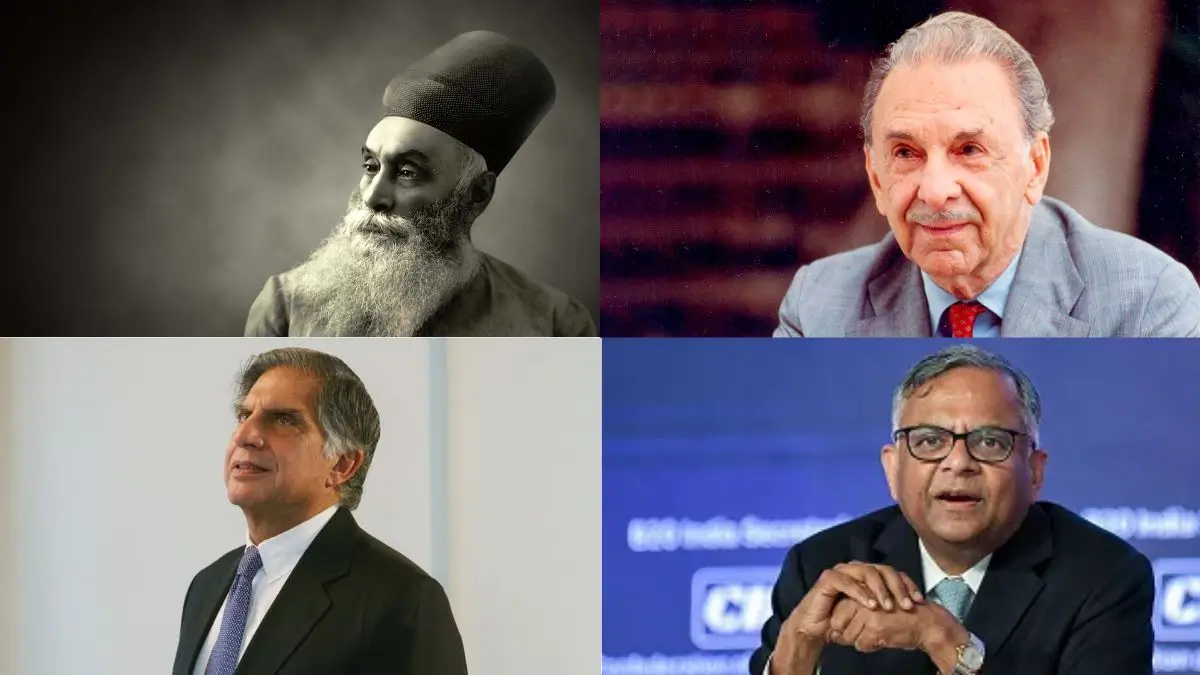
Throughout the years, the Tata Group has been led by generations of visionaries including the founder, Jamsetji Tata, to the present chairman, N Chandrasekaran. Over the years, each leader has helped to transform the Tata group into a global enterprise through diversification of its industrial interests.
The Tata Group, which was founded by Jamsetji Tata in 1868, has grown from being involved in manufacturing steel and generating power to being involved in industries such as aviation, automobile, hospitality, IT and consumer goods among others. Every chairman has made a distinct contribution during this period.
On August 12, 2026, N Chandrasekaran stated that he would not be seeking for reappointment as the chairman of Tata Sons as his current mandate comes to an end in February 20, 2027.
List of Tata Group Chairmen
| Sr. No | Chairman | Tenure |
| 1 | Jamsetji Tata | 1868–1904 |
| 2 | Sir Dorabji Tata | 1904–1932 |
| 3 | Sir Nowroji Saklatwala | 1932–1938 |
| 4 | J. R. D. Tata | 1938–1991 |
| 5 | Ratan Tata | 1991–2012 |
| 6 | Cyrus Mistry | 2012–2016 |
| 7 | Ratan Tata | 2016–2017 |
| 8 | N Chandrasekaran | 2017–February 20, 2027 |
Some of the notable chairmen listed in the heritage materials of the Tata Group are Dorabji Tata, Nowroji Saklatwala, JRD Tata and Ratan Tata.
Jamsetji Tata: The Founder Who Founded the Legacy
Jamsetji Tata (1868–1904) was the founder and chairman of the Tata Group and set the stage for the emergence of the most influential business group of India.
However, his vision and ideas transcended the scope of establishing individual companies. He initiated various ventures in different fields like steel, electricity, scientific research and education.
His aspirations included founding an institute of world class standards and establishing the first major steel company in India.
Even though the majority of major organisations within the group were established after his death, the vision that he had helped lay the foundations for the Tata
Sir Dorabji Tata: Vision to Reality
Sir Dorabji Tata (1904-1932) succeeded his father and was instrumental in converting the ambitions of Jamsetji into large-scale industrial enterprises.
During his leadership, Tata Steel and Tata Power emerged as the major pillars of the group. Dorabji further enriched the philanthropic traditions of the group and ultimately gave most of his wealth to charitable trusts.
His leadership was instrumental in to converting the Tata enterprises into an industrial group from being a set of ventures.
Sir Nowroji Saklatwala: Maintaining Group Consistency
Sir Nowroji Saklatwala (1932-1938) succeeded Dorabji Tata as chairman. He was a trusted associate of Dorabji who was famous for his concern about the well-being of employees and responsible management.
According to the official timeline of the Tata Group, Nowroji Saklatwala took the position of chairman after the demise of Dorabji Tata in 1932.
J.R.D. Tata: The Most Prolonged Leadership in Tata History
Jehangir Ratanji Dadabhoy Tata (J. R. D. Tata), who succeeded Nowroji Saklatwala as chairman in 1938, held this position till 1991.
More than five decades of his leadership marked one of the most transformational eras in Tata history. During the era of JRD, the Tata group diversified its operations into chemicals, automobiles, tea, information technology, and several other sectors.
He was a pioneer of Indian aviation industry too. In 1932, he flew the first flight of Tata Aviation Service from Karachi to Bombay that ultimately became Air India.
In addition, his leadership era focused on the aspect of professional management and motivated the Tata companies to hire professionals out of the conventional family structure.
Taking Tata Global: Ratan Tata
The current Tata Sons chairman Ratan Tata has been leading since 1991, replacing JRD Tata when India’s economy was experiencing liberalisation.
During his time in the Tata Group, Ratan Tata sought to make the group more cohesive as well as increase its global presence.
Global acquisitions of Tetley, Corus and Jaguar Land Rover have been some of the most notable acquisitions in Tata under his leadership, which saw the group transform from being an Indian business group to a global business group.
Ratan Tata left his position in 2012 but re-emerged as the interim chairman in 2016 after the ousting of Cyrus Mistry.
He held that position until he handed over the position to Chandrasekaran in 2017. According to the Tata Group, the Ratan Tata period saw the group go to foreign markets and promote innovation and calculated risk taking.
Controversial Tenure of Cyrus Mistry
The chairman of the Tata Group since 2012 is Cyrus Mistry, who succeeded Ratan Tata.
Unlike all past chairmen of the Tata Group, Mistry is not from the Tata family. While the main focus of his leadership was the restructuring and improvement of several business units of the group, Mistry eventually had a falling out with the Tata Trusts and Ratan Tata, which saw him lose his position as the chairman of the Tata Sons in October 2016.
Following this development, Ratan Tata became the interim chairman until a replacement is found.
Taking Charge N Chandrasekaran
The chairman of Tata Sons since 2017 is N Chandrasekaran, who has succeeded Ratan Tata. He is the first person from the non-Parsi Tata community to head the business group.
Chandrasekaran had previously worked for decades in the Tata Group, most of which was at Tata Consultancy Services, where he was CEO and managing director.
As the chairman of the Tata Group, the group under his leadership has gone through expansion in technology, electronics, aviation, electric vehicles among others. Under him, the group also made the acquisition of Air India.
However, on August 12, 2026, N Chandrasekaran said that he will not be contesting for a second term as the chairman of Tata Sons. His existing term will come to an end on February 20, 2027.







 Who Is Navi Pillay? Nobel Peace Prize 20...
 Vande Bharat vs Amrit Bharat Express: Ke...
 Asian Games to LA28: Which Sports Earned...










