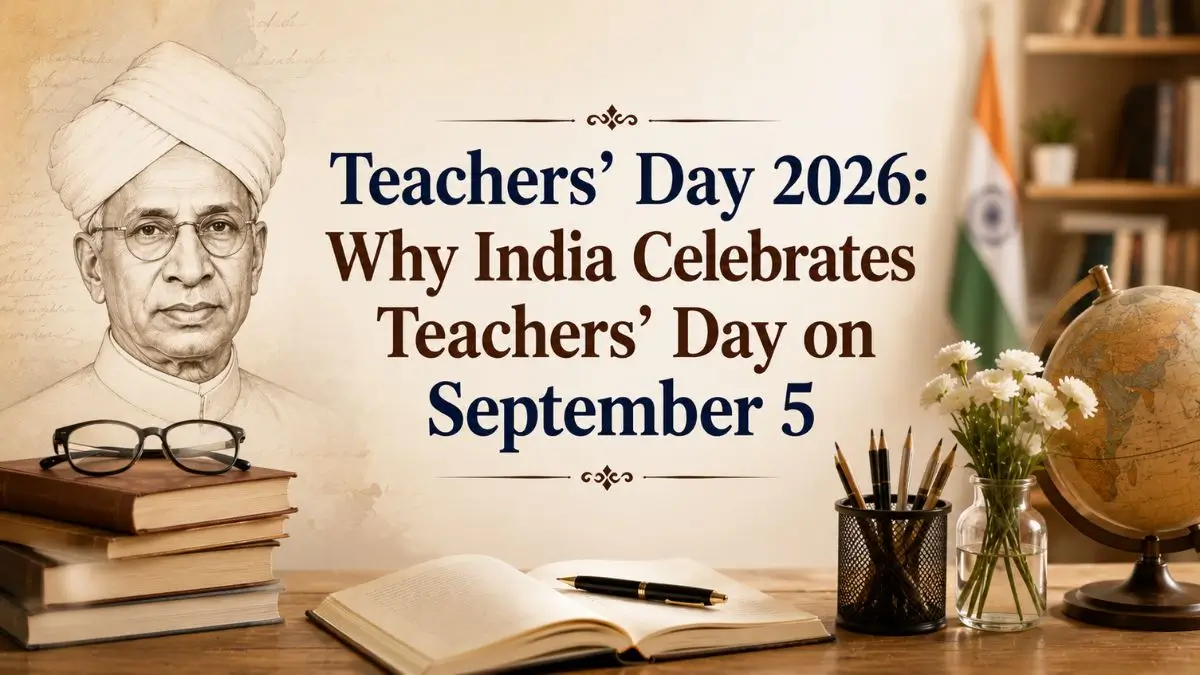
Teachers Day is observed in all parts of India annually on 5 September. Teachers’ Day provides students with the opportunity to honour their teachers and mentors for their contributions. Cultural events, speeches, competitions, cards, and gift-giving and many more activities are observed to celebrate this event by schools and colleges in India. The observance of this day has historical significance since it is associated with Dr Sarvepalli Radhakrishnan, who is considered to be one of the greatest philosophers, scholars and statesmen of India. He was born on 5 September 1888.
Why is Teachers’ Day Observed on 5th September?
India celebrates Teachers’ Day on 5th September in honour of the birthday of Dr Sarvepalli Radhakrishnan.
It is said that when his students and friends insisted upon celebrating his birthday, he said why don’t we celebrate this day as the Teachers’ Day instead of celebrating it as his own birthday.
This made the observance of the day more meaningful and gave recognition to the educators.
About Dr. Sarvepalli Radhakrishnan
Dr Sarvepalli Radhakrishnan was born on 5th September 1888 in Tiruttani, erstwhile Madras Presidency.
He graduated from Madras Christian College and proceeded to be a philosophy professor in some renowned colleges, such as the University of Mysore and University of Calcutta.
Through his scholarly works, particularly in philosophy and comparative religion, he was instrumental in acquainting Westerners with Indian philosophical tradition. He subsequently occupied the post of the Spalding Professor of Eastern Religions and Ethics at the University of Oxford.
For Radhakrishnan, education is not just about knowledge alone. Rather, it involves a lot of other things such as reason, character and responsible citizenship.
Political Career of Radhakrishnan
Although he is more famous for his work in education and philosophy, Radhakrishnan also held two of India’s highest constitutional positions.
He was India’s first Vice President from 1952 to 1962, and then became the country’s second President in 1962, serving till 1967.
This move from his career in academia into politics was based on his wider belief that education was key to nation-building.








 International Day for the Eradication of...
 World Food Day 2026: Theme, History, Sig...
 Mahila Kisan Diwas 2026 to Highlight Wom...