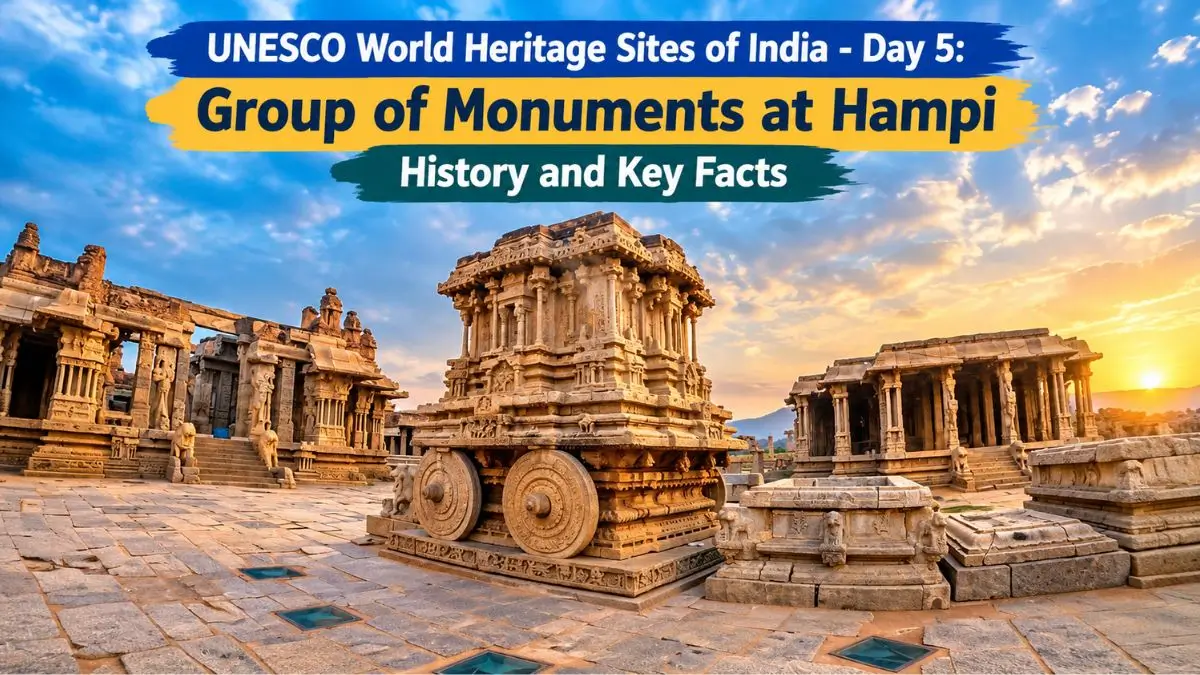
The Hampi complex is one of the most significant archaeological and cultural heritages in India, where there are remnants of the ancient Vijayanagara Empire, an influential South Indian civilization that existed from the 14th to the 16th century. It is situated in Karnataka State in proximity to the Tungabhadra River, and it consists of Dravidian temples, palace compounds, stone chariots, fortifications, and advanced irrigation systems.
Criteria (i), (iii), and (iv) led to the addition of the Group of Monuments in Hampi into the World Heritage List by UNESCO in 1986. The monuments of this site provide an outstanding testimony to the achievements of the Vijayanagara civilization and its destruction after the Battle of Talikota in 1565.
Hampi- Key Overview
| Information | Details |
| UNESCO World Heritage site | The group of monuments in Hampi |
| Location | Karnataka in India |
| Historic Background | Capital of the Vijayanagara Empire. |
| Year of inscription | 1986 |
| Criterion of UNESCO world heritage sites criteria | Criteria (i), (iii), (iv). |
| Total area | 4,187.24 hectares and buffer zone area of 19,453.62 hectares |
| Cancellation of the buffer zone | 2012 |
| Major River | Tungabhadra |
| Major historical event | Battle of Talikota in 1565 |
Hampi and Vijayanagara Kingdom
The ruins of Hampi are remnants of Vijayanagara, which was an extremely influential kingdom of South India. Hampi evolved as an important political, religious, and commercial center since the 14th century, owing to its geographical location close to the Tungabhadra River.
Vijayanagara kings built walls, temples, palaces, markets and a water management system for their capital. It earned fame for its riches and architecture, and attracted foreign travelers who talked about its prosperity and splendor.
The Vijayanagara kingdom achieved its peak under the rule of King Krishnadevaraya (1509–1530 CE), who belonged to the Tuluva dynasty. During his reign, there was significant progress in building temples, sculpture making, and other cultural activities.
The watershed moment came in 1565 CE, when the army of Vijayanagara was defeated by the combined forces of the Deccan Sultanates. This defeat led to the destruction of Hampi, which got heavily looted. While Vijayanagara traditions survived in politics for some time, its capital never recovered its past glory.
Key Attractions and Architectural Monuments
Hampi is not just one monument, but rather a vast archaeological area which consists of temples, sacred and royal complexes, fortifications and various water structures, along with remnants of urban life around. UNESCO has registered the presence of over 1600 historical remains within the site.
1. Virupaksha Temple
This temple is dedicated to Lord Shiva in his form of Virupaksha. Parts of this temple date back before the Vijayanagara Empire was established, and the tall gopuram of the temple is prominent in the historic landscape.
2. Vittala Temple Complex
This temple complex is regarded as one of the best examples of Vijayanagara temple architecture with lavishly decorated pillars, mandapas, and a granite stone chariot representing a Garuda shrine. It also has an ancient bazaar street, ceremonial structures, and a stepped tank.
3. Statue of Lakshmi Narasimha
This large statue shows Narasimha, the half-lion, half-human avatar of Vishnu. It is one of the most important examples of monumental stone sculptures in Hampi and demonstrates the artistic abilities of Vijayanagara artisans.
4. Lotus Mahal
It is situated in the royal urban sector; the Lotus Mahal is famous for the its unique arches and symmetric architecture. This shows that certain Indo-Islamic architectural features have been included in some secular structures in the Vijayanagara era.
5. Elephant Stables
Elephant stables are one of the important structures remaining from the royal sector. The dome-shaped rooms and arches found in this structure represent architectural features which deviate from the typical Dravidian temple architecture.
Why is Hampi a UNESCO World Heritage Site?
The United Nations Educational, Scientific, and Cultural Organization designated the Group of Monuments at Hampi as a cultural World Heritage site in 1986, recognizing it under three cultural criteria.
| Criteria | Description |
| Criterion (i) | Constitutes Hampi as a unique artistic creation through the incorporation of its planned and defended city, temple architecture, and natural environment. |
| Criterion (iii) | Constitutes the site as an outstanding example of the civilization of the Vijayanagara Empire, especially during its peak time under the reign of Krishnadevaraya. |
| Criterion (iv) | Constitutes the site as an outstanding example of a capital city whose remnants of the sacred, royal, civil and military structures constitute the destruction of Vijayanagara after the Battle of Talikota of 1565 CE. |
In 2012, UNESCO ratified an extension of the site’s buffer zone. The current UNESCO designation of the property allocates an area of 4,187.24 hectares and a buffer zone of 19,453.62 hectares.








 Indian State Animals: Complete State-Wis...
 Smit Machchhar Receives UAE’s First Cl...
 UNESCO World Heritage Sites of India - D...