
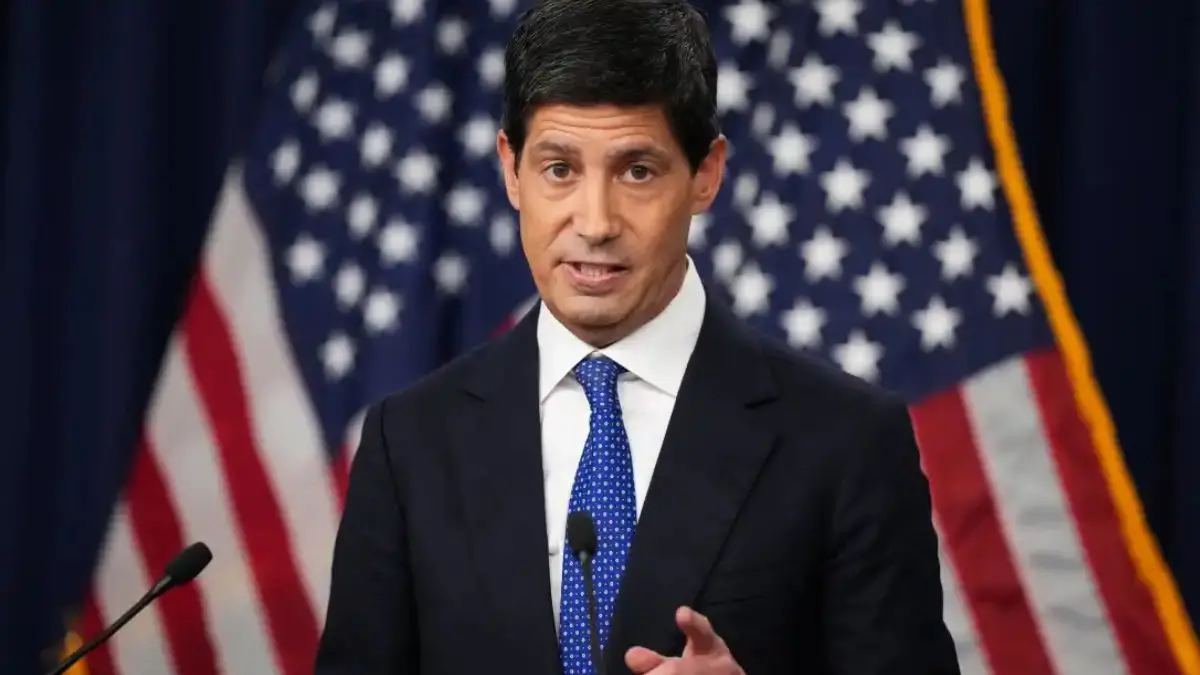
The benchmark federal funds rate in the US by the Federal Reserve, remained unchanged at 3.75% – 4% in the monetary policy meeting held on 28 October 2026. Two of the twelve members of the FOMC who were voting opposed this decision, advocating for an increase of a quarter percentage point. This reflects the difficulty of reconciling the two conflicting objectives of monetary policy. The Fed was also keen to have more data on the economy before making any further decisions.
Federal Reserve October 2026 Latest Decision
After a two-day FOMC meeting which was held on 27 and 28 October 2026, the committee made its decision. It voted 10-2 in favor of keeping the federal funds rate at 3.75% to 4%.
| Aspect | Information |
| Central bank | US Federal Reserve |
| Policy-making body | Federal Open Market Committee (FOMC) |
| Date of decision | 28 October 2026 |
| Rate of federal funds | 3.75% – 4% |
| Results of voting | 10 in favor, 2 against |
| Members opposed to the decision | Lisa D. Cook, Beth M. Hammack |
| Target of inflation | 2% |
| Next meeting of FOMC | 8-9 December 2026 |
Why Has the Federal Reserve Maintained Rates at Current Levels?
According to the Fed, economic activity in the US was growing at a brisk pace due to the strong performance of household expenditure, investment spending, and productivity. Jobs were being created at the pace of growth in the labor force, whereas the rate of unemployment had been relatively stable.
Nevertheless, inflation was still high. According to the committee, more data was required to determine whether a correct monetary stance was pursued to bring inflation down to the level of 2%.
Maintaining rates is not equivalent to saying that the Fed does not plan any further changes in the future. The decision on rates will be made based on upcoming economic statistics.
What Was the Reason for the Opposition by Two FOMC Members?
Lisa D. Cook, a member of the Federal Reserve Board of Governors, and Beth M. Hammack, president of the Federal Reserve Bank of Cleveland, voted against an unchanged interest rate policy.
They were in favor of a 25-basis-point hike in the target range, which would have put it at 4%-4.25%. Their position indicates a preference for tightening of monetary policy due to ongoing inflation.
What Is the Federal Funds Rate?
The federal funds rate is the rate at which depository institutions borrow reserve balances from each other overnight, mostly without collateral. It is the desired range of the interest rate determined by FOMC members as one of the tools of monetary policy in the United States.
The federal funds rate changes can have an impact on the total cost of borrowing and other financial indicators.
- Rate increase: normally raises the cost of borrowing.
- Interest rate decrease: improves the borrowing conditions.
- Interest rate unchanged: enables monetary authorities to gather information about the economy.
What Is the Dual Mandate of the Federal Reserve?
The Federal Reserve is a congressionally mandated agency with an objective of maximizing employment and stable prices through its monetary policy. Its decisions are intended to address these two objectives.
| Objective | Description |
| Maximum Employment | Maximizing a situation conducive to strong employment figures |
| Price Stability | Managing inflation |
| Inflation Target | The inflation target of the Fed is 2% |
In October’s statement, although spending and economic activities are strong, inflation still remains elevated. This reflects the difficult situation of maintaining price stability without compromising employment or economic growth.
What Is the Federal Open Market Committee (FOMC)?
The Federal Open Market Committee is the committee that sets the monetary policy of the Federal Reserve. It is a regular meeting in which the economic and financial situations are evaluated to establish the monetary policy stance.
Its composition comprises the seven members of the board of governors of the Federal Reserve System, the president of the Federal Reserve Bank of New York, and the presidents of four other Reserve Banks who rotate in serving on the committee. This makes up 12 voting members.







 India Supports UN Resolution Calling for...
 India’s Soybean Imports Hit Record 1.1...
 COP31 2026: Venue, Dates, President, Key...