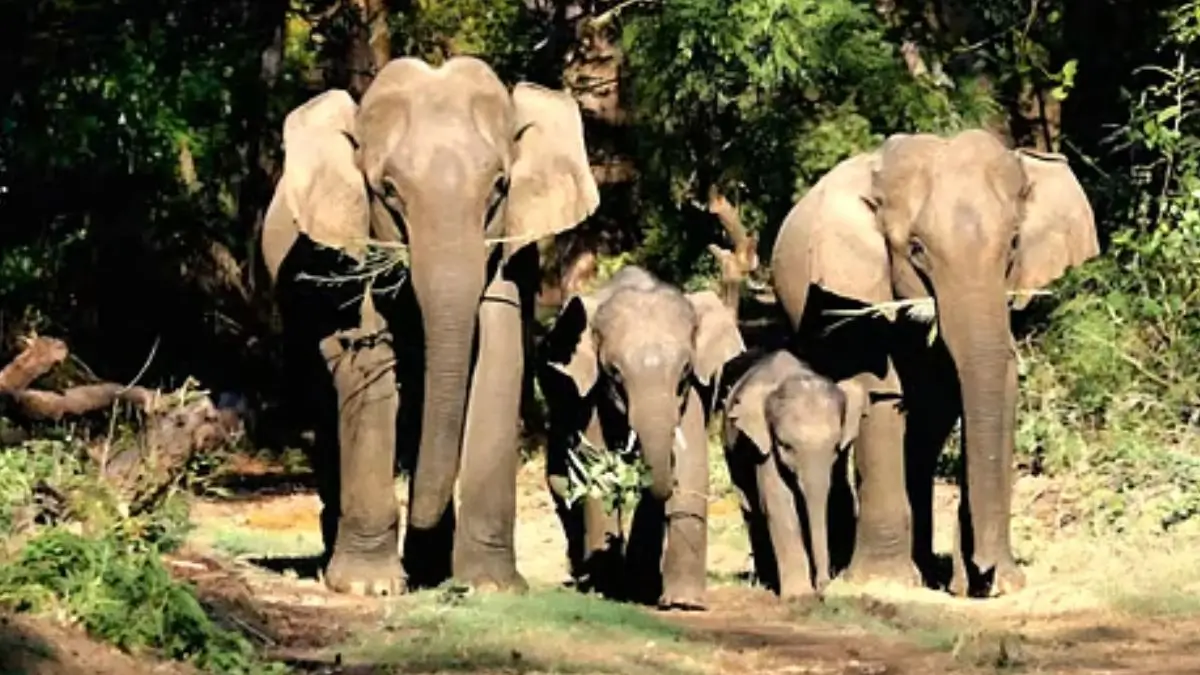
As work are underway for the 2027 Haridwar Kumbh Mela, the Uttarakhand Forest Department has introduced a groundbreaking project to manage the wildlife in order to make the event safe for pilgrims and elephants. Under this project, the department will cooperate with the Wildlife Institute of India (WII) to set radio collars on elephants leading the herd so that their movements can be tracked in real time. This project aims at to minimizing the risk of human-elephant contact, enabling quick responses, and conserving wildlife in one of the most crucial wildlife passages of the country.
Why Uttarakhand Is Radio-Collaring Elephants?
Given the proximity of Haridwar to the Rajaji-Corbett elephant landscape, it is not surprising that wild elephants traverse between forests and local settlements.
The increased human presence caused by religious events, like Kumbh Mela, only exacerbates the situation.
Even with initiatives in place like: the construction of deep trenches, erecting solar-fenced barriers, creating geo-fencing mechanisms, and conducting forest patrols, elephants continue to visit villages and urban fringes in search of food or following traditional migration paths.
Radio-collaring elephants will serve as an early warning mechanism to facilitate mannered encounters.
How The Radio-Collaring Work
Uttarakhand Forest Department and Wildlife Institute of India are working on this project together.
Since May 2026, the researchers have been observing the field about the elephants. The study includes the,
- Herd Size mapping
- Migration routes tracking
- Movement timings identification
- Locations of places visited by elephants
When the lead elephant is located in a herd, the collar will be put on that elephant. As the herds move together, tracking the leading elephant is beneficial in tracking the entire herd.
Wildlife Institute of India already provided four radio collars for the project.
Real-Time Tracking to Improve Public Safety
The behavioral collars will provide real-time information, equipping officials with tools for the immediate reactions as elephants enter populated areas.
The collaring will also provide the following benefits:
- Quick access for mitigating teams to endangered locations.
- Facilitating with movements of elephants by directing them back to the forests by forest officers.
- Issuing warning to residents in time.
- A successful co-ordination during the massive gathering expected in 2027.
Assessment and Approval of Government
The proposal has recently been discussed in the meetings of,
- The State Wildlife Board
- The State-Level Tiger Steering Committee.
Both the meetings were presided over by the Chief Minister of Uttarakhand, Pushkar Singh Dhami.
Before putting the initiatives into practice, the approval should be taken from the Union Ministry of Environment, Forest and Climate Change because putting collars on wild elephants involves many technical actions, including proper immobilization and subsequent tracking of the elephants after collaring the animal.
The Significance of Haridwar as an Elephant Corridor
Haridwar lies close to Rajaji National Park, which has a vital role in the Terai and Shivalik region by hosting some of India’s densest populations of elephants.
Per the elephant census conducted in the Uttarakhand in 2020, the following can be said regarding the elephant population,
As per reports, there have been 2,026 elephants counted in the wilderness.
The number recorded in 2017 was 1,839 so that we can see that the population has grown at a rate of nearly 10% in three years.
Elephants use the Rajaji-Corbett corridor to travel between different reserved forests, however, with the increase of settlements, highways, and railroads, more encounters between humans and animals have become possible.
Major events such as Kumbh Mela demand the particular evaluation of the situation.








 Delhi Institute for Transformation and I...
 Delhi Cabinet Approves Go-Delhi Foundati...
 Asiatic Lions Return to Barda Wildlife S...