
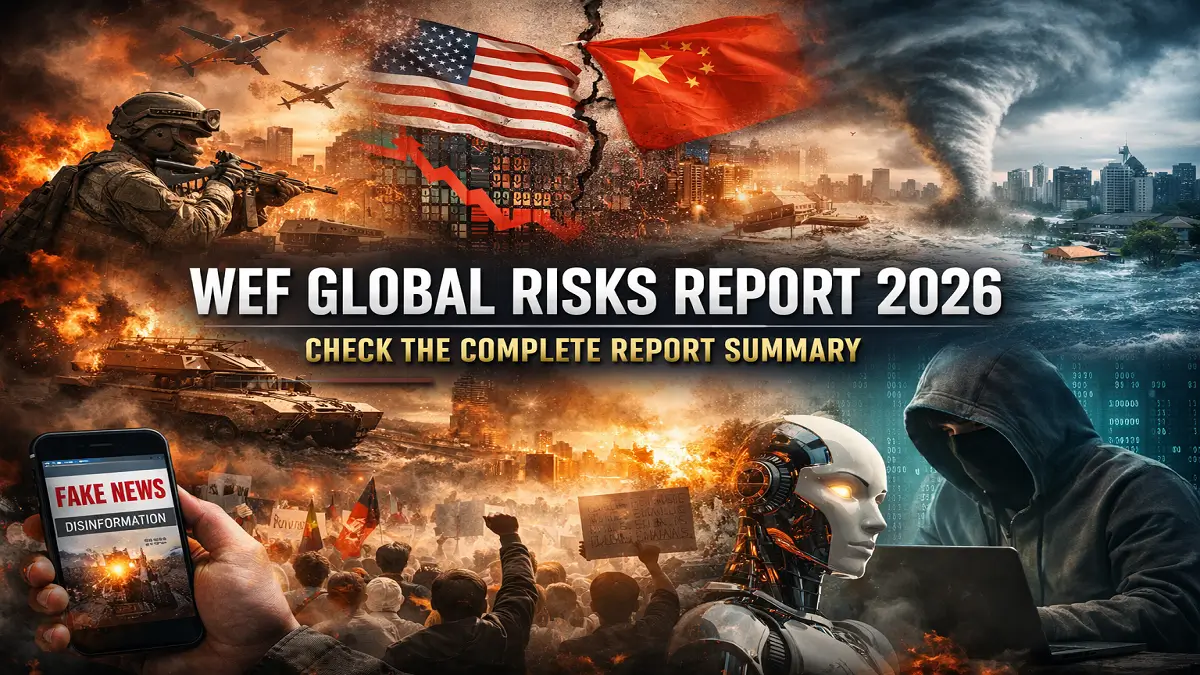
The World Economic Forum (WEF) Global Risks Report 2026 (21st edition) paints a worrying picture of the coming decade. The report suggests that the world is moving into an “Age of Competition”, where rivalry between countries is intensifying—not only in the military space, but also through trade restrictions, sanctions, technology controls, and information warfare. This shift is creating a global environment where shocks spread faster, cooperation becomes harder, and societies become more vulnerable to instability.
The report ranks risks across two key time horizons—the near future (2 years) and the long term (10 years). Its core message is straightforward: the global landscape is becoming more fragmented, more unpredictable, and more exposed to multiple overlapping risks.
1) What Does WEF Mean by “Global Risk”?
WEF defines a global risk as a threat or event that can cause major negative impact on a large scale, affecting:
- the world’s population
- the global economy
- natural resources and ecological systems
This definition matters because it places emphasis on threats that cross borders, spread rapidly, and create ripple effects across regions.
2) How the Report Is Built
The report is primarily based on expert perceptions collected through global surveys of leaders and specialists across sectors. It then organizes risks into categories such as:
- Geopolitical
- Economic
- Societal
- Technological
- Environmental
It also studies how risks connect with each other, showing that crises rarely happen in isolation. Instead, one major event often triggers several others.
3) Global Mood: Instability Is Rising
A major finding of the report is that a large share of experts expects the world to experience turbulence in both the short and long term. This suggests that many see current tensions as part of deeper structural changes rather than temporary fluctuations.
Main reasons behind the growing instability include:
- rising rivalry between major powers
- shrinking space for international cooperation
- economic pressures such as high debt and uneven growth
- rapid technological disruptions
- intensifying climate impacts
4) Most Likely Crisis Trigger in 2026: Geoeconomic Confrontation
The report identifies geoeconomic confrontation as the most likely risk to trigger a global crisis in 2026.
What geoeconomic confrontation means
It refers to the use of economic tools as instruments of strategic power, such as:
- sanctions and counter-sanctions
- tariffs and trade barriers
- restrictions on technology exports
- control over supply chains
- manipulation of critical resources (oil, gas, rare earth minerals, chips)
Why it is dangerous
Geoeconomic rivalry:
- disrupts global trade networks
- increases inflationary pressures
- reduces investment confidence
- weakens global supply chains
- creates uncertainty for industries and jobs
In today’s world, economic rivalry is becoming as destabilizing as direct military confrontation.
5) Conflict and Security: The Risk of Armed Escalation
Along with economic rivalry, the report highlights state-based armed conflict as a leading risk. Conflicts today have grown more complex because they often combine:
- conventional warfare
- cyberattacks
- economic sanctions
- information manipulation
Key concerns linked to armed conflict
- damage to infrastructure and energy networks
- global commodity price instability
- increase in displacement and migration
- rising military expenditure at the cost of development spending
6) Information Crisis: Misinformation, Disinformation, and Polarization
One of the strongest warnings in the report is the growing influence of misinformation and disinformation, especially through digital platforms. The report links false information with social unrest and political division.
How misinformation becomes a global threat
- spreads confusion during crises (pandemics, wars, disasters)
- reduces trust in governments and media
- creates fear and anger among communities
- influences elections and public decision-making
Societal polarization: a connected risk
Polarization means deep social division where people move into rigid groups and stop trusting each other.
It leads to:
- frequent protests and instability
- weaker policymaking and governance
- rising hostility between communities
- breakdown of social harmony
7) Economic Risks: Signs of a Possible Reckoning
The report notes that economic risks are rising sharply in importance.
Major economic risks highlighted
- economic downturn
- inflation resurgence
- asset bubble risks
- widening gap between rich and poor
Why these risks are increasing
Some key drivers include:
- high public and private debt
- unstable trade flows
- pressure on currencies and interest rates
- financial market volatility
A prolonged downturn could amplify societal anger, unemployment, and political instability.
8) Cyber Insecurity: A Direct Threat to Critical Systems
In the digital era, cyber insecurity has become one of the most immediate global risks.
Cyber threats impact:
- banking and financial systems
- electricity grids
- railways and aviation networks
- hospitals and healthcare data
- government databases
- military systems
Why cyber risk is rising
- increasing digital dependence
- growth of ransomware attacks
- state-sponsored cyber operations
- weak cybersecurity capacity in many sectors
Cyberattacks can cause economic loss and also shake national security.
9) AI Risk: Powerful, Fast—and Hard to Control
The report emphasizes that adverse outcomes of AI technologies are among the most significant long-term threats.
What AI-related risks include
- deepfakes and automated misinformation
- job displacement in multiple industries
- algorithmic bias and discrimination
- surveillance and privacy violations
- autonomous weapons and AI-driven warfare
- concentration of AI power in few hands
AI is described as a double-edged technology—it can boost productivity, but without strong safeguards it can weaken trust, stability, and accountability.
10) Environmental Risks: The Most Dangerous Long-Term Threat
The long-term risk ranking is dominated by environmental dangers. The report highlights that climate risks are not only continuing but intensifying.
Top environmental risks (long-term)
- extreme weather events
- biodiversity loss and ecosystem collapse
- critical changes to Earth systems
- pollution
- resource shortages (water, food, minerals)
Why this is alarming
Environmental damage creates chain reactions:
- crop failures and food insecurity
- water stress and conflicts
- forced displacement
- economic shocks
- increased health emergencies
The report warns that climate stress can become a multiplier—making economic and political risks even worse.
11) Inequality: The Most Interconnected Global Risk
A very important insight of the report is that inequality is one of the most “connected” risks, meaning it triggers or strengthens several other threats.
Inequality fuels:
- political dissatisfaction
- crime and insecurity
- social unrest
- polarization
- migration pressures
- weakening of trust in institutions
This shows that inequality is not just a social problem—it is also a governance and stability issue.
12) The World Order Ahead: Multipolar and Fragmented
The report suggests that the world is shifting away from a single dominant power structure. Instead, it sees the future as:
- multipolar (many major powers)
- or fragmented (regions setting different rules)
What this could lead to
- competing trade blocs
- multiple technology ecosystems
- inconsistent global regulations
- reduced effectiveness of international institutions
This fragmentation makes collective action harder—especially on climate, global health, and conflict prevention.


 UV Index Explained: The Hidden Health Ri...
 QS World University Rankings 2026: India...
 Best Airlines in the World 2026: Best Fu...











