
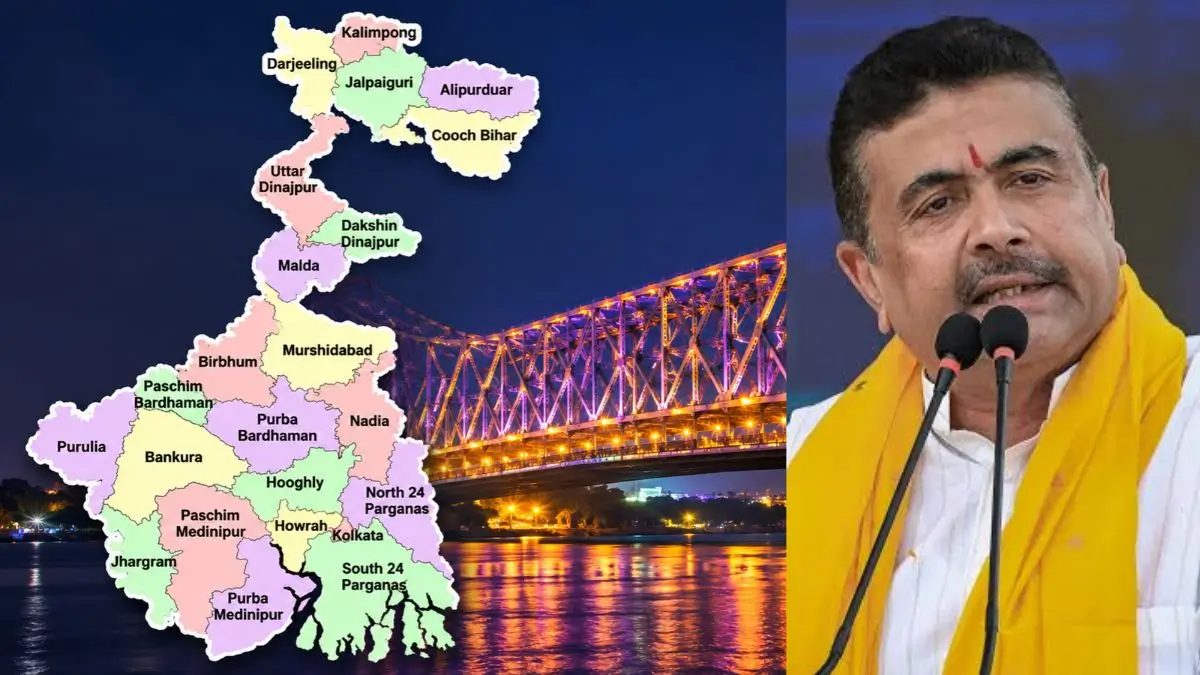
The West Bengal Cabinet has approved a name change and announced that it will submit a resolution to the Legislative Assembly on December 9, 2026. There has been an ongoing discussion regarding the appropriate name for the state. However, the Cabinet and state Assembly resolutions do not on their own allow for a name change. After this, Parliament can alter the name of a state by passing an ordinary law with a simple majority.
West Bengal New Name: Paschim Banga
West Bengal will be known as Paschim Banga. Honorable Chief Minister Suvendu Adhikari has stated that this new name is to be used in both English and Bengali and will replace the current English name of West Bengal.
On November 23rd 2026 the Cabinet approved the name change. The state government will then submit a resolution to the Legislative Assembly during the winter session.
Until the name change is officially implemented via the constitution, West Bengal will continue to be known by its current name.
Key Dates for West Bengal Name Change
| Detail | Date |
| Cabinet approves name change | 23 November 2026 |
| Start of the winter session | 4 December 2026 |
| Assembly resolution submitted | 9 December 2026 |
| End of winter session | 14 December 2026 |
| Proposed new name | Paschim Banga |
| Constitutional amendment | Requires the parliamentary legislation |
Has West Bengal Already had its Name Changed?
No. Although the Cabinet has approved a new name, the state government will now submit a resolution to the Assembly.
Even if a resolution is favourably received by the Assembly, the name will still not be changed until the process is completed and authorised by both the Union government and Parliament as set out in Article 3 of the Constitution.
History behind the creation of West Bengal in 1947
The most recent name change initiative has been associated by the Chief Minister with the history behind the creation of West Bengal in 1947.
Previously, it has been suggested that West Bengal should Change Its Name, as it is positioned relatively late in alphabetical orderings of Indian states.
As its English name commences with a ‘W’, it is not ranked highly in many alphabetical listings.
Furthermore, West Bengal wished to adopt a name which better represents the state’s language and region. Previous state governments put forward options including Paschim Banga and Bangla but these were never successfully implemented.
Past Initiatives to Change West Bengal’s Name
Throughout the years there have been differing initiatives to rename West Bengal.
| Year | Proposed Name | Outcome |
| 1999 | Paschim Banga | No successful implementation |
| 2011 | Paschim Banga | State government re-raises the issue of renaming the state |
| 2016 | Bangla, Bengal and Bangal | Various names were suggested for different languages |
| 2018 | Bangla | A resolution was submitted to the Assembly suggesting that West Bengal be called Bangla |
| 2019 | Bangla | Union government did not approve this name change |
| 2026 | Paschim Banga | Cabinet approved a new name change resolution to be submitted to the Assembly |
Whilst in 2018 it was proposed that the state be called Bangla in all languages, the Union government did not approve this. The most recent initiative suggests reverting to the Paschim Banga name.
How is a State’s Name Changed in India?
Article 3 of the Indian Constitution enables Parliament to amend the name, territory and/or borders of an Indian state.
Typically, the following occurs,
- Submission of a state resolution – The state government can submit a resolution for name change and attempt to gain the Assembly’s endorsement.
- Recommendation of the President – Legislation to rename a state can only be submitted to Parliament if so advised by the President.
- State Legislature consultation – The President consults the relevant State Legislature on the proposed legislation within a defined timeframe.
- Parliamentary legislation – Parliament then reviews and adopts any submitted legislation.
- Implementation – The new name is implemented in line with the relevant parliamentary legislation.
Note: Although the State Legislature is consulted, Parliament is not obligated to take this into account. Simply submitting a resolution to the state Assembly does not legally alter a state’s name.
Indian States that Have Changed their Names
Since Independence, a number of Indian states have altered their names in order to better represent their language, culture and history.
| Old Name | New Name | Year Changed |
| Madras State | Tamil Nadu | 1969 |
| Mysore State | Karnataka | 1973 |
| Uttaranchal | Uttarakhand | 2007 |
| Orissa | Odisha | 2011 |
| Kerala | Keralam | 2026 |
| Pondicherry | Puducherry | 2006 |
This shows how states can change their names, following the constitutional process and in conjunction with Parliament.
FAQs on the Proposed Renaming of West Bengal
Q1. What new name has the West Bengal Cabinet proposed for the state, and in which languages will it be used?
Ans. The proposed new name is Paschim Banga, which will be used in both English and Bengali.
Q2. On which date did the West Bengal Cabinet approve the proposed name change in 2026?
Ans. The West Bengal Cabinet approved the proposed name change on November 23, 2026.
Q3. On which date is the West Bengal government scheduled to submit the name-change resolution to the State Legislative Assembly?
Ans. The resolution is scheduled to be submitted on December 9, 2026, during the winter session.
Q4. Which Article of the Indian Constitution empowers Parliament to change the name, territory or boundaries of a state?
Ans. Article 3 of the Indian Constitution empowers Parliament to change the name, territory or boundaries of a state.
Q5. Does a State Cabinet or Legislative Assembly resolution alone legally change the name of a state?
Ans. No, a state’s name can be officially changed only after Parliament passes the required legislation following the constitutional procedure.








 Arunachal Pradesh Police Receives Presid...
 What is Mekedatu Dam Project? Why Karnat...
 Odisha Cabinet Approves Bovine Breeding ...