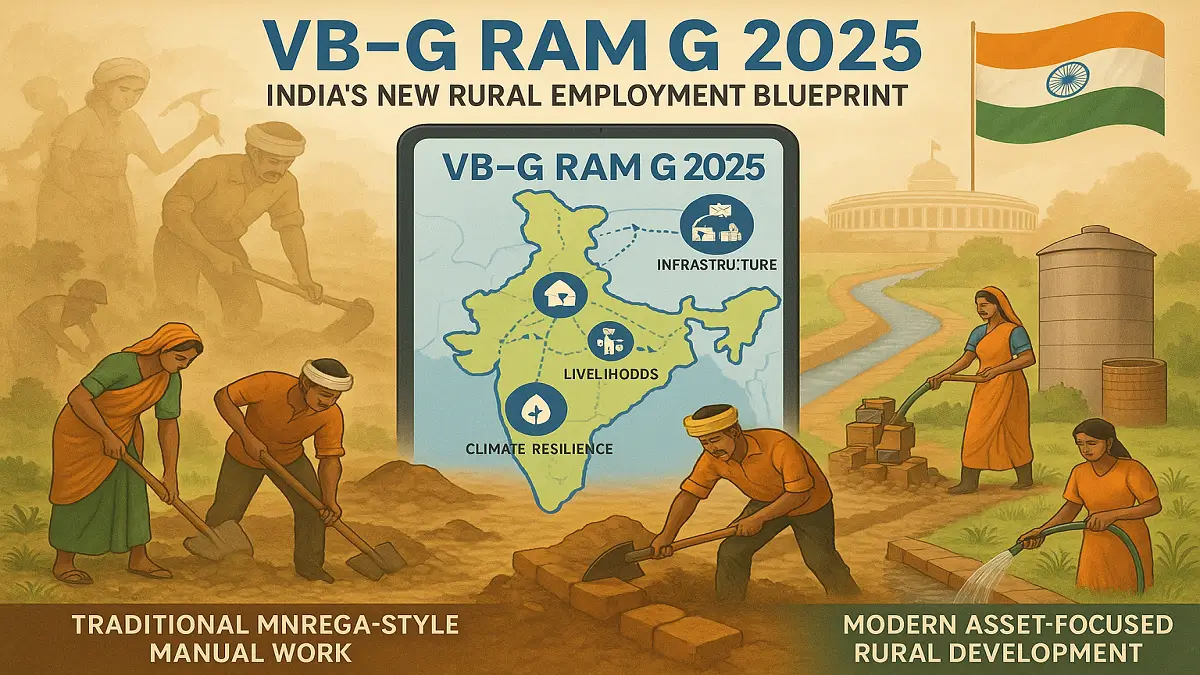
The Viksit Bharat–Guarantee for Rozgar and Ajeevika Mission (Gramin), or VB–G RAM G 2025, marks the most ambitious overhaul of India’s rural employment framework since the launch of MNREGA in 2005. While MNREGA focused largely on short-term wage support, the new law reflects a deeper shift in thinking—using public employment as a tool to build durable rural infrastructure and strengthen long-term livelihoods.
Aligned with the government’s Viksit Bharat 2047 vision, VB–G RAM G aims to combine income security with productivity, climate resilience, and modern planning.
What Is VB–G RAM G 2025?
At its core, VB–G RAM G guarantees 125 days of wage employment per rural household, an increase from 100 days under MNREGA, for adults willing to perform unskilled manual work.
However, the real transformation lies beyond the number of days. The scheme redefines rural employment as a means to:
- Create productive and durable assets
- Strengthen village-level infrastructure
- Build climate-resilient rural economies
Four Priority Work Verticals
All works under VB–G RAM G are channelled into four clearly defined verticals, replacing MNREGA’s long and scattered list of permissible works:
1. Water Security and Water-Related Works
- Water harvesting
- Irrigation structures
- Groundwater recharge
Water is positioned as the foundation of rural productivity, especially for agriculture.
2. Core Rural Infrastructure
- Roads and connectivity
- Storage facilities
- Common utility infrastructure
These assets are designed to link villages directly with markets.
3. Livelihood-Related Infrastructure
- Assets that support agriculture, allied activities, and local enterprises
This focuses on income generation beyond daily wages.
4. Climate and Disaster Mitigation Works
- Flood control
- Soil conservation
- Extreme weather mitigation
Climate resilience is no longer optional—it is central to the scheme.
Digital Backbone: National Rural Infrastructure Stack
Every asset created under VB–G RAM G is mapped into a single digital platform—the Viksit Bharat National Rural Infrastructure Stack. This links:
- Village-level planning
- District and state databases
- National infrastructure platforms
This integration aims to eliminate repetitive, low-value works and ensure coordinated, location-specific planning.
How VB–G RAM G Breaks from MNREGA
1. More Guaranteed Work
- 125 days instead of 100
- Around 25% higher income potential for rural households
2. From Scattered Works to Focused Assets
MNREGA’s flexibility often resulted in short-lived or disconnected assets. VB–G RAM G narrows the scope to ensure:
- Durability
- Economic productivity
- Long-term value
3. Planning Becomes Structured and Mapped
Each Gram Panchayat must prepare a Viksit Gram Panchayat Plan, aligned with platforms like PM Gati-Shakti. This replaces ad-hoc project selection with spatial and strategic planning.
4. Shift to Normative Funding
Instead of open-ended, demand-driven budgeting, the scheme uses objective norms to allocate funds. Importantly:
- The legal guarantee of work remains
- If work is not provided, unemployment allowance is mandatory
Why the Government Says MNREGA Needed a Reset
MNREGA was designed for a rural India marked by high poverty, limited financial inclusion, and few livelihood options. The government argues that rural India has since changed:
- Poverty levels have declined
- Consumption and financial inclusion have increased
- Livelihoods have diversified
At the same time, governance challenges under MNREGA became more visible:
- Cases of non-existent works and fund misuse
- Irregular monitoring and misuse of machinery
- Significant misappropriation of funds
- Less than 8% of households completing 100 days of work in recent years
VB–G RAM G is presented as a response to these structural and administrative limitations.
Impact on the Rural Economy
Water Security as the Anchor
With water-related works at the top of the priority list, the scheme aims to boost:
- Farm productivity
- Groundwater levels
- Climate resilience
Asset-led employment models like Mission Amrit Sarovar are cited as successful precedents.
Infrastructure That Connects to Markets
By focusing on roads, storage, and connectivity, the scheme seeks to:
- Reduce transaction costs
- Encourage rural enterprises
- Integrate villages into regional markets
Reduced Distress Migration
Higher guaranteed income and better local infrastructure are expected to reduce migration driven purely by economic distress.
What Changes for Farmers
Farmers often complained that MNREGA disrupted labour availability during peak seasons. VB–G RAM G addresses this by allowing states to:
- Notify up to 60 days per year when public works are paused during sowing or harvesting
This aims to:
- Ensure farm labour availability
- Prevent artificial wage inflation
- Stabilise food production costs
At the same time, farmers benefit from improved irrigation, storage, and connectivity.
What Changes for Labourers
For workers, the benefits are substantial but depend on effective implementation:
- 125 days of guaranteed work
- Predictable work schedules
- Near-universal digital wage payments
- Mandatory unemployment allowance if work is denied
Workers also gain indirectly from the infrastructure they help create, improving daily life and local opportunities.
The Funding Shift: The Biggest Debate
The move from demand-driven to normative funding has raised concerns. The government argues this:
- Improves budget predictability
- Aligns with other Union schemes
- Prevents last-minute funding crises
Safeguards include:
- Centre–State cost sharing
- Disaster-related relaxations
- Legal unemployment allowance
Critics, however, will closely watch whether funding norms quietly become a de facto cap on employment.
Centre–State Cost Sharing
VB–G RAM G is a centrally sponsored scheme:
- 60:40 for most states
- 90:10 for North-Eastern and Himalayan states
- 100% central funding for UTs without legislatures
This reset makes state cooperation critical for success.

 Delhi to Implement ‘Rah-Veer’ Scheme to ...
 2 Years of PM Surya Ghar Scheme: Rooftop...
 From Seva Teerth, PM Modi Announces PM R...