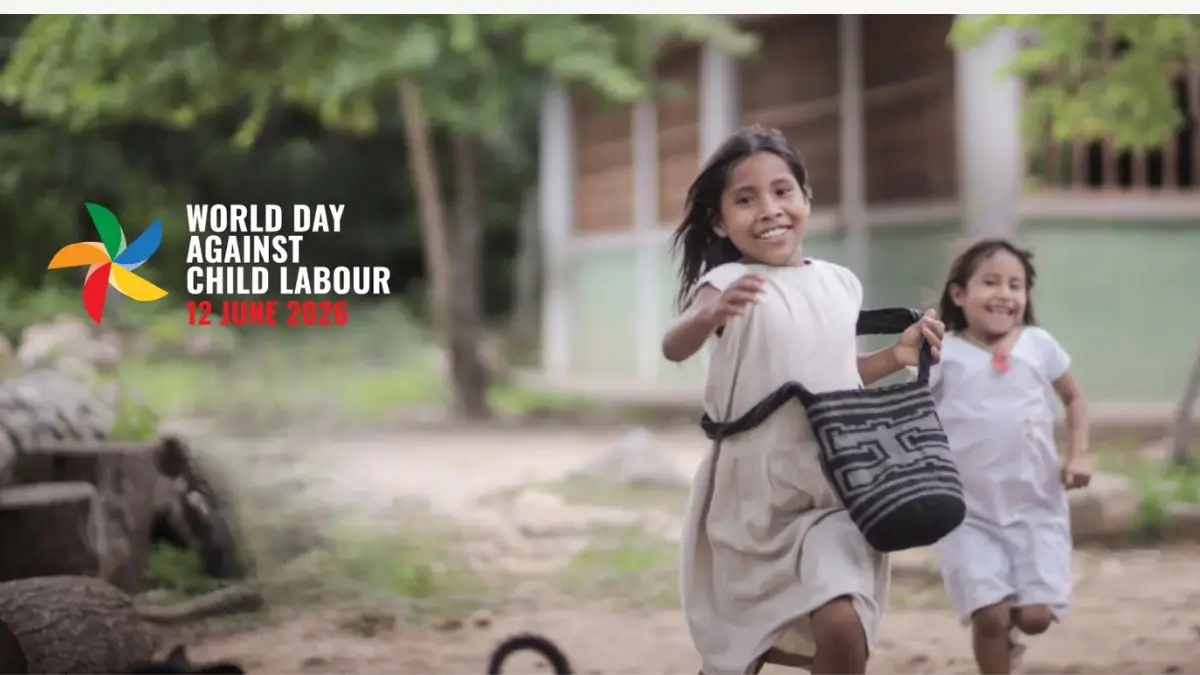
The World Day Against Child Labour is observed worldwide every year on 12th of June and to raise the awareness about the child exploitation and promote efforts to eliminate child labor worldwide. The 2026 observance comes at the crucial time after the Sixth Global Conference on the Elimination of Child Labour held in the Marrakech, Morocco. Despite the significant progress over the period of years and nearly 138 million children continue to be engaged in the child labour worldwide and which also including 54 million in hazardous work.
Why World Day Against Child Labour 2026 Is Significant
The 2026 observance focuses on to accelerating the global efforts to end child labor and convert international commitments into concrete action.
This year’s campaign emphasizes the,
- Access to the quality education.
- Universal social protection.
- Decent employment for adults.
- Strong labour laws and enforcement.
- Addressing poverty and inequality.
The campaign calls upon the governments, employers, civil society and citizens to work together to eliminate the child labor in all forms.
Theme of World Day Against Child Labour 2026
The for the 2026 is “Red Card to Child Labour: Fair Play for Children, Decent Work for Adults”
It is inspired by the universal symbolism of a red card in sports and this theme urges societies to reject the child labor and ensure that children remain in schools while adults have access to the decent and fairly paid employment.
This campaign also seeks to build the momentum after the commitments which are adopted during the Marrakech Global Framework for Action Against Child Labour.
History of World Day Against Child Labour
This day was first launched by the International Labour Organization (ILO) on 12th of June 2002.
The objective was to draw the global attention to the widespread problem of child labor and mobilize efforts for its elimination.
Since then, governments, trade unions, employers organizations, NGOs and international agencies have observed the day annually via the awareness campaigns, policy discussions and community outreach program.
Global Child Labour: Latest Statistics
According to the recent international estimates,
- Nearly 138 million children are engaged in the child labour globally.
- Around 54 million children are involved in to hazardous work.
- More than 70% of the child labor occurs in the agriculture.
- Africa records the highest number with the approximately 72 million child laborers.
- Asia and the Pacific account for around 62 million child laborers.
These figures have indicated that although progress has been made and world remains far from eliminating child labor completely.
India’s Progress and Challenges
India has taken the multiple measures to address the child labor through legislation, education, and rehabilitation program.
According to the 2011 Census, approximately 10.1 million children who are aged between 5-14 years were working as either main or the marginal workers, a decline from 12.6 million in 2001.
Major Causes of Child Labor in India
- Poverty and the economic hardship.
- Lack of the educational opportunities.
- Family indebtedness.
- Migration and displacement.
- Informal sector employment.
The Government’s National Policy on Child Labour (1987) also strongly focuses on the rehabilitation of affected children while addressing the socio-economic factors contributing to child labour.
Global Action After Missing SDG Target 8.7
The international community failed to achieve the Sustainable Development Goal (SDG) Target 8.7 which aimed to end child labor in all forms by the 2025.
To improve the conditions, stakeholders have adopted the Marrakech Global Framework for Action Against Child Labor in February 2026.
The framework emphasizes the,
- Strong implementation of the ILO Conventions 138 and 182.
- Expansion of social protection systems.
- Increased investment in education.
- Corporate accountability in supply chains.
- Strengthened the labour inspections.








 Mahila Kisan Diwas 2026 to Highlight Wom...
 World Students’ Day 2026: Date, Signif...
 International Day for Disaster Risk Redu...