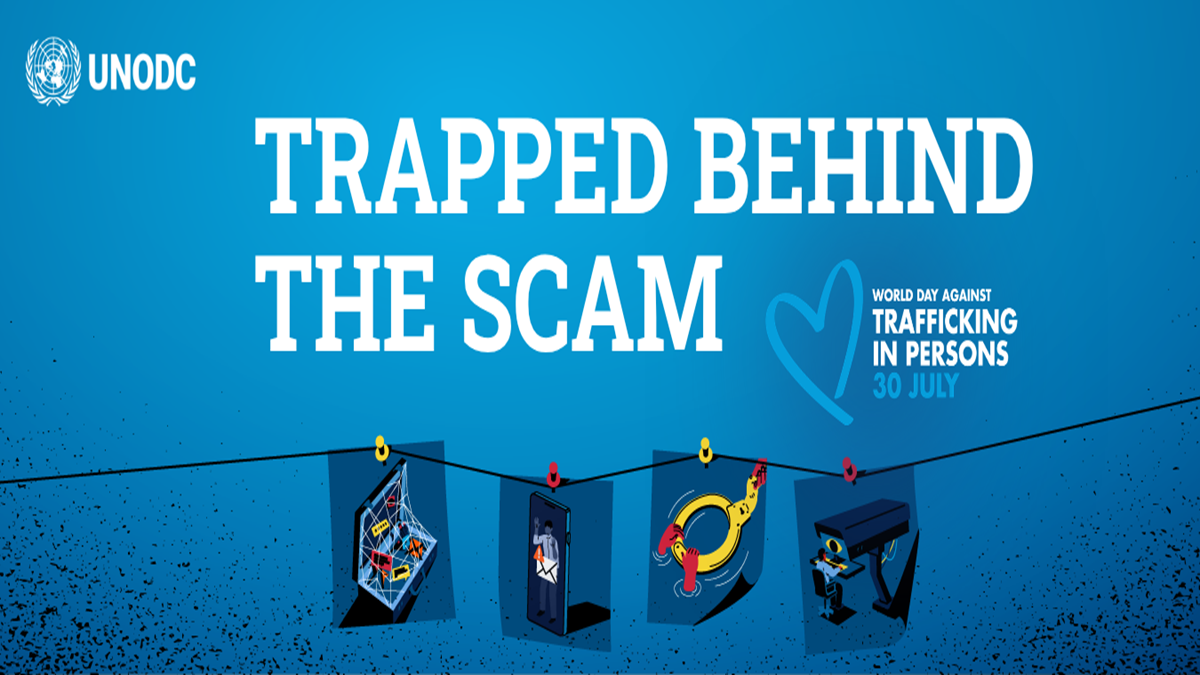
The World Day Against Trafficking in Persons is observed every year on 30 July to raise awareness about the global crime of human trafficking and to promote the protection of victims’ rights. Proclaimed by the United Nations General Assembly (UNGA) in 2013, the day highlights the urgent need for stronger international cooperation to prevent trafficking, prosecute offenders, and support survivors.
The 2026 theme, “Trapped Behind the Scam,” focuses on a rapidly growing form of human trafficking where organized crime groups exploit victims through fake job offers and force them into cyber-enabled financial scams.
World Day Against Trafficking in Persons 2026 Theme
Theme: “Trapped Behind the Scam”
The 2026 theme sheds light on the increasing involvement of transnational organized crime networks in trafficking people for forced criminality.
Victims are lured through fake overseas employment opportunities and later forced to participate in industrial-scale online scam operations, including:
- Romance scams
- Cryptocurrency investment fraud
- Online financial fraud
- Digital payment scams
- Cyber-enabled deception schemes
This emerging form of trafficking demonstrates the growing connection between human trafficking, cybercrime, money laundering, corruption, and organized crime.
What is Human Trafficking?
Human trafficking is a serious violation of human rights involving the recruitment, transportation, transfer, harboring, or receipt of persons through:
- Force
- Threats
- Fraud
- Deception
- Abuse of power
- Exploitation of vulnerability
The purpose is exploitation, which may include:
- Sexual exploitation
- Forced labour
- Modern slavery
- Domestic servitude
- Forced criminal activities
- Organ trafficking
The definition is provided under the UN Protocol to Prevent, Suppress and Punish Trafficking in Persons, also known as the Trafficking in Persons Protocol.
How Victims Become Trapped in Online Scam Networks
According to the United Nations Office on Drugs and Crime (UNODC), traffickers increasingly target victims through fraudulent recruitment advertisements.
The typical process includes:
Fake Job Offers
Victims are promised attractive employment opportunities abroad in sectors such as customer service, IT support, or marketing.
Trafficking Across Borders
Upon arrival in another country, victims have their passports confiscated and are confined inside heavily guarded scam compounds.
Forced Cyber Fraud
Victims are forced to conduct online scams such as:
- Romance fraud
- Cryptocurrency investment scams
- Fake investment platforms
- Social media fraud
- Financial phishing schemes
Abuse and Exploitation
Victims often face:
- Physical violence
- Psychological abuse
- Debt bondage
- Constant surveillance
- Threats against family members
- Unrealistic work quotas
These conditions leave victims with little opportunity to escape.
Global Financial Impact of Scam Operations
UNODC estimates that in East and South-East Asia, cyber-enabled scam operations caused between US$18 billion and US$37 billion in financial losses during 2023.
A significant share of these fraudulent operations was linked to organized criminal networks operating across the region.
UNODC’s Efforts to Combat Human Trafficking
The United Nations Office on Drugs and Crime (UNODC) is assisting countries by:
Strengthening Investigations
- Training investigators
- Improving victim identification
- Supporting specialized anti-trafficking task forces
- Enhancing prosecution capabilities
Updating National Laws
UNODC helps governments modernize legislation to prosecute:
- Cybercrime
- Human trafficking
- Money laundering
- Corruption
- Organized crime
Promoting Cross-Border Cooperation
Since trafficking networks often operate internationally, UNODC encourages:
- Information sharing
- Joint investigations
- Mutual legal assistance
- International law enforcement cooperation
United Nations Convention Against Cybercrime
A major recent development is the adoption of the United Nations Convention Against Cybercrime by the UN General Assembly in December 2024.
The Convention aims to:
- Strengthen global cooperation against cybercrime.
- Improve collection and sharing of electronic evidence.
- Enhance investigations of cross-border criminal networks.
- Combat online fraud and technology-enabled organized crime.
This framework is expected to play a significant role in tackling trafficking-linked online scam operations.
Blue Heart Campaign: Symbol Against Human Trafficking
The Blue Heart is the international symbol representing the fight against human trafficking.
What Does the Blue Heart Represent?
- Solidarity with victims of trafficking.
- Awareness about modern slavery.
- The cold-heartedness of traffickers who exploit human beings for profit.
The campaign encourages individuals, governments, and organizations to support global anti-trafficking efforts.
How Can People Support the Campaign?
Individuals can contribute by:
- Sharing awareness campaigns using #EndHumanTrafficking.
- Supporting the Blue Heart Campaign.
- Donating to the United Nations Voluntary Trust Fund for Victims of Human Trafficking.
- Educating communities about trafficking risks.
- Reporting suspicious recruitment and trafficking activities.
History of World Day Against Trafficking in Persons
Recognizing the growing threat of human trafficking worldwide, the United Nations General Assembly proclaimed 30 July as the World Day Against Trafficking in Persons through Resolution A/RES/68/192.
The observance aims to:
- Raise awareness about trafficking.
- Protect victims’ rights.
- Promote implementation of international anti-trafficking laws.
- Encourage global cooperation against organized crime.
Importance of World Day Against Trafficking in Persons
The observance remains highly relevant because:
- Millions remain vulnerable to trafficking worldwide.
- Criminal networks increasingly use digital platforms.
- Online scams have become a new form of forced criminality.
- International cooperation is essential to dismantle trafficking networks.
- Public awareness can help prevent recruitment through fraudulent job offers.








 International Day for the Eradication of...
 World Food Day 2026: Theme, History, Sig...
 Mahila Kisan Diwas 2026 to Highlight Wom...