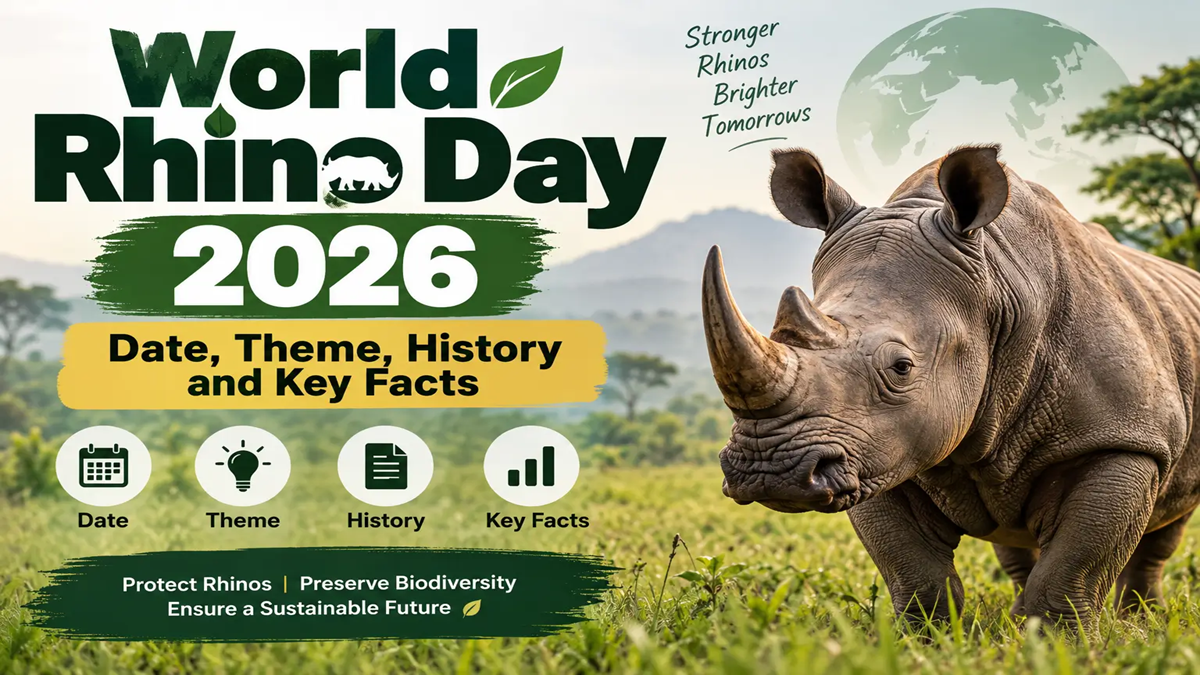
World Rhino Day 2026 is observed on 22 September 2026 to raise global awareness about the conservation of the world’s five surviving rhinoceros species. The observance highlights threats including poaching, illegal rhino-horn trade and habitat loss, while recognizing conservation efforts around the world.
World Rhino Day 2026 Theme
The official World Rhino Day theme 2026 is “Keep the Five Alive”. The focus is on securing viable populations and habitats for rhinos over the long term.
World Rhino Day 2026 at a Glance
| Particular | Details |
|---|---|
| Day | World Rhino Day |
| Date | 22 September 2026 |
| Day | Tuesday |
| 2026 Theme | “Keep the Five Alive” |
| First announced | 2010 |
| International observance began | 2011 |
| Announced by | WWF-South Africa |
| Number of surviving rhino species | 5 |
| Estimated global population | Around 26,700 |
The International Rhino Foundation’s newly released 2026 State of the Rhino report estimates the global rhino population at approximately 26,700.
History of World Rhino Day
World Rhino Day was first announced by WWF-South Africa in 2010. In 2011, conservation advocates Lisa Jane Campbell and Rhishja Cota helped develop it into an international observance encompassing both African and Asian rhinos.
Since then, 22 September has become an annual global occasion bringing together conservation organizations, zoos, NGOs and individuals working to protect rhinos.
Five Species of Rhinoceros
There are only five surviving rhino species in the world. Two occur naturally in Africa and three in Asia.
| Rhino Species | Main Region |
|---|---|
| White Rhino | Africa |
| Black Rhino | Africa |
| Greater One-Horned Rhino | India & Nepal |
| Javan Rhino | Indonesia |
| Sumatran Rhino | Indonesia |
For Indian competitive exams, the Greater One-Horned Rhino (Rhinoceros unicornis), also called the Indian rhino, is particularly important.
What Does the 2026 Rhino Report Say?
The International Rhino Foundation’s State of the Rhino 2026 provides several important new figures.
- Total rhinos worldwide: approximately 26,700
- Greater One-Horned Rhino: around 4,075, up from 4,014 in 2022.
- Black Rhino: 6,788 at the end of 2024, compared with 6,195 in 2022.
- White Rhino: 15,752 in 2024, down from 17,464 in 2023, largely because of poaching losses in South Africa.
- The report warns that the Javan Rhino faces an especially serious long-term extinction risk.
- Greater one-horned rhino numbers have increased substantially during the first quarter of the 21st century.
These figures make the Greater One-Horned Rhino recovery one of the notable global conservation successes.
Greater One-Horned Rhino and India
The Greater One-Horned Rhino is found primarily in India and Nepal. Its population had fallen to around 200 animals at the beginning of the 20th century, but conservation and protection measures have helped the population recover to more than 4,000 today.
In India, Assam is particularly important for rhino conservation. The species is strongly associated with protected areas such as Kaziranga National Park, while rhino conservation also extends to other protected landscapes.
The Greater One-Horned Rhino is currently classified as Vulnerable on the IUCN Red List.
Why Are Rhinos Important?
Rhinos function as ecosystem engineers. Their grazing, movement and wallowing can influence grasslands and waterholes, helping maintain habitat conditions that benefit other species as well.
The major threats to rhinos remain poaching for their horns, habitat loss and degradation, while very small and isolated populations face additional reproductive and genetic risks.
Exam-Relevant One-Liners
World Rhino Day: 22 September
World Rhino Day 2026 Theme: “Keep the Five Alive”
First announced by: WWF-South Africa in 2010
International observance: Since 2011
Number of surviving rhino species: 5
Rhino species found in India: Greater One-Horned Rhino
Scientific name: Rhinoceros unicornis
IUCN Status: Vulnerable
2026 estimated global rhino population: ~26,700
Greater One-Horned Rhino population: ~4,075
Major Indian rhino state: Assam
Key threats: Poaching and habitat loss/degradation








 National Human Rights Commission to Mark...
 World Arthritis Day 2026: Date, Theme, H...
 Navratri 2026: Dates, Nine Forms of Godd...