
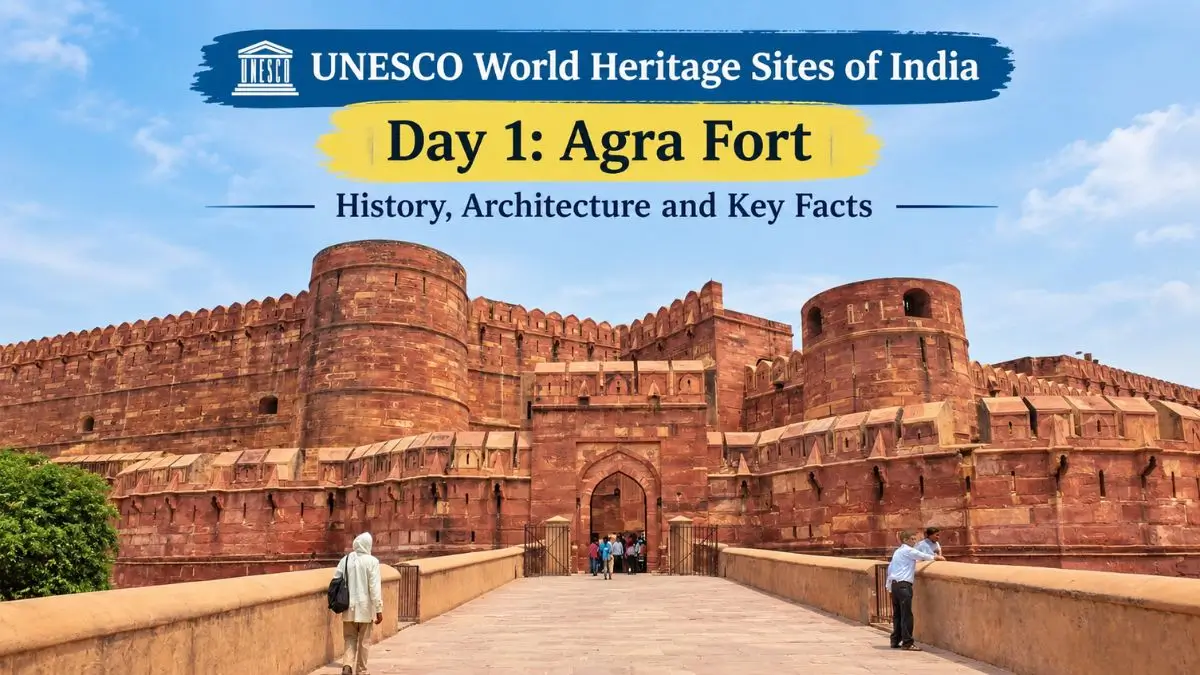
Situated along the banks of the River Yamuna in Agra, Uttar Pradesh, Agra Fort is one of the major landmarks of the Mughal era. Agra Fort is popularly known as the “Red Fort of Agra” owing to its huge walls of red sandstone and its magnificent Mughal architecture comprising royal palaces and audience chambers.
The Agra Fort was extensively rebuilt and modified by Emperor Akbar during the 16th Century and then later renovated by Emperor Shah Jahan. The Agra Fort was an important administrative center of Mughals along with being the seat of the Mughal Kings. In view of its historical and architectural importance, Agra Fort was added to the list of World Heritage Sites by UNESCO in 1983.
Location of Agra Fort
Agra Fort is situated at Agra, in the state of Uttar Pradesh, India, adjacent to the Yamuna River and roughly 2.5 kilometers away from the Taj Mahal.
This is a typical specimen of Mughal military architecture mixed with the imperial living and administrative quarters within it. The fort walls stretch for about 2.5 kilometers.
Agra Fort History
While there existed a fort in the past, its renovation by Emperor Akbar turned it into an important imperial citadel after the emperor chose Agra as one of the important centres of his empire. Construction of the fort commenced in 1565 using red sandstone as the main building material.
During the rule of Akbar, Agra Fort had a dual role, acting as both a military fort and an administration centre in addition to serving the residential needs of the ruling class. It facilitated security of the imperial centre and enabled expansion of the Mughal Empire.
Emperor Shah Jahan renovated the fort in later periods by adding new buildings that used marble and decorations as an expression of changing tastes and preferences of the Mughal Empire.
Moreover, Agra Fort is significant in the context of the end of reign of Shah Jahan since after taking over power, Aurangzeb confined Shah Jahan in Agra Fort until his death in 1666.
Architecture of Agra Fort
Agra Fort is a fortress built along with palatial buildings to reflect the grandeur of Mughal architectural style. The huge red sandstone walls, gates, courtyards, and royal structures of the fort highlight the architecture of the Mughal period.
Following buildings in the Agra Fort are important,
Jahangir Palace
- It is an important palace in the fort complex and is related to the imperial residential complex. It is famous because of its red sandstone and ornate architectural features.
Khas Mahal
- It is a royal palace related to Shah Jahan and is well-known for its elegant architecture and white marble.
Diwan-i-Khas
- This is the Hall of Private Audience and is related to formal meetings with the emperor and some of his courtiers.
Moti Masjid
- It is a white marble mosque in the Agra Fort and shows the elegant religious architecture of the Mughal period.
The above buildings indicate that Mughal forts not only served defensive purposes but also political and governmental purposes.
Why Is Agra Fort a UNESCO World Heritage Site?
Agra Fort is a UNESCO World Heritage Site, added to the list in 1983 under Criterion (iii).
Criterion (iii) relates to properties that represent a unique or at least exceptional testimony to a cultural tradition or civilization either extant or disappeared.
Agra Fort serves as a reflection of the political power, architectural style and court culture of the Mughal Empire. The fusion of strong defense structures and lavish architecture makes the monument one of the most representative monuments of Mughal architecture.
UNESCO has identified Agra Fort as a cultural heritage site. Not only do the physical elements hold significance but the information provided through these elements is equally important.
Connection Between Agra Fort and the Taj Mahal
The Agra Fort and the Taj Mahal are two separate World Heritage Sites of UNESCO situated in the city of Agra.
While the Agra Fort stands for the military, political, and residential aspects of the rule of the Mughals, the Taj Mahal has been renowned mostly for its architecture and connection to Mumtaz Mahal, wife of the emperor Shah Jahan.
Both the monuments were added to the UNESCO World Heritage List in 1983.








 Can a Place with Heavy Rainfall Be Calle...
 Dussehra 2026: Top 30 Most Important GK ...
 Dussehra and UNESCO: Ramlila, Durga Puja...