Malaysia Declares Emergency as Serian Haze Index Hits 519

Malaysia has placed the district of Serian in the state of Sarawak in an emergency condition owing to the presence of very hazardous levels of air pollution arising due to thick haze caused by forest fires in neighbouring Indonesia. According to official figures, the Air Pollution Index (API) reading stood at 519 in Serian on Friday, way above the hazardous threshold level of 300 that exists in Malaysia. The emergency has been placed only in the district of Serian as smoke from forest fires in the Indonesian part of Borneo continues to cause problems in some areas of Sarawak. Extraordinary steps are being taken to ensure people’s safety, including efforts to produce rainfall through cloud-seeding.

Why Did Malaysia Declare an Emergency in Serian?

The direct reason was the deteriorating air quality condition.

The API reading for Serian touched 519, which is beyond the 500 point mark beyond which an emergency can be declared in Malaysia. API reading above 300 is considered to be hazardous.

According to the state disaster management committee chairman of Sarawak Douglas Uggah Embas, the state asked for an emergency declaration as the pollution levels had crossed the threshold level.

Where Does the Haze Originate From?

Haze in Sarawak has been attributed primarily to forest fires in the adjacent nation of Indonesia.

Sarawak and Indonesia both occupy the island of Borneo, which means that smoke from the forest fires in Indonesia may move to Sarawak through the border provided the weather is favorable.

There have been cases of forest and land clearance fires leading to haze in parts of Southeast Asia, especially during dry seasons when smoke may travel large distances before accumulating over populated areas.

In the most recent case, the haze has already begun impacting people in Sarawak after previous closures of schools owing to air pollution.

What Measures Have Been Taken by Malaysia?

Authorities are putting in place several measures aimed at minimizing the effects of the pollution and improving the quality of air.

This includes cloud seeding, whereby authorities are carrying out cloud-seeding activities aimed at inducing rain. The rain will help minimize the number of particles suspended in the air, reducing the level of haze in the affected area.

The emergency applies only to Serian district within a radius of approximately 20 kilometers.

The smaller geographical region makes it easy for the authorities to concentrate on emergency measures while providing necessary services in the affected region.

Are the Essential Services Going to Operate?

Though there was an emergency declaration, the operation of essential services will go on.

As reported by the officials, the supermarkets, gas stations and banks will be kept open.

Thus, the emergency declaration has nothing to do with putting a stop to all the usual activity in the district but focuses on tackling the health and environmental hazards of the dangerous haze.

The officials will monitor the state of things as the smoke continues coming from the fire.

Why Is Southeast Asia Vulnerable to Haze?

Cross-border haze is a recurring environmental problem in Southeast Asia.

During dry weather, forest and peatland fires can spread quickly, while limited rainfall can allow smoke to remain in the atmosphere for longer periods.

When winds carry the smoke across national borders, neighbouring countries can experience severe deterioration in air quality even though the fires themselves are located elsewhere.

Nvidia to Buy Hugging Face for $13 Billion in AI Deal

Nvidia has entered into a deal to buy Hugging Face for $12.93 billion, signifying a significant boost in Nvidia’s business in the area of artificial intelligence software industry. As reported on September 3, 2026, the deal will help Nvidia bring one of the world’s most famous open AI development platforms into its fold. Hugging Face claims that it will continue to serve as an open platform working with different models, frameworks, cloud providers, and accelerators in the AI ecosystem. For Nvidia, the acquisition deal provides access to 18 million developers and thousands of AI models.

Key Points About the Nvidia-Hugging Face Acquisition

The total amount for the announced purchase by Nvidia is $12.9303 billion. In this deal, approximately $11.9 billion will go to Hugging Face’s shareholders, while $1 billion worth of the equity is reserved for the employees of the company. The deal is expected to be closed in the first half of 2027.

Hugging Face’s value in 2023 was estimated to be around $4.5 billion.

  • Companies: Nvidia and Hugging Face
  • Deal value: $12.93 billion
  • Shareholder consideration: About $11.9 billion
  • Employee equity incentives: About $1 billion
  • Announcement: September 3, 2026
  • Expected completion: First half of 2027
  • Hugging Face valuation in 2023: $4.5 billion

Why Nvidia Is Buying Hugging Face?

This acquisition will enable Nvidia to have a much stronger presence in the software and developer community, rather than just focusing on manufacturing hardware.

Hugging Face has grown into one of the leading platforms where developers and researchers can discover, share, assess, and customize AI models. Nvidia reports that over 18 million developers, researchers, and creators utilize this platform. It hosts over 3 million models, 500,000 datasets, and 1 million applications. More than 200,000 businesses also utilize this platform.

For Nvidia, such an acquisition would enable it to gain more control over the development, evaluation, and deployment of AI models.

Implications of the Deal for Open-Source AI

Probably, the key question in relation to the deal is whether Hugging Face will stay open and independent from any proprietary technology.

CEO of Nvidia Jensen Huang stated that the platform will stay open to the entire ecosystem of AI. Developers will be able to work with the tools of their choice – they will be able to select the models, frameworks, cloud provider and compute platform. The company also stated that the computing hardware provided by Nvidia will not be needed to develop and deploy through Hugging Face.

This is significant, as Hugging Face is known as a proponent of open-source and open-weight AI models.

AI Strategy of Nvidia

At the same time, the deal reveals Nvidia’s strategy of expansion, beyond the position of the semiconductor company.

In fact, Nvidia is one of the most active contributors of Hugging Face, as it has already published more than 500 models and 250 open datasets on the platform, according to the company.

Thus, the deal unites Nvidia’s infrastructure and AI platform by Hugging Face. This may lead to development in such aspects as evaluation, inference, deployment and platform infrastructure.

Changes for AI Developers?

In terms of the developers, what matters is the integration between the model ecosystem from Hugging Face and the computing power from Nvidia.

It seems that Hugging Face will keep supporting development on multiple clouds and multiple accelerators, which means that developers should be able to have freedom in choosing the infrastructure they are working on.

But at the same time, this move from Nvidia could also bring up some concerns regarding neutrality because analysts mention that it is possible that Nvidia would want to optimize AI workloads to its own hardware.

India Forex Reserves Hit Record $740.803 Billion: RBI Data

The foreign exchange reserves of India have surged $11.475 billion to reach an all-time high level of $740.803 billion in the week ending August 28 on account of the latest report published by the Reserve Bank of India (RBI). It should be noted that the rise in foreign exchange reserves has followed a prior rise of $12.422 billion to touch the figure of $729.328 billion during the week before, which was also a peak-level of reserves in the history of India.

India’s Foreign Exchange Reserves Reach Another All-Time High

India’s foreign exchange reserves were reported at $740.803 billion as of the week ended August 28.

It may be seen that India’s reserves have reached yet another new high, higher than the previous high level of $729.328 billion.

Prior to this rise, India’s highest reserves till date were reported at $728.494 billion during the week ending February 27, 2026.

The increase is important since India’s foreign exchange reserves were under pressure in the first part of the year.

Foreign Currency Assets Register Steep Gain

Foreign currency assets (FCA), which is the biggest part of India’s forex reserves, gained $9.337 billion during the week.

As per data from the Reserve Bank of India (RBI), FCA were recorded at $600.67 billion as on August 28.

Foreign currency assets consist of reserves of various foreign currencies such as euro, pound and yen. Their dollar value may fluctuate not just due to transactions but also due to appreciation or depreciation of these currencies vis-a-vis US dollars.

This means that the gain in FCA accounted for a major part of the recent growth in forex reserves of India.

Indian Gold Reserves Grow Steadily

India’s gold reserves grew by $2.191 billion during the reporting week.

The value of gold reserves of the country touched $116.409 billion, as per RBI.

Gold has emerged as one of the crucial parts of India’s total reserves. International gold prices may also impact the dollar value of the reserves.

The recent growth in gold reserves along with the gain in foreign currency assets helped boost the total reserves to a new high level.

SDRs and IMF Reserve Position Decrease

All the items did not record a rise in value for the week.

The SDRs that India held with the IMF fell by $43 million, amounting to $18.81 billion.

The country’s reserve position with the IMF also registered a decrease of $11 million, amounting to $4.914 billion at the close of the week.

Although there was a fall in some values, the considerable rise in foreign currency assets and gold reserves led to a strong rise in forex reserves.

Why Have Forex Reserves Increased in India?

The increase in forex reserves in India is due to the foreign exchange policy measures taken by the Reserve Bank of India in the month of June in response to pressures on the rupee.

Through these policies, there were flows of foreign exchange into the country amounting to above $132 billion, according to source information.

There were also interventions by the RBI in the foreign exchange market in times of pressures on the rupee through sales of dollars.

Ig Nobel Prize 2026 Winners: Full List and Key Findings

Ig Nobel Prize 2026 once again honored scientific research that might seem odd at first but can give rise to important queries and answers. Sponsored by the humor and science publication Annals of Improbable Research, this event gives awards to research that makes people laugh and then think. The 36th Ig Nobel Prize ceremony took place on September 3, 2026, at the Zurich Convention Center in Switzerland. There were ten award-winning research groups in fields such as Chemistry, Technology, Medicine, Soil Science, Physics, and Evolution, among others, with some Indian researchers included among the winners.

What Is the Ig Nobel Prize?

The Ig Nobel Prize is a yearly prize awarded to people who carry out scientific research in an amusing or interesting way but at the same time add to the field scientifically.

The Ig Nobel Prize does not mean mockery of the scientists’ work in any way; on the contrary, it shows the importance of the questions which are strange and help to study unknown areas of science.

This prize is held annually by the Annals of Improbable Research.

Ig Nobel Prize 2026 Winners List

Category Winners/Researchers Research Topic
Chemistry Sanchari Banerjee, Subrahmanyan Ramaswamy, et al. Studied protein crystals from cockroach milk and their energy content
Technology Changhong Cao, Jianyu Li, et al. Investigated mosquito blood-sucking mouthparts as ultra-fine 3D-printing nozzles
Medicine Dr. Tokuji Unno, posthumously Examined airflow and pressure changes associated with blowing the nose
Soil Science Pia Viviani, Atlant Bieri, et al. Buried cotton underwear across 25 countries to study soil life
Physics Zhao Pan, Kavee Thurairajah, et al. Developed splash-free urinal designs using fluid impact angles
Evolution Matilda Brindle, Stuart West, Catherine F. Talbot Studied how kissing may have evolved among animal species

How Did Indian Scientists Receive Ig Nobel Prize in Chemistry?

Among the more bizarre experiments receiving recognition in 2026 was the research on cockroach milk, which involved Indian scientists from the Institute for Stem Cell Science and Regenerative Medicine (inStem), Bengaluru, as part of the international team of researchers.

The researchers considered the Pacific beetle cockroach, Diploptera punctata. It is unique among cockroaches as this species delivers live babies.

In the process, the female secretes an energy-rich substance within the brood sac to nourish the embryos. During the ingestion process, protein crystals form in the midguts of the embryos.

Research indicates that these tiny crystals are made up of proteins, lipids, and sugars. The awarding article reports that the crystals contain three times the energy as that contained in an equivalent amount of milk from mammals.

This discovery does not imply that cockroach milk will soon replace regular milk. Rather, it illustrates the value of studying unusual biological systems to learn about proteins and other nutrients.

Importance of These Ig Nobel Prize Studies

The winners of 2026 prove that the scientific process does not necessarily start from regular questions.

The inspiration from the mouth parts of mosquitoes for developing precision machinery, the investigation of soil via burial of cotton underpants and the investigation of fluid dynamics in urinals seem ridiculous. However, all these studies are conducted in order to answer certain problems or observations.

This is exactly the main idea of the Ig Nobel Prize.

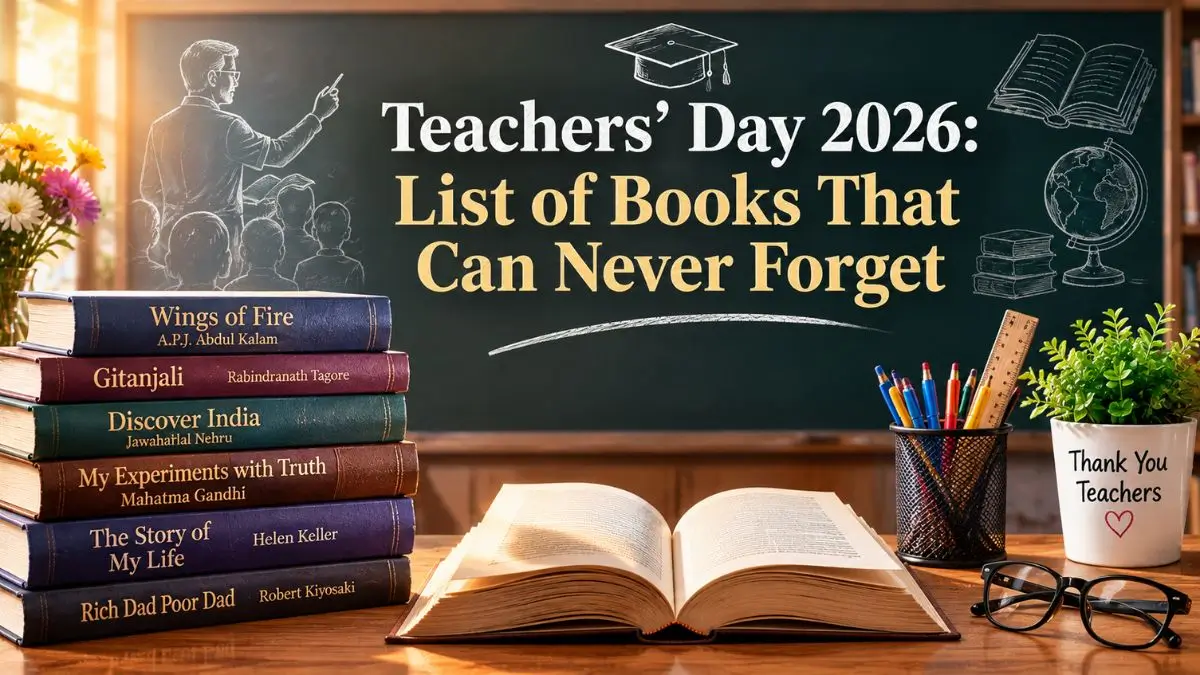
Teachers’ Day 2026: Here Are 10 Books We Can Never Forget

Teachers’ Day 2026 offers a chance to honor those teachers who influence our thought process, inspire curiosity and enable us to learn about things that go far beyond what is taught to us in the books. Celebrated in India on September 5th, this day also serves as a reminder of the significance of education and continuous learning. Books are an integral part of this process through which we come across various concepts, history, culture, science and society. These ten books for Teachers’ Day 2026 are a good source of learning on topics such as Indian history, economics, education, spirituality and nation building.

Top 10 Books We Can Never Forget

1. In Custody – Anita Desai

In Anita Desai’s “In Custody”, the author addresses the themes of language, literature and relationships formed in moments when one’s life, culture and society fall into ruin. The main character, Deven, a Hindi teacher, finds himself involved in the world of Urdu poetry. Through his experience, he reveals aspects of language and literature which cannot be taught at schools.

“In Custody” by Anita Desai will be relevant for Teachers’ Day since the author shows that education is not confined only to textbooks and tests. She encourages people to admire Indian linguistic and literary heritage.

2. Code Name God – Mani Bhaumik

In “Code Name God”, scientist and entrepreneur Mani Bhaumik looks into the connection between science and spirituality. Relying on his experience in science and attempts to explore spirituality, the author wonders about the idea that science and religion have to be mutually exclusive and antagonistic to each other.

The book will encourage people to look at different kinds of knowledge with interest and curiosity. It will be interesting for students in particular.

3. The Vedas – Roshen Dalal

A book on the Vedas by historian Roshen Dalal, entitled The Vedas, gives a comprehensive insight into the Vedas along with their significance historically, culturally, philosophically and literary in the intellectual tradition of India.

The book is highly recommended as supplementary reading for those who are preparing for competitive exams and are interested in learning more about ancient Indian history, culture, religion and philosophy. Teachers’ Day is the perfect time to explore such books which connect one’s classroom learning to the intellectual heritage of India.

4. In Service of the Republic: The Art and Science of Economic Policy – Vijay Kelkar and Ajay Shah

This book written by economists Vijay Kelkar and Ajay Shah delves into economics, public administration and the art and science of economic policy-making in India. Readers will get to know what role does institutions play in making and implementing of economic policy and decisions in the development of India.

The book will be of great interest to all those who want to learn more about Indian economy and governance and the challenges associated with it.

5. The Penguin History of Early India – Romila Thapar

In her work titled The Penguin History of Early India: From the Origins to AD 1300, historian Romila Thapar has traced the history of the early India. The book covers the political, social, economic and cultural evolution of India for many centuries.

This book is important for the students studying Indian history to gain in-depth knowledge about ancient and early medieval history of India. The students can use these books rather than relying on mere memorisation of dates and dynasties for understanding the historical development in its social and cultural context.

6. Poor Economics – Abhijit V. Banerjee and Esther Duflo

Poor Economics is a book by Nobel Prize-winning economists Abhijit V. Banerjee and Esther Duflo that uses economic research in the form of evidence for examining poverty and development issues.

The authors discuss how interventions of the real world could impact people suffering from poverty and also the need for evidence while formulating development strategies. This book will be important for those students who are interested in development economics and poverty alleviation issues.

7. Makers of Modern India – Ramachandra Guha

This book contains excerpts and speeches by notable Indian leaders. The author, Ramachandra Guha, analyzes the major topics like nationalism, democracy, caste system, gender relations, economy and social reform based on selected materials.

The reader is introduced to various views that contributed to the development of modern India. In this way, the book offers valuable information about the intellectual discussion of India’s transformation into independent democratic state.

8. Ignited Minds – A.P.J. Abdul Kalam

Written by ex-President and scientist A.P.J. Abdul Kalam, the book deals with the topic of potential of India and youth contribution to its future.

Instead of suggesting the concrete recipe for success, Kalam appeals to readers to become ambitious and creative, to cultivate scientific spirit and self-confidence. This work is particularly topical for the celebration of Teachers’ Day due to its theme.

Its ideas remain valuable for students seeking to play their role in the development of the country.

9. Shiksha: Experiments As An Education Minister – Manish Sisodia

Shiksha covers experiences and reforms in the context of Delhi’s public education system during the period of Manish Sisodia’s ministerial tenure as Education Minister. The book is based on the following issues concerning infrastructure, institution, teacher and education.

The book makes one think about education beyond the classrooms as an institutional process involving institutions, teachers, students, administration and policies.

As Teacher’s Day, the book provides a good reading about education policy and its impact on the process of education.

10. India Since Independence – Bipan Chandra, Mridula Mukherjee and Aditya Mukherjee

India Since Independence is about the development of political, economic and social dimensions of India since independence.

It deals with themes like Constitution, foreign policy, democracy, economic and social development of India.

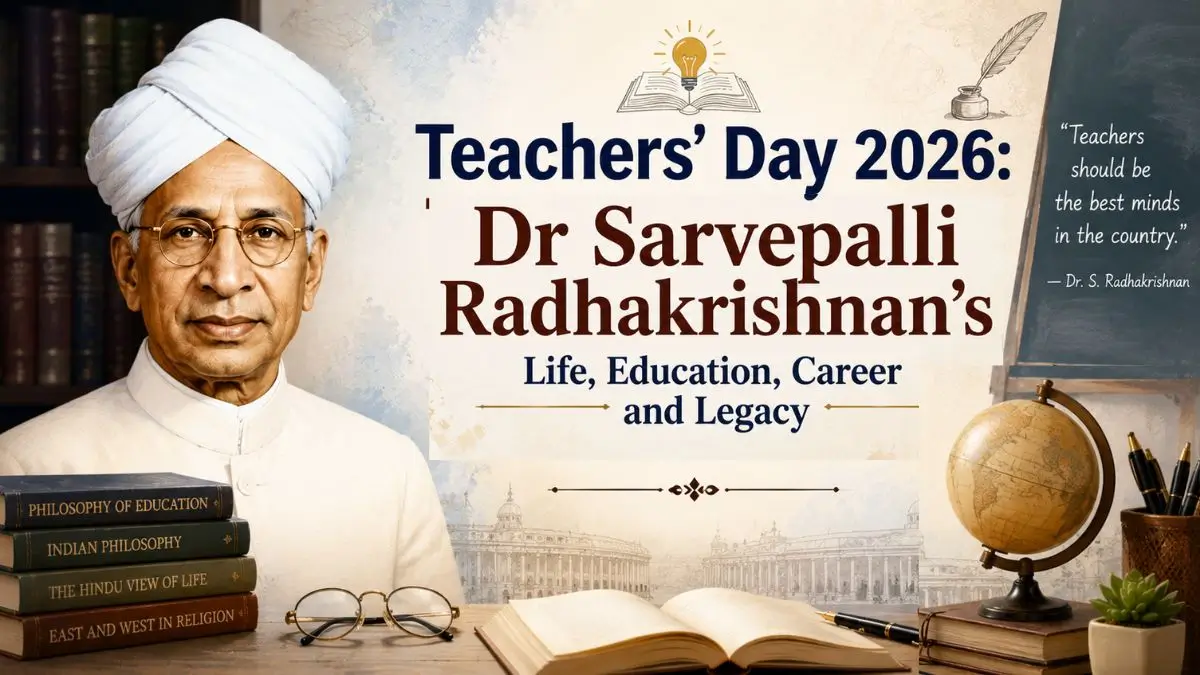
Teacher Day 2026: Dr Sarvepalli Radhakrishnan’s Life, Education, Career and Legacy

Teachers’ Day 2026 will be celebrated in India on September 5 which is the birth anniversary of Dr Sarvepalli Radhakrishnan, a highly revered Indian philosopher, educator, and statesman. Dr Radhakrishnan was the first vice president of India between 1952 to 1962 and later the second president of India between 1962 to 1967. His contribution to philosophy and education is greatly appreciated by generations of students and teachers. The life story of Dr Radhakrishnan from a humble background to becoming the highest constitutional authority in India is an indication of his dedication to learning, teaching, and excellence in intellect.

Early Life and Education

Dr Sarvepalli Radhakrishnan was born on September 5, 1888, in Tiruttani, in Madras Presidency, India, to a Telugu-speaking family. Sarvepalli Veeraswami was the name of his father who was working as a sub-revenue officer in the government.

Dr Sarvepalli Radhakrishnan went to different schools in Tiruttani and Tirupati and then studied further in Madras Christian College. He had earned both BA and MA degrees in philosophy from Madras Christian College.

One reason why he became so interested in philosophy may be due to the circumstances during his school days.

Personal Life

In 1903, Radhakrishnan married Sivakamu. The couple had five children. Among his children is Sarvepalli Gopal, who was a renowned historian and biographer.

Though Radhakrishnan reached the highest constitutional posts in India, he was still more remembered as a teacher and philosopher.

Teaching Career as a Professor

Once his education was complete, he began his career as a professor. He taught philosophy in various renowned educational institutes, which resulted in him being acclaimed internationally for his scholarly works.

He served as a professor at various institutions including Madras Presidency College, University of Mysore, and the Vice-Chancellor of Andhra University and Banaras Hindu University.

Apart from gaining fame as an author of scholarly works, he also earned recognition as a scholar on the international platform due to his affiliation with Oxford and other international educational institutes.

Teacher to Vice-President and President of India

Finally, Radhakrishnan’s career extended from the academic world into politics.

Post Independence, he was India’s representative in international organizations and India’s representative to UNESCO. His contributions in diplomacy as well as intellectually helped him gain popularity as a statesman and scholar.

In 1952, Radhakrishnan became the first Vice-President of independent India for two consecutive terms. In 1962, he became the second President of India, succeeding Dr Rajendra Prasad.

He held the office of the President from 1962 to 1967. Even in politics, he continued to be linked to education, philosophy, and intellectual debate.

Contributions of to Education and Philosophy

According to Radhakrishnan, education must develop intelligence as well as morals of an individual. His philosophy was based on high regards for critical thinking, ethics and deep insight into human life.

His contribution to philosophy was the way he introduced the philosophies of India to the Western world. He wrote about various topics like Hindu philosophy, comparative religions and connections between Eastern and Western philosophies.

Some of his most important works includes,

  • Indian Philosophy
  • Philosophy of Rabindranath Tagore
  • Hindu View of Life
  • Idealist View of Life
  • Eastern Religions and Western Thought

Dr Sarvepalli Radhakrishnan and the Bharat Ratna

In 1954, Radhakrishnan was conferred the prestigious Bharat Ratna, one of India’s highest civilian awards. This award is in recognition of his vast contributions to philosophy, education and public affairs.

Radhakrishnan’s academic contribution was recognized internationally as well. According to the nomination records of the Nobel Prize, Radhakrishnan was nominated several times for the Nobel Prize in Literature and Nobel Peace Prize during his life time.

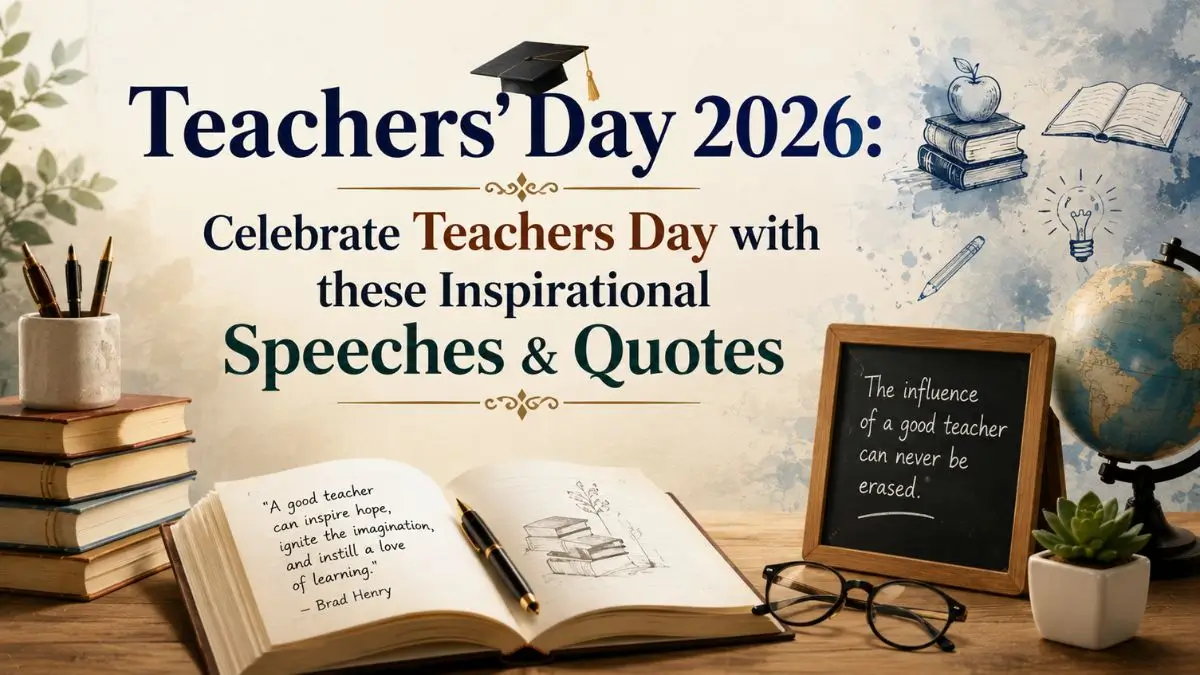
Teachers’ Day 2026: Inspirational Speeches by Important Public Figures

The Teachers’ Day of 2026 in India will be celebrated on September 5. This day is commemorated in honor of the birth anniversary of Dr. Sarvepalli Radhakrishnan, who was India’s first Vice-President and the second President. The Teachers’ Day is celebrated as “Shikshak Diwas” in India. It is observed as a tribute to the efforts made by teachers in the formation of students’ learning, character and future.

Qualities of an Inspirational Teacher

The inspirational teacher is not just about teaching and preparing students for examinations but goes beyond that to guide students to know their strengths and improve on their weaknesses.

This impact will be felt in many spheres including,

  • Academic knowledge: Teaching them to know and understand the concept and foster curiosity.
  • Character: Instilling honesty, discipline, and responsibility.
  • Building confidence: Inspiring students to overcome the fear of failure.
  • Critical thinking: Training them to be analytical and develop independent views.
  • Social responsibility: Making them responsible citizens who can give back to the society.

Famous Teachers Day Speech by Important Figures

Pranab Mukherjee

“Inspired teachers are the building blocks of a good education system. An inspired teacher links the individual goals of the students to the societal and national goals.”

He also said that teachers need to adopt new methodologies and technology to create modern and effective approaches to teaching and learning. Dr Mukherjee expressed his gratitude and wished the teaching community for their dedication and commitment for the furtherance of society.

Barack Obama

“In their daily lives, the men and women who teach our children fulfil the promise of a nation that’s always looking forward, that believes each generation has a responsibility to help the next in building this great country of ours and making the world a better place.”

He also said, “This is a profession where you have the potential to make more of a difference than just about anything you can go into. So teachers deserve more than just our gratitude they deserve our full support.”

Rabindranath Tagore

“Education means enabling the mind to find out that ultimate truth which emancipates us from the bondage of dust and gives us wealth not of things but of inner light, not of power but of love.

It is a process of enlightenment. It is divine wealth. It helps in the realisation of the truth”.

Michelle Obama

“All across this nation who get up every day and work their hearts out to lift up our young people. I am so grateful to all of you for your passion and your dedication, and all the hard work on behalf of the next generation, and I can think of no better way to end my time as the first lady than celebrating with all of you, so I want to close today by simply saying ‘thank you.”

Oprah Winfrey

“My producers surprised me by bringing in Mrs Duncan as a guest on the show. I hadn’t seen her since grade school, and suddenly, I’m reading the teleprompter: ‘Welcome, Mary Duncan’, “My eyes filled with tears, and I said, ‘Mrs Duncan had a name! Her name is Mary.’”

As a child, I hadn’t even considered that Mrs Duncan might have had a life beyond our class. It was in her class that I really came into myself. After all these years, I could say thank you to a woman who profoundly impacted my early life.”

“For the first time, I wasn’t afraid to be smart, and she often stayed after school to work with me. I thought I would one day become a fourth-grade teacher.”

Bill Gates

“I was desperately trying to go unnoticed because I had some big deficits, like atrocious handwriting (experts now call it dysgraphia) and a comically messy desk.

And I was trying to hide the fact that I liked to read something that was cool for girls but not for boys. Then, Blanche Caffiere took notice of me and helped me accept myself. She pulled me out of my shell by sharing her love of books,”

Teachers’ Day 2026: Attempt 50 Important Questions and Answers

Teachers’ Day is celebrated on the birth anniversary of Dr Sarvepalli Radhakrishnan, who was the first Vice President and second President of India, and who was a great philosopher, scholar and educationist.

Teachers’ Day also helps in gaining insight into various aspects of the Indian education system, which include the National Education Policy, teacher training programs, digital learning, and teacher award schemes in India.

Here we bring to you 50 Teachers’ Day Questions and Answers covering significant information about Dr. Radhakrishnan, Teachers’ Day, Indian education schemes and general knowledge.

Here Are 50 Important Questions and Answers

1. When is Teachers’ Day celebrated in India?

(a) 14 November
(b) 5 September
(c) 2 October
(d) 5 October

Answer: (b) 5 September

Explanation: Teachers’ Day is celebrated in India on September 5, the birth anniversary of Dr Sarvepalli Radhakrishnan.

2. Why is September 5 celebrated as Teachers’ Day in India?

(a) Birthday of Jawaharlal Nehru
(b) Birthday of Mahatma Gandhi
(c) Birthday of Dr Sarvepalli Radhakrishnan
(d) Foundation Day of the Ministry of Education

Answer: (c) Birthday of Dr Sarvepalli Radhakrishnan

Explanation: September 5 marks the birth anniversary of Dr Sarvepalli Radhakrishnan, a renowned philosopher, scholar and educationist.

3. In which year did India begin celebrating Teachers’ Day?

(a) 1952
(b) 1960
(c) 1962
(d) 1972

Answer: (c) 1962

Explanation: India began observing Teachers’ Day in 1962, the year Dr Radhakrishnan became President.

4. When was Dr Sarvepalli Radhakrishnan born?

(a) September 5, 1888
(b) September 5, 1890
(c) October 5, 1888
(d) November 14, 1888

Answer: (a) September 5, 1888

Explanation: Dr Sarvepalli Radhakrishnan was born on September 5, 1888.

5. Where was Dr Sarvepalli Radhakrishnan born?

(a) Chennai
(b) Tiruttani
(c) Madurai
(d) Bengaluru

Answer: (b) Tiruttani

Explanation: Dr Radhakrishnan was born in Tiruttani, in the erstwhile Madras Presidency.

6. Which subject did Dr Radhakrishnan study for his postgraduate degree?

(a) History
(b) Sociology
(c) Philosophy
(d) Political Science

Answer: (c) Philosophy

Explanation: Dr Radhakrishnan completed his master’s degree in philosophy and later became an internationally respected philosopher.

7. Which college did Dr Radhakrishnan attend for higher education?

(a) Madras Christian College
(b) Hindu College
(c) Presidency College, Kolkata
(d) Fergusson College

Answer: (a) Madras Christian College

Explanation: Dr Radhakrishnan pursued his higher education at Madras Christian College.

8. Which constitutional position did Dr Radhakrishnan hold first?

(a) President of India
(b) Prime Minister of India
(c) Vice-President of India
(d) Governor of Madras

Answer: (c) Vice-President of India

Explanation: Dr Radhakrishnan became the first Vice-President of India in 1952.

9. Who was the first Vice-President of India?

(a) Dr Rajendra Prasad
(b) Dr Sarvepalli Radhakrishnan
(c) Dr Zakir Husain
(d) Jawaharlal Nehru

Answer: (b) Dr Sarvepalli Radhakrishnan

Explanation: Dr Radhakrishnan served as India’s first Vice-President from 1952 to 1962.

10. When did Dr Radhakrishnan become President of India?

(a) 1952
(b) 1957
(c) 1962
(d) 1967

Answer: (c) 1962

Explanation: Dr Radhakrishnan became the second President of India in 1962.

11. Which President of India was Dr Sarvepalli Radhakrishnan?

(a) First President
(b) Second President
(c) Third President
(d) Fourth President

Answer: (b) Second President

Explanation: Dr Radhakrishnan served as the second President of India from 1962 to 1967.

12. During which period did Dr Radhakrishnan serve as President?

(a) 1952–1957
(b) 1957–1962
(c) 1962–1967
(d) 1967–1972

Answer: (c) 1962–1967

Explanation: He served as President of India for one term, from 1962 to 1967.

13. Which civilian award was conferred on Dr Radhakrishnan in 1954?

(a) Padma Bhushan
(b) Padma Vibhushan
(c) Bharat Ratna
(d) Desh Ratna

Answer: (c) Bharat Ratna

Explanation: Dr Radhakrishnan was awarded the Bharat Ratna in 1954 for his contributions to philosophy, education and public life.

14. Which university did Dr Radhakrishnan serve as Vice-Chancellor?

(a) Andhra University
(b) University of Delhi
(c) University of Calcutta
(d) University of Madras

Answer: (a) Andhra University

Explanation: Dr Radhakrishnan served as Vice-Chancellor of Andhra University.

15. Dr Radhakrishnan also served as Vice-Chancellor of which institution?

(a) Banaras Hindu University
(b) Aligarh Muslim University
(c) University of Bombay
(d) Jamia Millia Islamia

Answer: (a) Banaras Hindu University

Explanation: He served as Vice-Chancellor of Banaras Hindu University and contributed significantly to higher education.

16. Which international organisation did Dr Radhakrishnan represent India at?

(a) IMF
(b) UNESCO
(c) World Bank
(d) WTO

Answer: (b) UNESCO

Explanation: Dr Radhakrishnan represented India at UNESCO after independence.

17. What did Dr Radhakrishnan famously say about teachers?

(a) Teachers should be the best minds in the country
(b) Teachers should work only in universities
(c) Teachers should focus only on examinations
(d) Teachers should avoid political subjects

Answer: (a) Teachers should be the best minds in the country

Explanation: Radhakrishnan strongly emphasised the importance of highly capable teachers in nation-building.

18. Which profession was Dr Radhakrishnan primarily associated with before entering public life?

(a) Engineering
(b) Teaching and philosophy
(c) Medicine
(d) Journalism

Answer: (b) Teaching and philosophy

Explanation: He was a distinguished professor of philosophy before taking on major public responsibilities.

19. Who is the central figure associated with Teachers’ Day in India?

(a) Dr A.P.J. Abdul Kalam
(b) Dr Sarvepalli Radhakrishnan
(c) Dr Rajendra Prasad
(d) Mahatma Gandhi

Answer: (b) Dr Sarvepalli Radhakrishnan

Explanation: Teachers’ Day is observed on his birth anniversary as a tribute to his contribution to education and philosophy.

20. What is the purpose of Teachers’ Day?

(a) To honour teachers and educators
(b) To celebrate scientists
(c) To celebrate government employees
(d) To honour sportspersons

Answer: (a) To honour teachers and educators

Explanation: Teachers’ Day recognises the contribution of teachers and educators to students and society.

21. When is World Teachers’ Day observed internationally?

(a) September 5
(b) October 5
(c) November 14
(d) December 10

Answer: (b) October 5

Explanation: World Teachers’ Day is observed internationally on October 5.

22. Which country celebrates Teachers’ Day on September 10?

(a) Japan
(b) China
(c) France
(d) Germany

Answer: (b) China

Explanation: China observes Teachers’ Day on September 10.

23. Which policy was approved by the Union Cabinet in 2020 to transform India’s education system?

(a) National Education Policy 2020
(b) National Literacy Policy 2018
(c) National School Policy 2019
(d) Education Reform Policy 2021

Answer: (a) National Education Policy 2020

Explanation: The National Education Policy (NEP) 2020 introduced wide-ranging reforms in school and higher education.

24. What is the major focus of NIPUN Bharat?

(a) Higher education
(b) Foundational Literacy and Numeracy
(c) Sports education
(d) Technical education

Answer: (b) Foundational Literacy and Numeracy

Explanation: NIPUN Bharat aims to ensure foundational literacy and numeracy among children in the early years of schooling.

25. What does DIKSHA stand for?

(a) Digital Infrastructure for Knowledge Sharing
(b) Digital Initiative for Knowledge and School Education
(c) Development Infrastructure for Knowledge Sharing and Higher Academics
(d) Digital Information and Knowledge System for Higher Academics

Answer: (a) Digital Infrastructure for Knowledge Sharing

Explanation: DIKSHA is a national digital platform supporting students and teachers with educational resources.

26. Which platform provides online courses under the Government of India?

(a) SWAYAM
(b) DIKSHA
(c) Vidyanjali
(d) NISHTHA

Answer: (a) SWAYAM

Explanation: SWAYAM is a Government of India online learning platform offering courses across different levels of education.

27. What does NISHTHA stand for?

(a) National Initiative for School Heads’ and Teachers’ Holistic Advancement
(b) National Institute for School Teaching and Higher Academics
(c) National Initiative for Student Training and Higher Achievement
(d) National Integrated Scheme for Teachers and Higher Academics

Answer: (a) National Initiative for School Heads’ and Teachers’ Holistic Advancement

Explanation: NISHTHA is a teacher-training and capacity-building programme.

28. Which initiative aims to strengthen community participation in schools?

(a) Vidyanjali
(b) SWAYAM
(c) NIPUN Bharat
(d) NISHTHA

Answer: (a) Vidyanjali

Explanation: Vidyanjali encourages community and volunteer participation in supporting school education.

29. Which scheme focuses on integrated school education?

(a) Samagra Shiksha
(b) PM-KISAN
(c) PM POSHAN
(d) Skill India

Answer: (a) Samagra Shiksha

Explanation: Samagra Shiksha is a comprehensive school education programme covering different stages of schooling and areas such as teacher development and inclusive education.

30. Which organisation confers the National Awards to Teachers in India?

(a) Ministry of Culture
(b) Ministry of Education
(c) Ministry of Youth Affairs and Sports
(d) Ministry of Skill Development

Answer: (b) Ministry of Education

Explanation: The Ministry of Education administers the National Awards to Teachers.

31. Which President of India presents the National Awards to Teachers?

(a) The President of India
(b) The Prime Minister
(c) The Education Minister
(d) The Vice-President

Answer: (a) The President of India

Explanation: The National Awards to Teachers are traditionally presented by the President of India around Teachers’ Day.

32. Who is widely regarded as one of India’s earliest modern women teachers?

(a) Sarojini Naidu
(b) Savitribai Phule
(c) Annie Besant
(d) Vijayalakshmi Pandit

Answer: (b) Savitribai Phule

Explanation: Savitribai Phule played a pioneering role in women’s education and is widely regarded as one of India’s first modern women teachers.

33. Who was the teacher of Lord Krishna according to traditional accounts?

(a) Dronacharya
(b) Sandipani Muni
(c) Vashishtha
(d) Garga Muni

Answer: (b) Sandipani Muni

Explanation: According to traditional Hindu accounts, Krishna and Balarama studied under Sandipani Muni.

34. Which award did Dr Radhakrishnan receive in 1954?

(a) Padma Shri
(b) Bharat Ratna
(c) Padma Bhushan
(d) Gandhi Peace Prize

Answer: (b) Bharat Ratna

Explanation: Bharat Ratna was conferred on Dr Radhakrishnan in 1954.

35. In which year was the University Education Commission established?

(a) 1935
(b) 1947
(c) 1948
(d) 1950

Answer: (c) 1948

Explanation: The University Education Commission was established in 1948 under the chairmanship of Dr Sarvepalli Radhakrishnan.

36. What was the primary purpose of the University Education Commission?

(a) To examine university education in India
(b) To establish primary schools
(c) To regulate technical colleges
(d) To introduce vocational education

Answer: (a) To examine university education in India

Explanation: The commission reviewed the state of university education and made recommendations for its improvement.

37. Which book was written by Dr Sarvepalli Radhakrishnan?

(a) Indian Philosophy
(b) Discovery of India
(c) Hind Swaraj
(d) India Wins Freedom

Answer: (a) Indian Philosophy

Explanation: Indian Philosophy is one of Dr Radhakrishnan’s major scholarly works.

38. Which book examines Rabindranath Tagore’s philosophy and ideas?

(a) The Philosophy of Rabindranath Tagore
(b) Gitanjali and Philosophy
(c) Tagore and Modern India
(d) The World of Tagore

Answer: (a) The Philosophy of Rabindranath Tagore

Explanation: Dr Radhakrishnan wrote The Philosophy of Rabindranath Tagore, reflecting his interest in Tagore’s philosophical thought.

39. Which famous Indian philosopher and educationist served as India’s first Vice-President?

(a) Dr S. Radhakrishnan
(b) Dr Zakir Husain
(c) Dr Rajendra Prasad
(d) Maulana Abul Kalam Azad

Answer: (a) Dr S. Radhakrishnan

Explanation: Dr Radhakrishnan became the first Vice-President of India in 1952.

40. Which initiative is primarily associated with teacher professional development?

(a) NISHTHA
(b) PM-KISAN
(c) UJALA
(d) Ayushman Bharat

Answer: (a) NISHTHA

Explanation: NISHTHA focuses on capacity building and professional development of teachers and school heads.

41. Which platform was particularly important for digital learning resources for teachers and students?

(a) DIKSHA
(b) PM Gati Shakti
(c) GeM
(d) DigiLocker

Answer: (a) DIKSHA

Explanation: DIKSHA provides digital educational content and resources for teachers and learners.

42. What is one of the key objectives of Samagra Shiksha?

(a) Inclusive and equitable education
(b) Agricultural development
(c) Industrial growth
(d) Financial inclusion

Answer: (a) Inclusive and equitable education

Explanation: Samagra Shiksha focuses on improving access, quality, inclusion and equity in school education.

43. Which programme provides online learning opportunities through MOOCs and other courses?

(a) SWAYAM
(b) Vidyanjali
(c) NISHTHA
(d) NIPUN Bharat

Answer: (a) SWAYAM

Explanation: SWAYAM provides online courses and learning opportunities for students, teachers and lifelong learners.

44. Who was the first woman to receive the National Award to Teachers, according to the source material?

(a) Savitribai Phule
(b) Mary Clubwala Jadhav
(c) Sarojini Naidu
(d) Annie Besant

Answer: (b) Mary Clubwala Jadhav

Explanation: Mary Clubwala Jadhav is identified in the supplied material as the first woman recipient of the National Award to Teachers.

45. Which institution is associated with Dr Radhakrishnan’s tenure as Vice-Chancellor?

(a) Banaras Hindu University
(b) Indian Institute of Science
(c) IIT Bombay
(d) Jawaharlal Nehru University

Answer: (a) Banaras Hindu University

Explanation: Dr Radhakrishnan served as Vice-Chancellor of Banaras Hindu University.

46. Which field made Dr Radhakrishnan internationally famous?

(a) Philosophy
(b) Medicine
(c) Engineering
(d) Economics

Answer: (a) Philosophy

Explanation: His scholarly work in Indian and comparative philosophy earned him international recognition.

47. Which of the following best describes the significance of Teachers’ Day?

(a) It celebrates only school examinations
(b) It recognises the contribution of teachers to society
(c) It marks the beginning of the academic year
(d) It celebrates university admissions

Answer: (b) It recognises the contribution of teachers to society

Explanation: Teachers’ Day recognises educators for their role in shaping knowledge, values, skills and responsible citizens.

48. Which of the following is associated with foundational learning in India?

(a) NIPUN Bharat
(b) SWAYAM
(c) Vidyanjali
(d) NISHTHA

Answer: (a) NIPUN Bharat

Explanation: NIPUN Bharat focuses on foundational literacy and numeracy among children.

49. Which day is observed globally to recognise teachers?

(a) September 5
(b) October 5
(c) November 5
(d) December 5

Answer: (b) October 5

Explanation: October 5 is observed as World Teachers’ Day internationally.

50. Which statement about Dr Sarvepalli Radhakrishnan is correct?

(a) He was India’s first Vice-President
(b) He was India’s second President
(c) He received the Bharat Ratna in 1954
(d) All of the above

Answer: (d) All of the above

Explanation: Dr Radhakrishnan was India’s first Vice-President, second President and a recipient of the Bharat Ratna in 1954. His birth anniversary on September 5 is observed as Teachers’ Day in India.


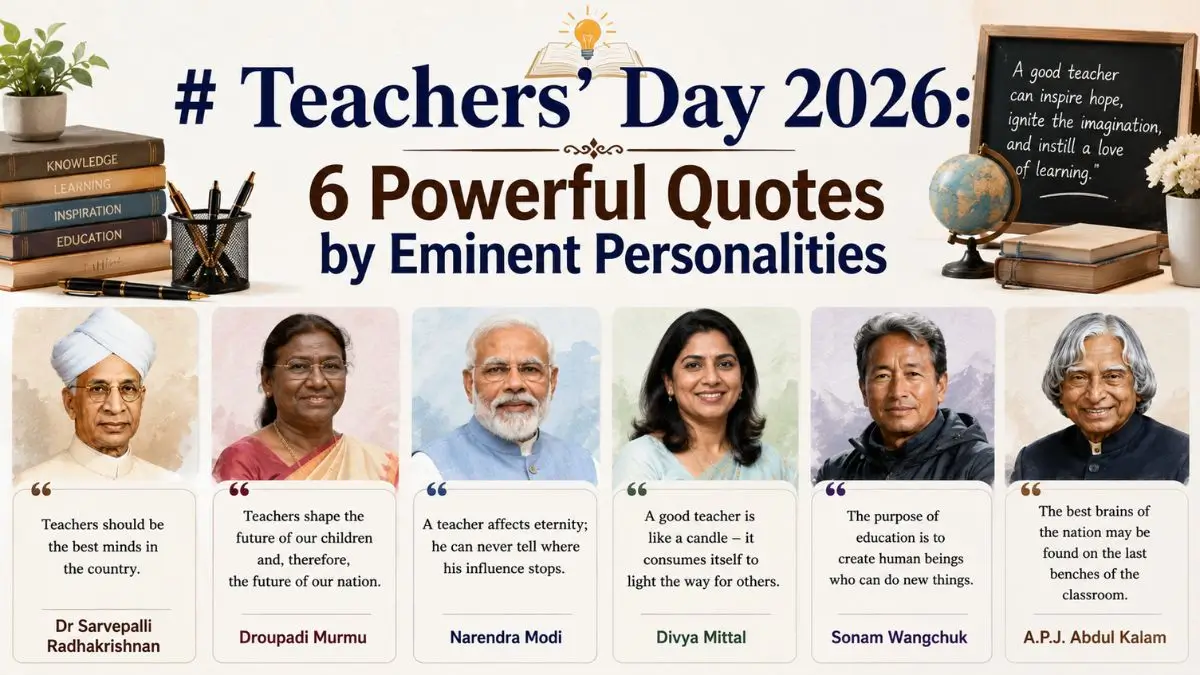
Teachers Day 2026: 6 Powerful Quotes by Eminent Personalities

The Teachers Day 2026 celebrated in India on September 5 in honor of the birth anniversary of Dr Sarvepalli Radhakrishnan, an Indian philosopher and educator who served as the second President of India. This day celebrates the contribution of teachers in helping students gain knowledge, wisdom, and ambitions. Many notable people have emphasized the contribution of teachers through the years.

Here Are Top-6 Powerful Quotes by Eminent Personalities

1. Dr Sarvepalli Radhakrishnan

“The true teachers are those who help us think for ourselves.”

Dr Sarvepalli Radhakrishnan was a distinguished philosopher and educationist who served as India’s first Vice-President and second President. His educational philosophy placed considerable importance on independent thought and intellectual development.

The quote captures an essential role of teachers: they should not merely provide information but encourage students to question, analyze and develop their own understanding.

2. Droupadi Murmu

“Teachers play the most important role in the success of any education system. Teaching is not just a job. It is a sacred mission of human development.”

President Droupadi Murmu has highlighted the central position of teachers in the education system. The statement underlines teaching as a responsibility that extends beyond academic instruction.

Teachers influence the intellectual and personal development of students, making their contribution important to the long-term development of society.

3. PM Narendra Modi

“The dedication of teachers to nurturing minds is the foundation of a stronger and brighter future.”

Honorable Prime Minister Narendra Modi has often praised the contribution of teachers towards nation building. This quote emphasizes that education is an investment for the future.

Teachers also provide the youth with knowledge and skills that may contribute towards the growth and development of the economy and science.

4. Divya Mittal

“Incredible educators shape young minds and ignite the flames of curiosity.”

Former IAS officer Divya Mittal highlights curiosity as one of the most valuable outcomes of good teaching. An effective educator does not simply encourage students to memorise facts but inspires them to explore ideas and ask questions.

This message is particularly relevant in modern education, where creativity, problem-solving and independent learning are increasingly important.

5. Sonam Wangchuk

“A teacher can shape generations. But if we don’t invest in teachers, entire generations will be destroyed.”

Engineer and educationist Sonam Wangchuk draws attention to the importance of investing in teachers. Quality education depends not only on infrastructure and technology but also on capable, motivated and well-supported educators.

The statement also connects Teachers’ Day with a broader policy question: how can societies strengthen the teaching profession to improve educational outcomes?

6. A.P.J. Abdul Kalam

“Teaching is a very noble profession that shapes the character, calibre, and future of an individual.”

Former President and renowned scientist Dr A.P.J. Abdul Kalam placed teachers at the centre of individual development. For Kalam, education was closely linked with character, creativity and the ability of young people to contribute to the nation.

His own continued engagement with students and teaching reflected his belief that educators could inspire young minds to dream and work towards meaningful goals.

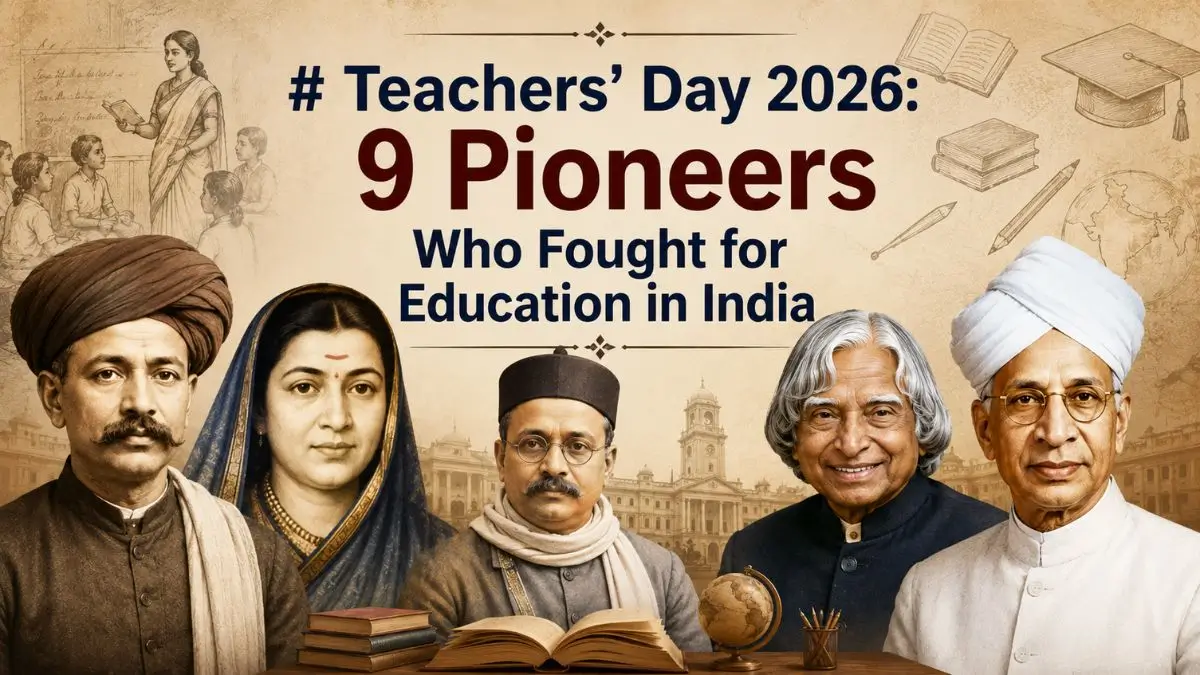
Teachers’ Day 2026: 9 Pioneers Who Fought for Education in India

India celebrates Teachers’ Day on September 5, which marks the birthday of the late philosopher and former president of India, Dr. Sarvepalli Radhakrishnan. Nevertheless, there are other figures from India’s history of education who did not shy away from breaking the established social barriers to promote education to greater parts of society. From the efforts of Savitribai and Jyotirao Phule to provide girls with education in 19th century Maharashtra to those of Begum Rokeya in promoting Muslim girls’ education, their efforts linked education with empowerment.

9 Pioneer Figures Who Fought for Education in India

1. Jyotirao and Savitribai Phule

Among those who pioneered girl’s education and education for marginalised communities in 19th-century India are Jyotirao Phule and Savitribai Phule.

The couple founded an institution for girl’s education in Bhide Wada, Pune in 1848, with Savitribai Phule becoming one of India’s first female teachers in the modern era.

The Phules established several schools in and around Pune and aimed to facilitate education to communities which were socially discriminated against due to their castes or genders. They also organised night schools and facilitated access to education beyond traditional school hours.

2. Fatima Sheikh

Fatima Sheikh was an early Muslim woman educator who worked in tandem with Savitribai Phule. She was part of the Phules’ educational movements and taught children from socially discriminated against communities.

Her contribution is important as she was involved in the movement for women’s education during the time when girls faced difficulties getting educated due to their disadvantaged status.

3. Sethu Lakshmi Bayi

Sethu Lakshmi Bayi, the last Maharani to reign in Travancore, promoted women’s education and involvement in social affairs. Women’s educational prospects increased during her regency period.

Moreover, her government supported women’s prospects in further education and in working in public sectors, thereby highlighting the role played by institutional measures to complement other reforms.

4. Dr Sarvepalli Radhakrishnan

Dr Sarvepalli Radhakrishnan is a well-known philosopher, professor and educationist who contributed significantly to the academic world of India.

He taught philosophy at the Madras Presidency College, University of Mysore, and the University of Calcutta.

He worked as the Vice-President of India between 1952 and 1962 and became the President of India between 1962 and 1967.

His contributions are remembered in the form of celebrating Teachers’ Day on September 5 in India.

5. A.P.J. Abdul Kalam

A.P.J. Abdul Kalam was a celebrated scientist and 11th President of India who always remained close to the students in his lifetime. He resumed teaching after completing his tenure as President.

Kalam inspired the students to be scientific and to set high targets to work towards their development. The date of birth of Kalam, 15 October, is celebrated as World Students’ Day.

6. Gopal Krishna Gokhale

Gopal Krishna Gokhale was an important nationalist, social reformer, and an educationist. He was associated with Fergusson College, Pune, and founded Servants of India Society in 1905.

According to Gokhale, education is necessary for social development. In 1911, Gokhale introduced a bill in the Imperial Legislative Council for making primary education mandatory.

7. Sarala Devi Chaudhurani

Sarala Devi Chaudhurani was a nationalist, social reformer and also a significant supporter of women’s education. In the year 1910, she formed Bharat Stree Mahamandal, which aimed at fostering the cause of women’s education and development.

Furthermore, she formed educational institutions for girls and endeavored to provide opportunities to women of different social sections. Her contribution was a part of the broader movement for the empowerment of women during the colonial era.

8. Madan Mohan Malaviya

Madan Mohan Malaviya was an educationist, social reformer and also a nationalist leader who made a significant contribution towards the formation of Banaras Hindu University (BHU), which was formed in 1916 and became one of the most prominent institutions of higher education in India.

Malaviya considered education as a significant tool of nation building. He also provided support for increased educational opportunities for women.

9. Begum Rokeya Sakhawat Hossain

Begum Rokeya Sakhawat Hossain is considered to be one of the early proponents of Muslim women’s education in Bengal.

She started a school for Muslim girls in Bhagalpur in 1909, followed by the establishment of the Sakhawat Memorial Girls’ School in Calcutta in 1911.

She defied conservative views on the education of women, asserting that education was necessary for women to be able to stand on their own feet and be financially independent.

_12.1
September 2026
M T W T F S S
 123456
78910111213
14151617181920
21222324252627
282930