
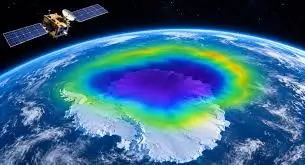
The National Aeronautics and Space Administration (NASA) and the National Oceanic and Atmospheric Administration (NOAA) reported on 4 November 2026 that the 2026 Antarctic ozone hole ranked seventh largest in 48 years of monitoring, based on its seasonal average area.
Scientists attributed its unusually large extent partly to a powerful polar vortex and atmospheric conditions favourable for ozone depletion. However, they emphasised that the ozone layer remains on track for long-term recovery.
Key Highlights
- Reporting organisations: NASA and NOAA.
- Ranking: Seventh largest in 48 years of monitoring.
- Average area: Approximately 25 million square kilometres during 7 September–13 October 2026.
- Maximum extent: Approximately 27.1 million square kilometres on 18 September 2026.
- Lowest measured ozone over the South Pole: 105 Dobson Units on 17 October 2026.
- Main contributing atmospheric factor: An unusually powerful polar vortex.
Why Does the Ozone Hole Form?
The ozone layer is located in the stratosphere and protects Earth from harmful ultraviolet radiation.
Ozone depletion occurs when chlorine- and bromine-containing chemicals, including substances released from older industrial products, reach the stratosphere and participate in chemical reactions that destroy ozone.
Extremely cold Antarctic conditions and polar stratospheric clouds accelerate these reactions.
Role of the Montreal Protocol
The Montreal Protocol, adopted in 1987, established international controls on ozone-depleting substances such as chlorofluorocarbons (CFCs).
NASA and NOAA scientists say the decline in ozone-depleting chemicals demonstrates the effectiveness of international environmental cooperation. Despite the large 2026 ozone hole, long-term recovery is expected to continue, with Antarctic ozone recovery projected for the 2070s.
Important Facts for Exams
| Question | Answer |
|---|---|
| 2026 ozone hole ranking | Seventh largest |
| Monitoring period | 48 years |
| Maximum area | 27.1 million sq. km |
| Ozone measurement unit | Dobson Unit |
| Montreal Protocol adopted | 1987 |
| Reporting agencies | NASA and NOAA |








 Asteroid 2026 QQ8 Becomes Earth's Tempor...
 JNCASR’s Terahertz Chip Achieves 100 G...
 Aditya-L1 Reveals Asymmetric Expansion o...