
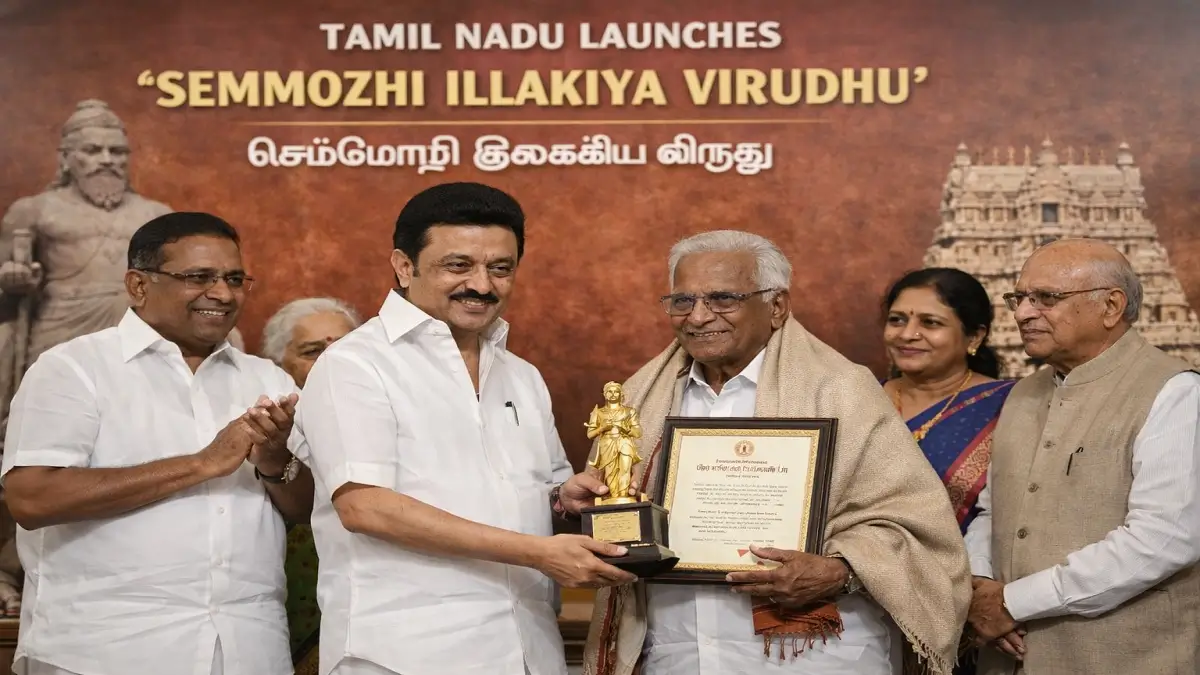
Tamil Nadu has taken a major step in strengthening India’s multilingual literary culture by announcing a new annual state-sponsored literary honour that will recognise outstanding books in leading Indian languages other than Hindi. The initiative was unveiled by Chief Minister M K Stalin during the valedictory ceremony of the Chennai International Book Fair, placing the spotlight on the importance of independent and inclusive recognition for writers across the country.
This policy move has drawn attention not just because of the award amount, but also because of the political and cultural context in which it has been launched—especially amid concerns over interference in national literary awards.
What is the Semmozhi Illakiya Virudhu?
The Tamil Nadu government announced a new annual award titled: “Semmozhi Illakiya Virudhu (Classical Language Literary Award)”. This award will be conferred every year, and will have a national-level character, meaning it is not restricted only to Tamil Nadu writers. It aims to celebrate high-quality literary works published in selected Indian languages.
Key Feature
Each selected language will carry a cash prize of ₹5 lakh, making it one of the most financially significant state-backed literary honours in India.
Languages Covered in the First Phase
In the first phase, the Semmozhi Illakiya Virudhu will recognise the best literary works in seven Indian languages:
- Tamil
- Telugu
- Kannada
- Malayalam
- Odia
- Bengali
- Marathi
The government has also indicated that the award’s scope could expand in later phases, potentially including more Indian languages depending on policy decisions and expert recommendations.
Why Tamil Nadu Introduced This Award
1) Promoting Indian multilingual literature
The decision reflects Tamil Nadu’s long-standing stance that Indian unity is strengthened through linguistic diversity, not weakened by it. The Chief Minister stressed that language should act as a bridge, not a barrier.
2) Strengthening cultural policy through state support
Unlike one-time recognitions, this is a structured annual award, showing Tamil Nadu’s intention to institutionalise cultural support for literature—similar to how governments support sports, science, and innovation.
3) Response to uncertainty around Sahitya Akademi awards
A major context behind the announcement was the controversy regarding the Sahitya Akademi awards announcement, which was reportedly cancelled. The Chief Minister alleged that the cancellation was influenced by the Union Culture Ministry.
Concerns Over Autonomy in Literary Awards
During his address, Chief Minister Stalin raised concerns about political interference in literature and arts. He described such interventions as dangerous, arguing that creative spaces must remain independent to protect freedom of expression.
He also stated that writers and representatives of literary bodies approached the Tamil Nadu government requesting a constructive response due to uncertainty around the functioning and announcement of national literary honours.
This development is important because literary awards are not just about recognition—over time, they influence:
- the publishing industry
- decisions related to translation
- institutional support
- and the visibility of writers at a national level
Independent Selection Mechanism: How Winners Will Be Chosen
One of the most significant features of this award is its selection structure, designed to ensure transparency and credibility.
Tamil Nadu government’s role
The state government will act only as a patron, not as a decision-maker in the selection process.
Who will select the winners?
- Separate expert committees will be formed for each language
- Each committee will include reputed writers and literary experts
- This ensures quality, independence, and transparency, while protecting the award from political influence
This selection model is being projected as a key difference between this award and other national-level honours where political interference has been alleged.








 Punjab Launches SANGAT Mental Health Clu...
 Uttarakhand Becomes India’s 6th Fully ...
 Odisha Launches India’s First MICE Inc...










