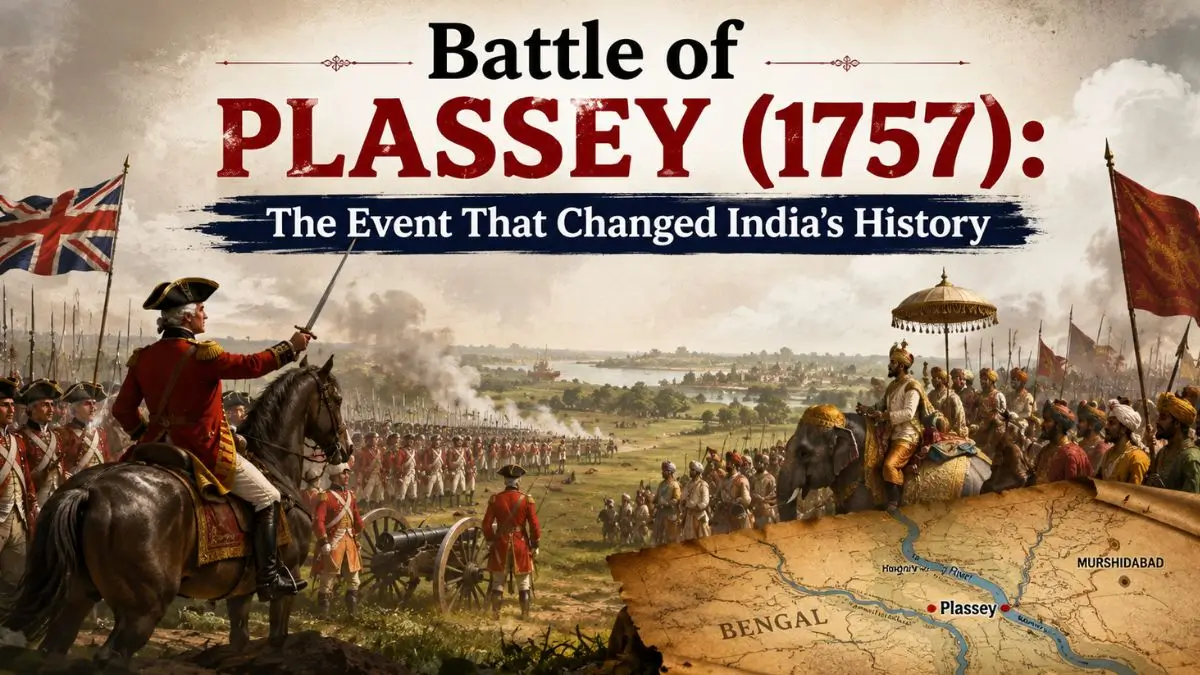
The Battle of Plassey happened on 23rd June 1757. It is considered to be among the most important battles in the history of India. The armies of the East India Company led by Robert Clive clashed against the army of Siraj-ud-Daulah, the Nawab of Bengal near Plassey.
The actual battle lasted for a short while but its political implications were extremely significant. By means of military maneuvers and political intrigues, as well as betrayal of some members of the court of Siraj-ud-Daulah, the East India Company won this battle.
As a result of the battle, the East India Company obtained a strong control over the government and resources of Bengal. But more importantly, the Battle of Plassey became one of the main points in the process of the East India Company transforming from a commercial company into a political-military organization.
Battle of Plassey 1757: What Happened?
The Battle of Plassey occurred on 23 June 1757 during the times of increasing conflict between the Nawab of Bengal and the English East India Company.
The East India Company possessed many commercial privileges in the territory of Bengal. At that time, British officials used these privileges incorrectly. The East India Company also built up the fortifications around Calcutta without getting the permission of the Nawab.
On the other hand, Siraj-ud-Daulah was faced with strong internal opposition. Some important personages of his court were not satisfied with him which gave an advantage to Robert Clive and the East India Company.
Clive established secret agreements with Mir Jafar and other important personages such as Rai Durlabh, Jagat Seth and Omichand. These agreements were based on the plan to replace Siraj-ud-Daulah with Mir Jafar as the Nawab.
When the battle started, Siraj-ud-Daulah had a larger army than Clive. But the part of the army of Siraj-ud-Daulah did not take an active part in the battle. This factor turned out to be decisive and enabled Clive to defeat the army of Siraj-ud-Daulah.
After being defeated in the battle, Siraj-ud-Daulah was captured and executed. After that Mir Jafar became the Nawab of Bengal.
Battle of Plassey Causes
Trade Disputes
- One of the primary causes of the conflict was the trade disputes between the East India Company and the Bengal Government.
- The Company had some profitable trade privileges like free passes which were being abused by the Company officials for their personal gains, thereby lowering the revenue available to the Nawab’s administration.
- It led to growing tensions between the Bengal government and the Company.
Calcutta Fortifications
- The British fortified the defenses of Fort William in Calcutta without considering the objections raised by Nawab.
- Siraj-ud-Daulah was suspicious about the increased military presence of the Company as he felt that the Europeans were gaining more power and could threaten his rule.
Shelter to Krishna Das
- The East India Company gave shelter to Krishna Das, the son of Raj Ballabh, who had escaped to Calcutta along with his wealth.
- Siraj-ud-Daulah asked the Company to deliver him to him, but the refusal by the Company made matters worse between the two.
British Fear of French Alliance
- The East India Company was also worried about Siraj-ud-Daulah making an alliance with the French who had commercial and political influence in Bengal.
- The rivalry between the two European powers in the context of the fight for control over India became another cause of conflict in Bengal.
Internal Rivalries at Siraj’s Court
- There were internal rivalries at Siraj-ud-Daulah’s court from prominent individuals in the Bengal political establishment including Mir Jafar, Ghasiti Begum and other wealthy bankers and officials.
- Robert Clive took advantage of these rivalries by making agreements with Siraj’s opponents.
The Black Hole of Calcutta
The Black Hole of Calcutta is regarded as the immediate cause which increased animosity of the British towards Siraj-ud-Daulah.
According to the British tradition, after capturing Fort William, a large number of prisoners were locked overnight in a small room causing death due to suffocation.
However, modern historians have cast doubts on certain aspects of the traditional narrative including the number of prisoners and deaths. It should be viewed in the light of the history rather than blindly accepting the traditional figures.
Role of Robert Clive and Mir Jafar
Clive played a vital part in utilizing political differences of Bengal to gain military advantage against the Bengal army.
Before the battle, he formed a secret agreement with Mir Jafar, an important military commander in the army of Siraj-ud-Daulah. He promised to make him the Nawab of Bengal if he defeated Siraj-ud-Daulah and supported the Company.
This ensured that the Company did not have to defeat the whole of the Bengal army by relying solely on their military prowess. Political betrayal in the camp of Siraj-ud-Daulah severely undermined his position.
Consequently, the Battle of Plassey came to be known as not just a military victory but also because of the political machinations behind it.
Consequences of the Battle of Plassey
The British East India Company won on 23rd June 1757.
Siraj-ud-Daulah was defeated, captured and killed while Mir Jafar was appointed as the Nawab of Bengal.
With the victory, huge economic and political gains were made by the Company. The resources of Bengal became available to the Company, improving its military and commercial strength.
Political influence of the Company over the Nawab increased and direct interference in the political affairs of the Nawab took place.
Post Battle of Plassey
It is important to note that the appointment of Mir Jafar did not solve the problem of political instability in Bengal. On the contrary, it created a new situation between the Company and the Nawab.
Mir Jafar could not meet the requirements of the Company financially. Dissatisfaction led to his removal from the position of Nawab by Mir Qasim, who was his son-in-law.
As per the agreement of 1760, Mir Qasim conceded to the Company in terms of territories and finances, ceding Burdwan, Midnapur and Chittagong to the Company.
Relations between the Nawab and the Company deteriorated to such an extent that it resulted in another battle, Battle of Buxar of 1764.
Importance of the Battle of Plassey
The Battle of Plassey is regarded to be an important event in the Indian history since it marked the change in the position of the East India Company politically.
Prior to Plassey, the East India Company was mainly a commercial organization that operated on the command of Indian kings. After Plassey, the Company became a political and military organization that could affect the rule of Bengal.
The Company also acquired access to the vast economic resources of Bengal. These resources enabled the company to conduct military campaigns and acquire territories.
Thus, Plassey provided the basis for the growing importance of the East India Company, which grew considerably after the Battle of Buxar and obtaining the Diwani rights of Bengal, Bihar and Orissa in 1765.








 Asian Games to LA28: Which Sports Earned...
 Guava Capital of India: Which Place Is K...
 7 Most Beautiful Train Stations in the W...