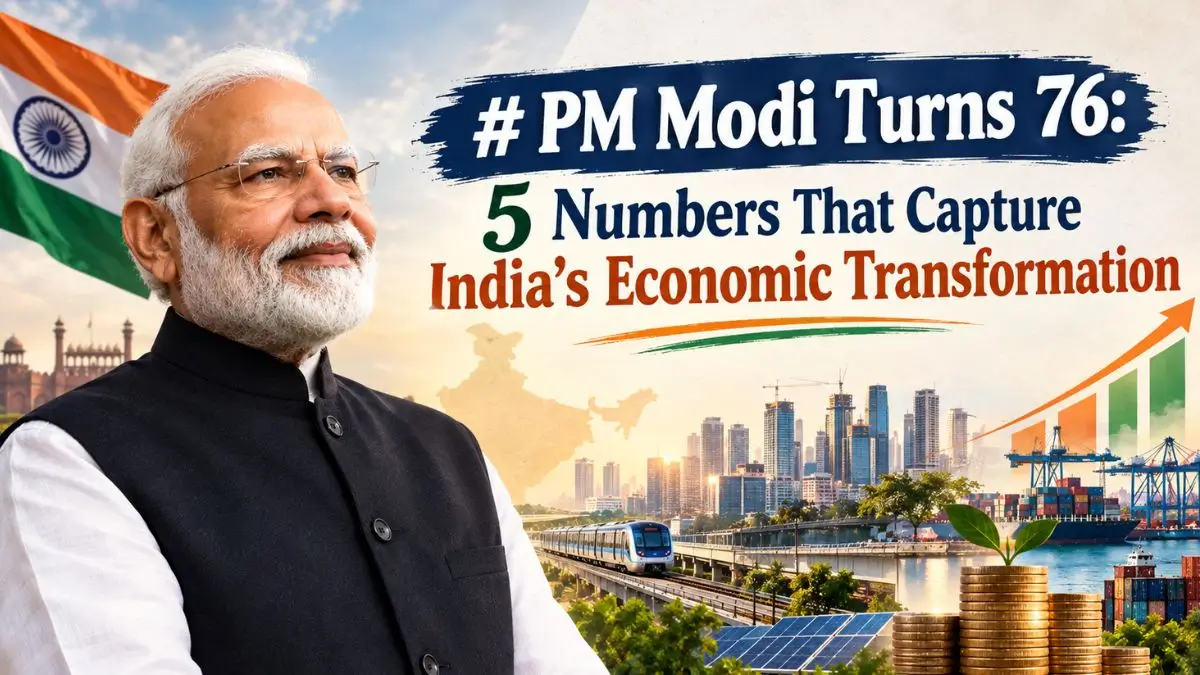
Indian Prime Minister Narendra Modi will complete 76 years of age on September 17, 2026, after ruling the country for more than 12 years as Prime Minister since assuming power in May 2014. During this time, India’s economy and infrastructure have seen several changes in various sectors including growth, foreign exchange, financial inclusion, roads, and entrepreneurship.
Five numbers from the most recently published statistics can highlight the extent of these changes.
Here Are 5 Numbers Which Capture India’s Economic Transformation
1. 7.8%: India’s Latest GDP Growth Rate
In the April-June quarter of FY27, India has witnessed 7.8% growth in its GDP on a real basis. It has been helped by manufacturing and service sectors.
In fact, the real Gross Value Added (GVA) has risen by 8.2%, while investments are up by 11.9%. The growth in household consumption has been 7.1%, whereas exports are up by 12% in the quarter under review.
This latest quarterly growth has come amidst the continuing uncertainties in global trade and geopolitics. India has also witnessed 7.7% real GDP growth in FY2025–26.
2. $785.7 Billion: Highest Ever Foreign Exchange Reserves
The foreign exchange reserves of India stood at a high of $785.7 billion in the week ending on September 4, 2026, as per data published by the Reserve Bank of India.
There was an increase of almost $120 billion in the foreign exchange reserves for 10 successive weeks and India was also seen as the fourth largest in terms of foreign exchange reserves in the world.
Foreign exchange reserves can serve as a cushion against external economic shocks.
3. 59.21 Crore: Jan Dhan Accounts
Pradhan Mantri Jan Dhan Yojana (PMJDY) was launched in August 2014 and increased access to banking.
The total number of PMJDY accounts has been 59.21 crore till September 2, 2026, as per data released by Moneycontrol. The deposits in these accounts have been ₹3.17 lakh crore and 41.39 crore RuPay debit cards have been issued under the scheme.
Among women, there were 32.98 crore accounts, while rural and semi-urban beneficiaries made up 46.03 crore.
4. 1,46,572 km: National Highway Network
The national highway network of India has grown over the past decade.
The network was of length 1,46,572 km in contrast to 91,287 km in FY2014, according to the figures mentioned in the report.
According to the figures from the Economic Survey data used in Moneycontrol, the average annual highway constructions have also grown from 4,174 km in 2004-14 to 9,704 km in 2014-25.
The growth in the highway network has also seen an emphasis on expressways, logistics, and infrastructure integration.
5. 2.47 Lakh: Recognized Startups
The startup ecosystem of India has expanded quite a bit since the advent of Startup India in 2016.
The number of DPIIT-recognized startups has risen from mere 502 in 2016 to more than 2.47 lakh in August 2026, according to the figures from the government cited in the report.
As per the government, India is the world’s third-largest startup ecosystem. Recent changes have also raised the threshold for startups from ₹100 crore to ₹200 crore, and ₹300 crore for DeepTech startups.
India’s Economic Growth Through Five Figures
- Growth in real GDP, Q1: FY27 7.8%
- Foreign exchange reserves: $785.7 billion
- Jan Dhan account holders: 59.21 crore
- National highway network: 1,46,572 km
- Recognized startups (DPIIT): 2.47 lakh+
Significance of These Figures
Collectively, all the above figures represent five different aspects of economic growth in India which include growth, financial stability, financial inclusion, physical infrastructure, and entrepreneurship.
This also shows that economic progress cannot be gauged only by looking at GDP growth figures because growth in bank account numbers, highways, and recognized startups also represents economic change.








 PM Modi Turns 76: 10 Major Initiatives a...
 Cabinet Raised EPFO Wage Ceiling from â‚...
 Kishau Dam Project Clears 8-Year Hurdle ...