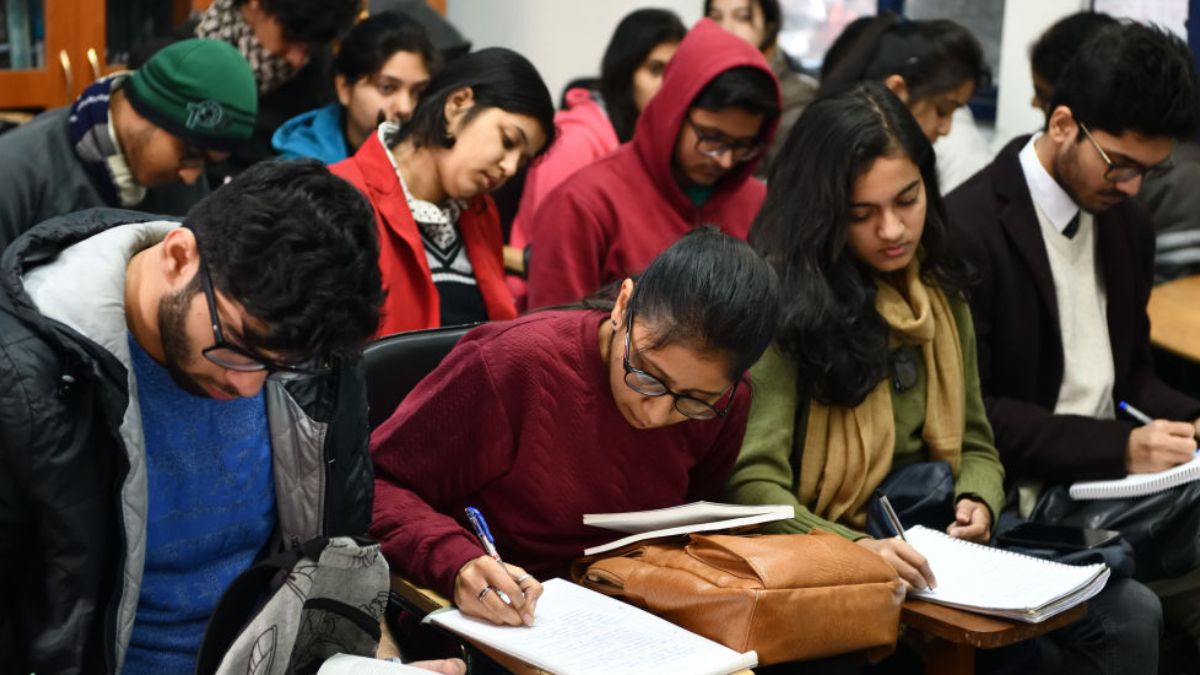
The Union Ministry of Education has released the All India Survey on Higher Education (AISHE) Reports for the year 2022-23 and 2023-24, it has revealed that the total enrolment has touched to all time high of around 4.5 crore students. This latest reports highlight the remarkable progress in the women’s education, STEM enrolment, Gross Enrolment Ratio (GER), and participation from the various category like Scheduled Castes (SC), Scheduled Tribes (ST), and Other Backwards Classes (OBC).
What is the All India Survey on Higher Education (AISHE)?
The All India Survey on Higher Education (AISHE) is the Government of India’s annual survey which collects detailed information from universities, colleges, and standalone higher education institutions all around the country.
It is conducted via a web-based data collection system, this survey gathers gather information on,
- Student Enrolment
- Faculty
- Infrastructure
- Examination Results
- Academic Programs
- Institutional Facilities
It serves as the premier source of the official higher education statistics and it helps policymakers to design reforms, allocate resources, and monitor the performance of the education sector.
Insights from the 2023-24 AISHE Report
Aggregate Enrolment Touches 4.5 Crores
- In the academic year of 2023-24, the overall enrolment in higher education was 4.5 crores.
- This has revealed a rise of 31.5% from the previous data of 3.42 crores of the year 2014-15.
- This can be attributed to the increase in accessibility and demand for higher education in India.
Performance of the GER
- The GER (Gross Enrolment Ratio), which represents the number of people aged between 18-23 years and taking up higher education courses, has shown positive progression.
- The GER in 2023-24 is 30.
- In 2022-23, the GER stood at 29.5.
- In 2014-15, the GER was recorded 23.7.
- The growing GER exemplifies that the youth have begun to pursue college education in larger numbers.
Growth in Female Participation
- The enrollment of women in 2023-24 is 2.24 crores.
- The enrollment of women in 2022-23 is 2.18 crores.
- The enrollment of women in 2014-15 is 1.57 crores.
- This indicates that female enrolment has increased by 42.2% since 2014-15.
- The female GER is 31.2 in 2023-24, which is more than the national average.
Gender Parity Index
- The Gender Parity Index (GPI) which shows the ratio of female and male enrollment is recorded as 1.08 in 2023-24.
- A GPI of more than 1 signifies more women enrollment as compared to men.
- The GPI has remained above 1 for seven years demonstrating the trend of increased female participation.
Enrolment Among the SC, ST, and OBC students
This documents also points to an upsurge in the number of students in the marginalised communities:
Scheduled Castes
- Enrolment in 2023: 69.72 lakh
- Improvement since the year 2014-15: 51.4%
- GER increased from 18.9 (in 2014-15) to 27.8 (in 2023)
Scheduled Tribes
- Enrolment in 2023: 28.83 lakh
- Improvement since the year 2014-15: 75.7%
- GER increased from 13.5 (in 2014-15) to 22.8 (in 2023)
OBC (Other Backwards Classes)
- Enrolment in 2023: 1.80 crore
- Improvement since the year 2014-15: 60.2% (1.13 crore)
- These numbers show that affirmative action measures are working, more institutions including access, and the governmental assistance for the beneficiaries is greater than before.
The rise in STEM education
- STEM enrolment in 2023-24 is 1.02 crore, for the first time, it exceeded the one-crore mark.
- STEM enrolment in 2014-15 was 91.5 lakh.
- This is evidence of increasing interest in the fields of Science, Technology, Engineering, and Mathematics.
Increase of share of women in STEM
- Share of women in STEM enrolment is 44% in 2023-24
- The share of women in STEM education in 2014-15 was 38.4%
- This proves that measures taken for providing gender inclusiveness to a certain extent are yielding results. However, more is still required.
Increase in Faculty Strength
- Total number of faculty in 2023-24 is 17.32 lakh
- Total number of female faculty in 2023-24 is 7.78 lakh
- Total number of female faculty in 2014-15 was 5.69 lakh
- The rise in faculty strength is important for maintaining a favourably low student-teacher ratio.
Importance of AISHE Report
The AISHE Report is not just a simple arrangement of numbers. It provides the essential information for policymakers on the achievements of India’s higher education system and the future transformations.
These information provided serves as a basis for strategising under NEP 2020, which will assists in identifying new areas for investing in education services such as infrastructure, hiring teaching staff, and developing online education processes in terms of NEP 2020 implementation.
The findings of this report indicate the growth of India’s education sector and its achievement of developing an inclusive education system by giving more opportunities for education to women, SC, ST, OBC, and other students from the remote areas of the country.








 Government Unveils 2026-2030 Strategy to...
 Health Ministry to Launch JOSH Teams for...
 PM Modi Completes 25 Years as Head of Go...