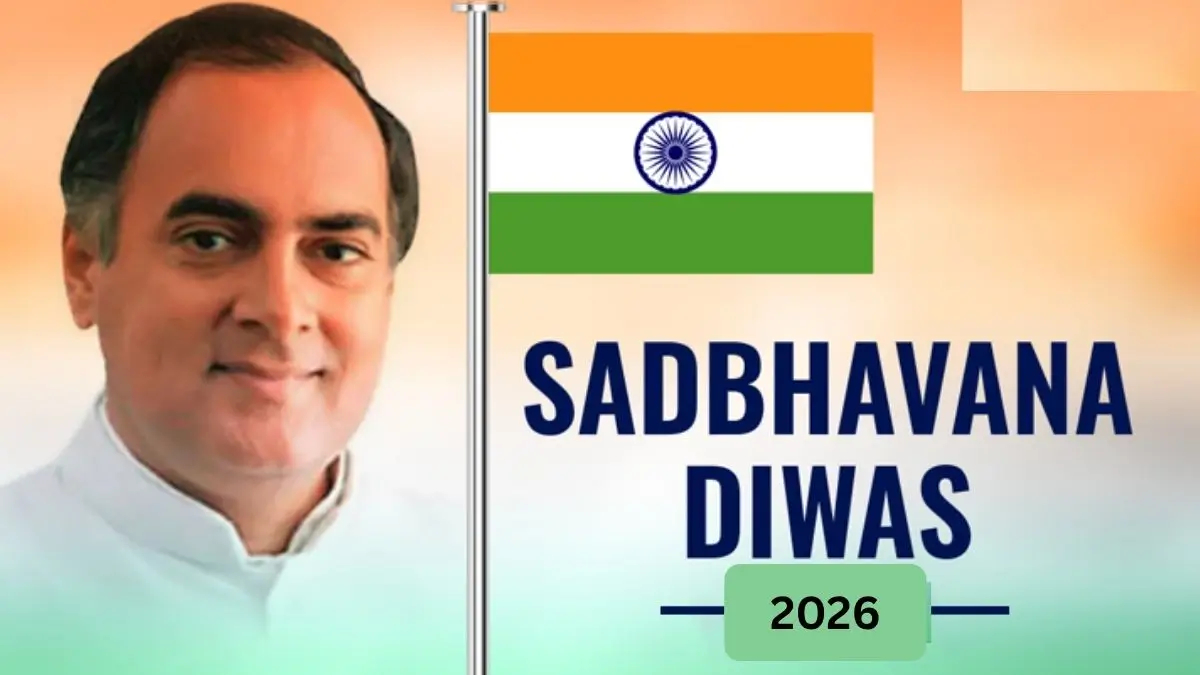
Sadbhavana Diwas is celebrated every year on August 20 in honor of the birthday of former Prime Minister of India, Rajiv Gandhi. The day is linked with the themes of peace, national unity, harmonious relations between members of various religions and communities. At the time of Rajiv Gandhi’s rise to the position of Prime Minister, the country was going through a tough phase in its history. Following the death of his mother and former Prime Minister, Indira Gandhi, assassinated on October 31, 1984, Rajiv Gandhi came to power as Prime Minister when he was only 40 years old, making him the youngest Prime Minister of India.
Why Is Sadbhavana Diwas Celebrated on August 20?
August 20 is chosen to celebrate the birthday of Rajiv Gandhi, who was born on August 20, 1944.
The meaning of the word “Sadbhavana” is translated as goodwill, harmony, and mutual understanding.
How Did Rajiv Gandhi Become Prime Minister of India?
Initially, Rajiv Gandhi was not a politician. He began his professional career as a pilot. Although his brother was more engaged in politics than him, after the death of his younger brother in 1980, Rajiv became more politically active.
Rajiv Gandhi became involved in politics and joined the Lok Sabha. In October 1984, his political career underwent drastic changes.
On October 31, 1984, the Prime Minister of India Indira Gandhi was assassinated by her own Sikh bodyguards. This led to a serious political and social crisis.
After his assassination, Rajiv Gandhi was appointed Prime Minister on the same day. Becoming India’s Prime Minister at the age of 40, he was its youngest Prime Minister.
The next general election was held in December 1984. The Congress Party won a landslide victory, obtaining 404 seats in the Lok Sabha during the elections.
Rajiv Gandhi’s Contribution to Science and Technology
Key Technology Initiatives
| Sector | Initiative | Major Significance |
| Computing | Computer Policy, 1984 | Encouraged computerisation and improved access to technology |
| Software | Software Policy, 1986 | Helped establish software as an important industry |
| Telecom | C-DOT, MTNL and VSNL | Expanded telecommunications and indigenous technology |
| Supercomputing | C-DAC, 1988 | Advanced India’s capabilities in high-performance computing |
| Rural Connectivity | PCO expansion | Increased public access to telephone services |
| Public Welfare | National Technology Missions | Applied technology to water, literacy, health and agriculture |
Education and Democratic Reforms
Apart from technology, Rajiv Gandhi left behind another important contribution to the country. He implemented the National Policy on Education in 1986, which focused on making education modern and accessible.
The second big constitutional reform came through the 61st Constitutional Amendment Act, 1988, when the voting age was lowered to 18 years. The move helped make youth vote in Indian elections.
The third important act was the 52nd Constitutional Amendment Act, 1985, otherwise known as the anti-defection law.








 Ashfaqullah Khan Birth Anniversary 2026:...
 World Iodine Deficiency Day 2026: Causes...
 Police Commemoration Day 2026: History, ...