
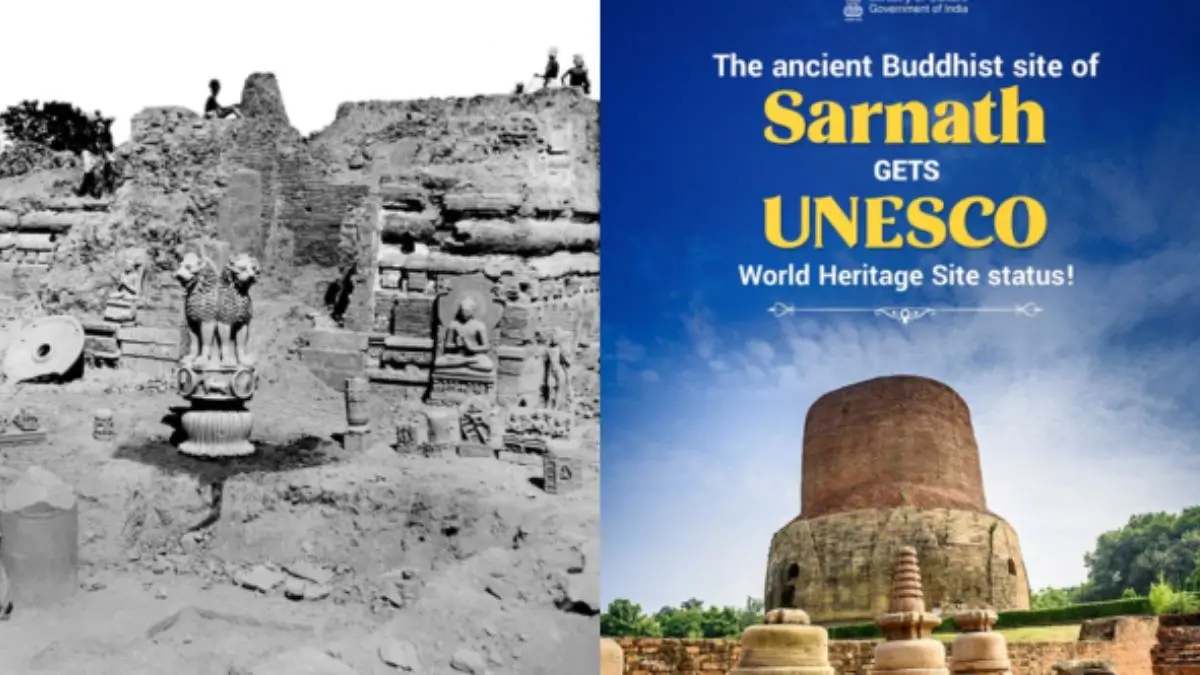
Sarnath, an ancient Buddhist site located in Uttar Pradesh, made it to the UNESCO World Heritage List on July 25th, 2026, at the 48th Session of the World Heritage Committee which took place in Busan, South Korea. With this Sarnath is the 45th UNESCO World Heritage Site from India while also emphasizing its significance in terms of history, religion, and culture. It is widely known as the place where Gautama Buddha gave his first sermon after attaining enlightenment, Sarnath has been symbolic of peace, wisdom, and spirituality for a span of 2500 years. This inscription adds to the rich heritage of India and adds even more significance to worldwide efforts to protect one of the holiest pilgrimage sites of Buddhism.
Sarnath Announced As World Heritage Site
The World Heritage Committee during its 48th meeting convened in Busan, Republic of Korea decided to inscribe Sarnath, Ancient Buddhist Site, on the United Nations Educational, Scientific, and Cultural Organization’s World Heritage List.
Thus,
- Now India has 45 World Heritage Sites.
- Sarnath is on the list of the places with Outstanding Universal Value.
- The inscription acknowledges Sarnath’s contribution to the history, culture, and religion of the world.
The UNESCO decision demonstrates the its efforts in protecting places of cultural heritage which belong to the whole mankind
What Makes Sarnath Significant?
The significance of Sarnath lies in its distinguished place in history regarding Buddhism.
Sarnath is where Gautama Buddha delivered his first sermon (Dhammacakkappavattana Sutta) after gaining enlightenment in Bodh Gaya in the sixth century before the beginning of the Common Era.
The significance of this event lies in the following,
- The beginning of the propagation of Buddhism.
- Establishment of Buddhist monastery (the Sangha).
- Basis of the Buddhist doctrine.
This is what makes Sarnath the fourth holiest Buddhist place after Lumbini, Bodh Gaya, and Kushinagar.
Sarnath’s Historic Monuments
Centuries of transformation have seen kings, monks, and followers of Buddhism turn the city of Sarnath into a notable center of Buddhist scholarship.
The important monuments in the city include the following the,
Dhamek Stupa
Dhamek Stupa is the most well-known monument in Sarnath. The large cylindrical stupa was built at the location where the Buddha reportedly gave his first sermon, with elaborate stone carvings. It attracts thousands of visitors every year.
Dharmarajika Stupa
Currently in ruins, Dharmarajika Stupa is one of the oldest stupas in Buddhism and has traditionally been associated with Emperor Ashoka, who played an important role in the spread of Buddhism.
Chaukhandi Stupa
The Chaukhandi Stupa commemorates the event of the Buddha meeting with his first disciples prior to giving his first sermon. It marked a key incident in the history of Buddhism.
These monuments represent what is known as the Deer Park (Mrigadava), the place where Buddhism began its journey as a world religion.
UNESCO’s Recognition and Outstanding Universal Value
UNESCO has considered Sarnath as the noteworthy and deserving to be on the list due to the following reasons,
- Sarnath’s association with one of the major religions.
- Its continuous importance for more than two millennia.
- Presence of the ancient and substantial artifacts honoring the Buddhist religion.
- Effect on philosophy, education, and pilgrimage throughout Asia.
- Bright future as the site will receive due attention and protection through UNESCO recognition.
UNESCO’s Message About the International Value of Sarnath
After receiving the inscription, Tim Curtis, Director of the UNESCO International Bureau of South Asia, congratulated India and pointed out that Sarnath has been inspiring many Buddhist monks for two thousand years.
He observed that the temples, monasteries, and stupas of Sarnath are the imprints of kindness, intelligence, faith, and shared human heritage.
UNESCO also underlined the fact that the responsibility of safeguarding the site belongs to the current and future generations.








 PM-VBRY Scheme: EPFO Offers Up to ₹15,...
 Global Hunger Index 2026: India Ranks 10...
 Sudhakar Dalela Appointed as India’s N...










