
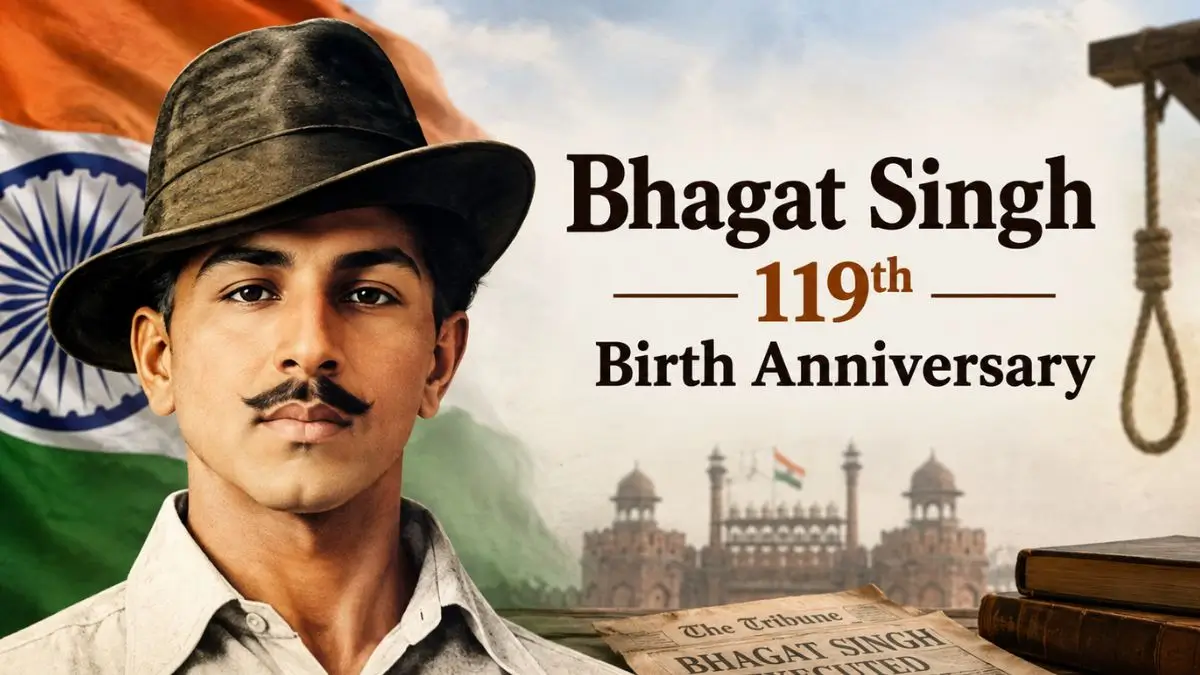
Bhagat Singh 119th Birth Anniversary 2026 is to observed on 28 September 2026. Born on 28 September 1907 in Banga, Lyallpur district, Punjab Province of British India (now Pakistan), Bhagat Singh emerged to be one of the greatest revolutionaries in the Indian independence movement. Bhagat Singh’s affiliation with Hindustan Socialist Republican Association (HSRA), political articles, and involvement in revolutionary work and his execution in 1931 will all be significant elements of modern Indian history.
Early Years and Political Incentives
Bhagat Singh came from a family that was involved in nationalism. His father, Kishan Singh and uncles, Ajit Singh and Swaran Singh were people who were part of the freedom movement. The 1919 Jallianwala Bagh massacre greatly affected his political stance.
He attended the Dayanand Anglo-Vedic School in Lahore and subsequently enrolled in National College in Lahore, which was linked with Lala Lajpat Rai. Besides his academic subjects, he was interested in many other things such as history, politics, economics, and revolutionary literature.
Bhagat Singh and the Revolutionary Movement
Bhagat Singh was a part of revolutionary groups and he was involved in the process of changing the name of Hindustan Republican Association to Hindustan Socialist Republican Association. HSRA was formed in the year 1928 in the assembly of revolutionaries in Feroz Shah Kotla in Delhi.
Following the death of Lala Lajpat Rai due to the injuries he suffered when he was lathied by the police during demonstrations against the Simon Commission, Bhagat Singh and his fellow members decided to attack the responsible policeman. On 17 December 1928, Bhagat Singh, Shivaram Rajguru, and their associates killed J.P. Saunders, the Lahore policeman, under an identity mistake.
Bombing of the Central Legislative Assembly
Singh and Dutt hurled bombs in the Central Legislative Assembly in Delhi during the discussion of the Public Safety Bill on 8 April 1929. According to historical accounts, this was a political statement against the legislative process carried out by the British in India. The revolutionaries did not escape from the crime spot and were arrested there.
Singh and Dutt used the court cases and the period of imprisonment to express their political stance. Singh also joined a hunger strike as a prisoner demanding better conditions and special status for political prisoners.
Political Thought and Writings
Apart from opposition to colonial rule, the political thought of Bhagat Singh evolved and included ideas about socialism, equality, secularism, and the problem of exploitation.
One of his most famous works is “Why I am an Atheist.” It is dated 1930–31 and written when he was incarcerated in Lahore Central Jail. This work contains his explanations regarding religion, faith and atheism.
The slogan “Inquilab Zindabad” became synonymous with Bhagat Singh. The slogan means “Long Live the Revolution.”
Execution and Legacy
Bhagat Singh was awarded capital punishment in the Lahore Conspiracy Case and was hanged with his co-conspirators Shivaram Rajguru and Sukhdev Thapar on 23 March 1931 in Lahore. He was 23 years old at the time.
The execution of Bhagat Singh resulted in the public reaction. The contemporaneous writings of Jawaharlal Nehru documented the emotional outburst after his execution while also underscoring the distinction between non-violent approach of the Congress and the revolutionary way of Bhagat Singh and his comrades.








 Dussehra 2026: Date, History, Significan...
 International Day for the Eradication of...
 World Food Day 2026: Theme, History, Sig...










