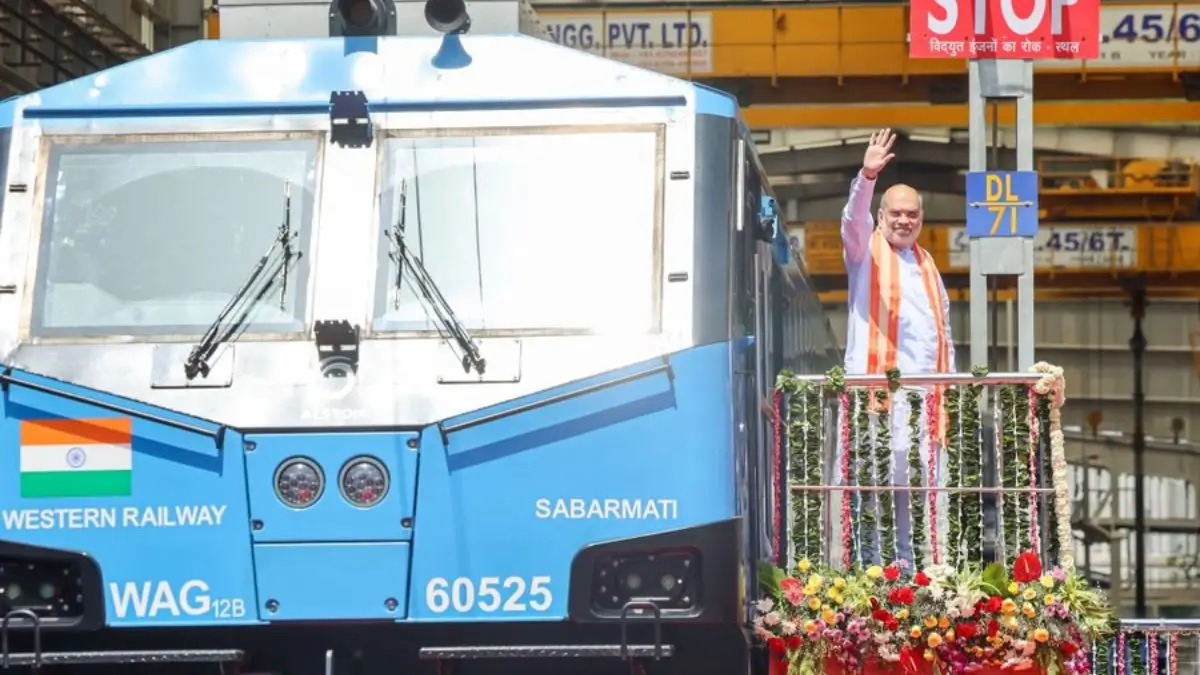
India’s first LNG-powered train flagged off from Sabarmati Railway Station in the Ahmedabad, Gujarat, on September 27th 2026, by Respecatble Union Home and Cooperation Minister Amit Shah. This venture seeks to utilize LNG as an alternative fuel source in the operations of railways through the adoption of a dual-fuel LNG-diesel model. As per the government, the idea behind this project is to reduce diesel consumption, save on fuel costs, and facilitate cleaner railway operations.
How Dual-Fuel LNG-Diesel Train Operates
This train is not fueled by LNG alone. The Driving Power Cars (DPCs) in this train have been modified to run on both LNG and diesel.
In essence, the process enables the engine to alternate fuel usage based on availability. LNG can substitute diesel usage by up to 40%, while the dual-fuel setup ensures that the train runs even in cases of unavailability of LNG. The modified system still maintains the capacity of the conventional diesel engine.
Conversion of Two 1,400 HP Driving Power Cars
This particular conversion project is about two Driving Power Cars, each one having 1,400 HP power, which have been converted for LNG-diesel dual fuel operations.
A total distance of more than 2,000 kilometers has been covered during the field trials conducted prior to the introduction of the technology. The first LNG-diesel DEMU train has reportedly been running on Sabarmati to Mahesana junction.
Key Details
- Fuel System: LNG + diesel dual fuel
- Number of the converted DPCs: 2
- Power of the each DPC: 1,400 HP
- Diesel reduction: Around 40%
- Field trials of Train: More than 2,000 kilometers
- Capacity of LNG tanks: Approximately 2,200 liters per DPC
- Quantity of LNG in usable form: Around 950-1,000 kg per tank
- Distance covered reportedly: Approximately 444 kilometers per day with the full tanks
Fuel Saving and Environmental Impact
Diesel consumption and costs of fuel will be lowered through the conversion to LNG. Annual savings of about ₹11.9 lakh per DPC are estimated by Indian Railways. The estimated savings annually for a rake of eight coaches would be about ₹23.9 lakh.
Moreover, it is expected to lower the emission associated with diesel engine running. Emission of CO₂, NOx, and PM are going to be reduced through the project. Therefore, the initiative can be considered a part of the efforts of Indian Railways towards exploring alternative fuels.
LNG at Indian Railways: Static Connection
LNG means Liquefied Natural Gas. Liquefied natural gas is a form of natural gas that has been cooled to the temperature of approximately −162°C and turned into liquid.
LNG must not be confused with CNG (Compressed Natural Gas). While CNG is the form of natural gas that is under high pressure, LNG is liquefied natural gas.
Dual-fuel technology using CNG and LNG had been applied before by Indian Railways. Official data of Indian Railways mention previous conversion of Diesel Power Cars.
LNG Train and India’s Alternative Fuel Railway Initiative
The LNG train is part of an overall Indian Railways drive to harness alternative energy technology. Indian Railways launched its first hydrogen fuel cell train in July 2026 as yet another way to reduce its reliance on traditional fossil fuel.
The LNG train is different from a hydrogen fuel cell train in that the former uses natural gas as a dual-fuel internal combustion engine, while the latter creates its own electricity with hydrogen fuel cells onboard.






 PM-VBRY Scheme: EPFO Offers Up to ₹15,...
 Global Hunger Index 2026: India Ranks 10...
 Sudhakar Dalela Appointed as India’s N...