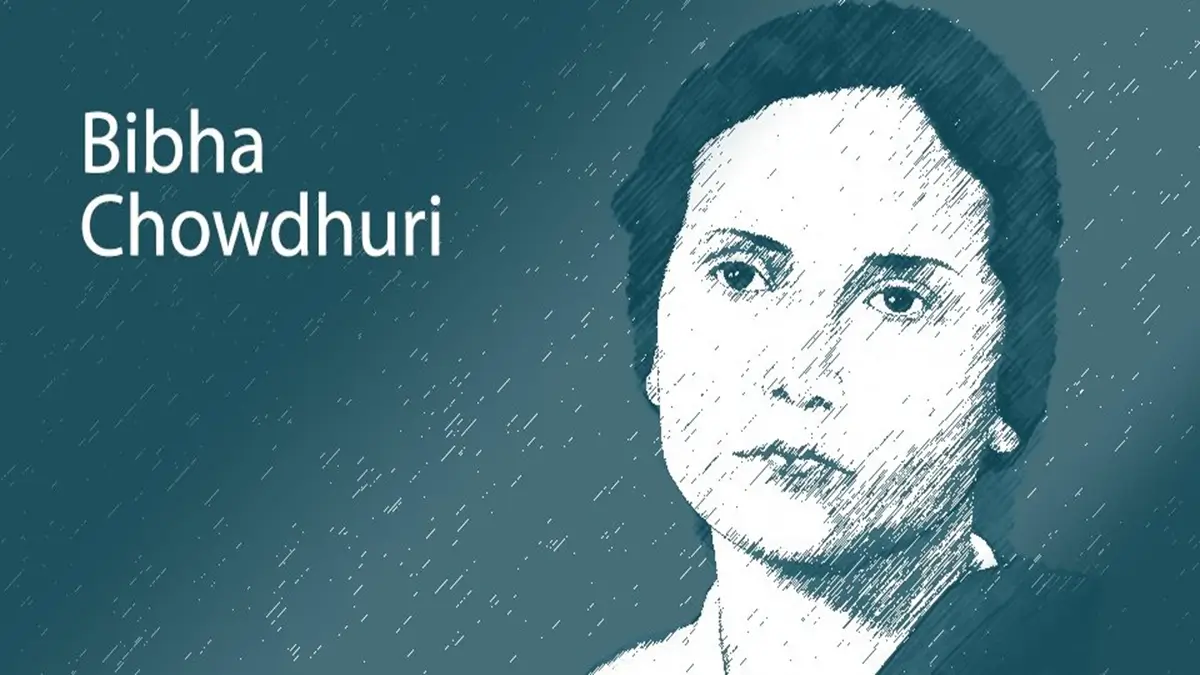
When the history of modern physics is discussed, names like Einstein, Oppenheimer and Marie Curie often dominate the conversation. Yet hidden within the story of twentieth-century science are pioneers whose work shaped the field but remained far less recognised.
One such scientist was Bibha Chowdhuri—an Indian physicist whose research contributed to the early understanding of subatomic particles and helped expand India’s scientific presence during a period when women were rarely seen in advanced scientific research.
Her story is not only about scientific achievement. It is also about persistence, intellectual excellence and recognition that arrived much later than it should have.
Who Was Bibha Chowdhuri?
Bibha Chowdhuri was an Indian physicist known for her work in particle physics and cosmic ray research. She is remembered as one of India’s earliest women physicists to contribute to experimental high-energy physics during the twentieth century.
Her research became associated with the study of cosmic rays—high-energy particles arriving from outer space—which played a major role in understanding the structure of matter before modern particle accelerators became widely available. Although her name remained less known for decades, recent historical attention has highlighted the importance of her scientific work.
Early Life and Education
Bibha Chowdhuri was born on 3 February 1913 in Kolkata (then Calcutta). She grew up during a period when opportunities for women in higher education and scientific research were limited. Despite those challenges, she pursued science and developed a strong interest in physics.
She completed her higher studies at the University of Calcutta, one of India’s leading academic institutions of that era. Her academic performance and scientific curiosity eventually led her toward research.
Beginning Her Scientific Career
Bibha Chowdhuri entered scientific research at a time when physics was undergoing major global transformation. Quantum mechanics, nuclear science and particle discoveries were changing how scientists understood the universe.
She worked under the guidance of renowned Indian physicist Debendra Mohan Bose, a respected researcher in experimental physics. Together, they began studying cosmic rays, which became one of the most important research areas of that period.
Bibha Chowdhuri’s Contribution to Particle Physics
Bibha Chowdhuri is most widely remembered for research connected to the early observation of a particle later understood to be associated with the meson family of particles.
During the 1930s and 1940s, scientists across the world were trying to understand unknown particles appearing in cosmic ray experiments. Using photographic detection methods, Bibha Chowdhuri and her collaborators recorded evidence that later gained historical significance in particle physics.
Historians of science have argued that her observations came remarkably close to identifying particles that became central to later discoveries. Although recognition at the time remained limited, her work became increasingly appreciated in later scientific discussions.
Work Beyond India and Scientific Collaborations
Bibha Chowdhuri later continued scientific work beyond India and became associated with international research environments. She worked in Europe and participated in scientific communities that were helping shape post-war physics.
Her international academic exposure reflected the growing contribution of Indian scientists to global scientific progress. At a time when opportunities for women scientists remained extremely limited, her presence itself represented an important milestone.
Challenges Faced as a Woman Scientist
Bibha Chowdhuri built her scientific career in an era when women often had fewer opportunities, less visibility and limited institutional support. Recognition in science frequently favoured established institutions and senior researchers.
As a result, many early contributions by women remained underrepresented in historical records. Her story highlights an important question in science:
How many pioneering contributions remain unnoticed simply because history remembered only a few names?
Why Bibha Chowdhuri Matters Today
Interest in Bibha Chowdhuri has grown in recent years because researchers and historians have revisited overlooked scientific contributions.
Her journey matters for several reasons:
- She was among India’s early women physicists
- She contributed to particle and cosmic ray research
- She represented Indian scientific excellence internationally
- Her story highlights overlooked contributions in science
Today, she is increasingly recognised as an important figure in the history of Indian physics.
Legacy of Bibha Chowdhuri
Bibha Chowdhuri’s legacy goes beyond laboratories and scientific papers. She represents a generation of Indian scientists who pursued discovery despite limited resources and recognition.
Her story reminds us that scientific progress is often built by many contributors—not only those whose names become famous. As more historical research brings forgotten pioneers into the spotlight, Bibha Chowdhuri’s place in the story of modern physics continues to grow.








 Guava Capital of India: Which Place Is K...
 7 Most Beautiful Train Stations in the W...
 World Architecture Day 2026: 8 Clever Fe...