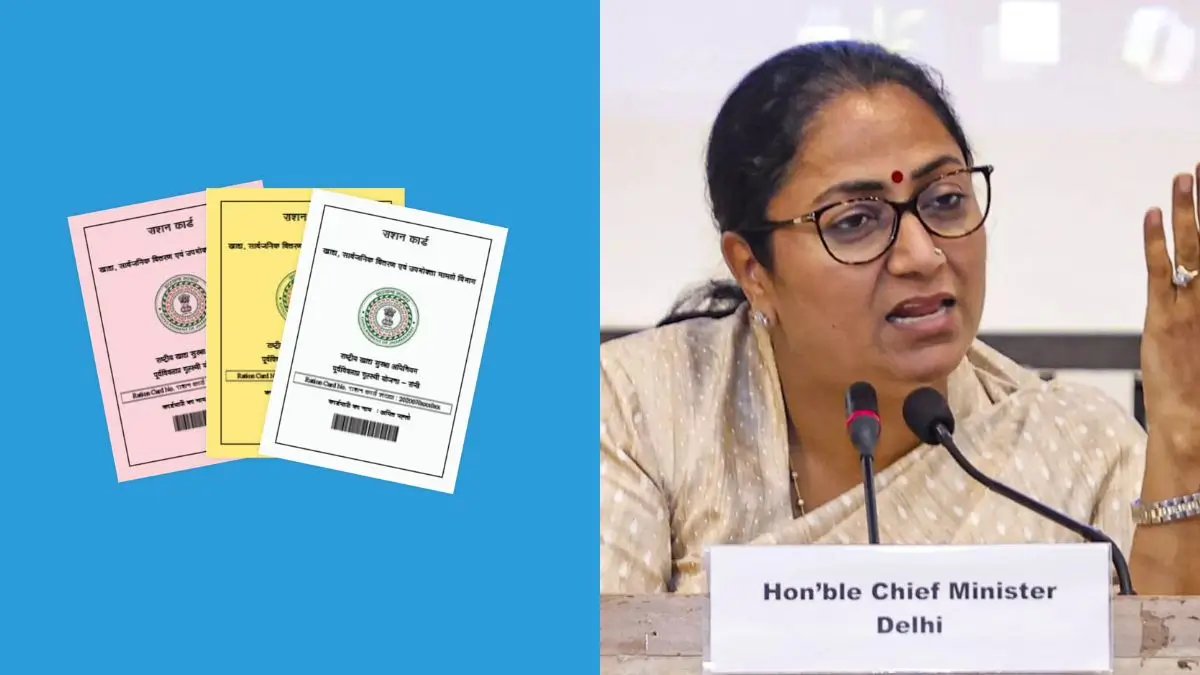
The state government of Delhi has announced plans to increase the annual income eligibility limit for ration cards from ₹1.2 lakh to ₹2.5 lakh. At the same time, the government has cancelled 7.72 lakh ration cards as part of the large verification exercise.
Delhi Plans to Raise Ration Card Income Eligibility
Currently, residents of Delhi with annual income above ₹1.2 lakh are not eligible for a ration card.
The government now plans to increase this threshold limit to ₹2.5 lakh per year.
This is important jump and could allow the many lower middle income households to become eligible for subsidized food benefits.
The proposal also reflects the changing economic realities including the inflation and rising urban living costs.
Why the Income Limit Is Being Increased
The earlier income cap had remained relatively low as compared to current household expenses in Delhi.
Over the years, the cost of essentials such as rent, transport, food, education and healthcare has increased sharply.
The families who are earning slightly above ₹1.2 lakh annually often still face financial pressure in the national capital.
With increasing the eligibility threshold, the government appears to be widening welfare access for the genuinely needy households.
7.72 Lakh Ration Cards Cancelled in Major Verification Drive
Alongside expanding the eligibility, the government has removed the massive number of existing ration cards.
Around 7.72 lakh cards have reportedly been cancelled.
This also suggests that a large scale verification and clean-up of the beneficiary database.
Such cancellations usually happen due to reasons like the,
- Duplicate entries
- Ineligible beneficiaries
- Incorrect documentation
- Migration or inactive beneficiaries
- Aadhaar or verification mismatches
The move indicates an effort to improve the transparency in welfare distribution.
What Is a Ration Card and Why It Matters?
A ration card is a key welfare document under the India’s Public Distribution System (PDS).
It allows the eligible households to access to the subsidized food grains and essential commodities.
Depending on category, beneficiaries may receive the,
- Rice
- Wheat
- Sugar
- Other subsidized essentials
For many low-income households, ration support plays the important role in monthly budgeting.








 Lakshadweep Becomes India’s First 100%...
 Ayodhya Ram Temple Receives FSSAI’s â€...
 Ambaji Mohanthal Gets GI Tag: Gujarat’...