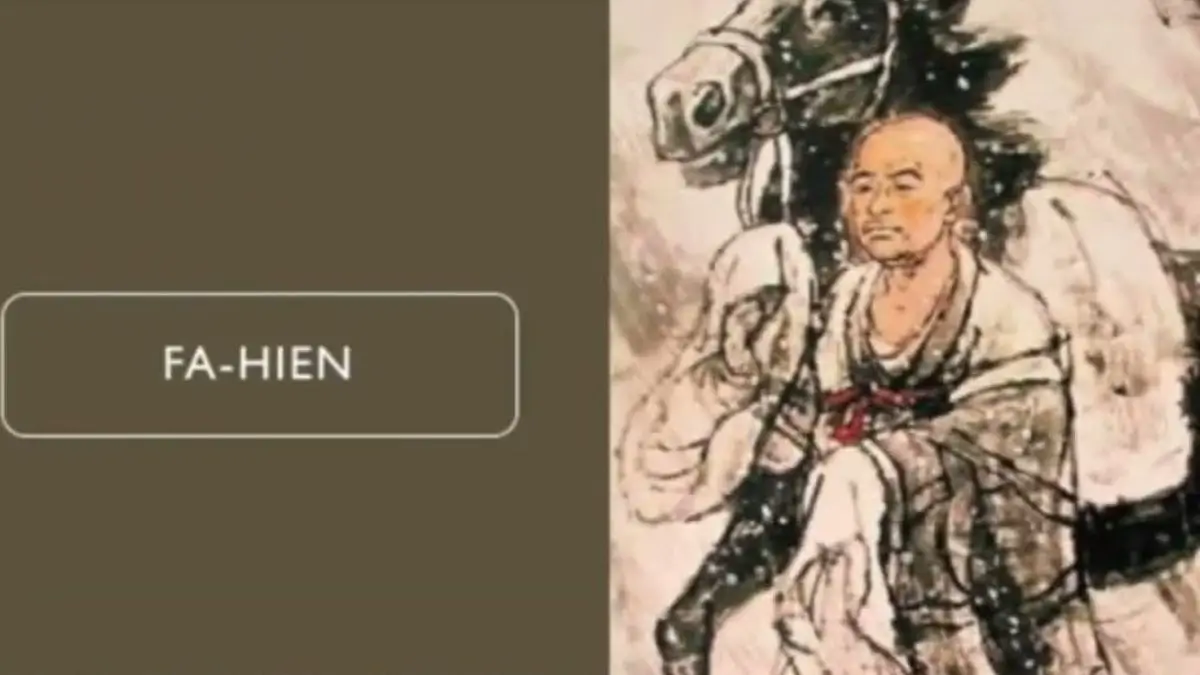
The Gupta Empire of the Ancient India is often called as the “Golden Age of India” because of the its remarkable achievements in art, literature, science, and governance. One of the important sources of this information about this period comes from the Chinese Buddhist monk who named Fa-Hien (Faxian), who traveled thousands of kilometers to visit the India.
There is a common history and general knowledge question is: Fa-Hien visited India during the reign of the which Gupta ruler?
The answer is Chandragupta II (Vikramaditya), who was one of the greatest emperors of the Gupta Dynasty. His travel accounts provides the valuable insights into the India’s society, religion and administration during the 5th century CE.
Fa-Hien Visited India During the Reign of Which Gupta Ruler?
Fa-Hien has visited the India during the reign of the Chandragupta II, who ruled the Gupta Empire from approximately 375 CE to 414 CE.
He arrived in India around the 404 CE and he spent several years traveling across the different regions of the Indian subcontinent.
His journey also coincided with a period of prosperity, political stability and cultural growth under Chandragupta II and making his observations an important historical source for the understanding ancient India.
Who Was Fa-Hien?
Fa-Hien who is also known as Faxian, was a Chinese Buddhist monk born around the 337 CE. He was deeply devoted to the Buddhism and he sought to gather authentic Buddhist texts and learn more about the religion’s origins.
He was driven by his religious mission, Fa-Hien embarked on the challenging journey from Chang’an (modern-day Xi’an in China).
He also crossed deserts, mountains and Central Asian regions before he finally reached to India.
His travels were not merely pilgrimages but they were scholarly expeditions which were aimed at to preserving and understanding Buddhist teachings.
Why Did Fa-Hien Come to India?
His main purpose of the visit was to collect the original Buddhist scriptures and traditions. At that time, many Buddhist texts available in the China were incomplete or inaccurately translated.
During his stay in India, he had,
- Collected the authentic Buddhist manuscripts.
- Visited sacred Buddhist pilgrimage sites.
- Studied the Vinaya Pitaka, which contains monastic rules.
- Learned the Sanskrit to better understand Buddhist literature.
- Interacted with monks and scholars from renowned Buddhist centers.
His dedication also helped to preserve the important Buddhist texts and facilitated the spread of the Buddhist knowledge across East Asia.
Places Visited by Fa-Hien in India
Fa-Hien has traveled extensively throughout the Indian subcontinent. His journey included the visits to several major religious and cultural centers.
Some of the important places he visited were,
- Peshawar
- Taxila
- Mathura
- Kannauj
- Sravasti
- Kapilavastu
- Sarnath
- Pataliputra (modern-day Patna)
He spent nearly three years in the Pataliputra studying Sanskrit and collecting manuscripts. At that time, this city remained as the important center of the learning and administration.
Who Was Chandragupta II?
Chandragupta II who was also known as the Vikramaditya, was among the most celebrated rulers of the Gupta Dynasty. He succeeded the renowned emperor Samudragupta and he expanded the Gupta empire’s influence across the northern and western India.
His reign is remembered for the,
Military Successes
Chandragupta II defeated the Shaka rulers of the western India and he strengthened the Gupta control over the important trade routes and coastal regions.
Cultural Advancement
He was a great patron of the art, literature, and scholarship. His court is traditionally associated with the famous Navaratnas (Nine Gems), it was a group of distinguished scholars and intellectuals.
Support for Learning
The emperor also encouraged the education, religious tolerance and intellectual pursuits and helped to create an environment where the literature and science flourished.
Fa-Hien’s Account of India
After returning to the China, Fa-Hien wrote a travelogue which titled as “Fo-Kwo-Ki” (Record of Buddhist Kingdoms). This work remains as one of the most valuable historical records of the Gupta-era India.
His writings describes the,
- Social life and customs.
- Religious practices.
- Buddhist monasteries and institutions.








 Guava Capital of India: Which Place Is K...
 7 Most Beautiful Train Stations in the W...
 World Architecture Day 2026: 8 Clever Fe...