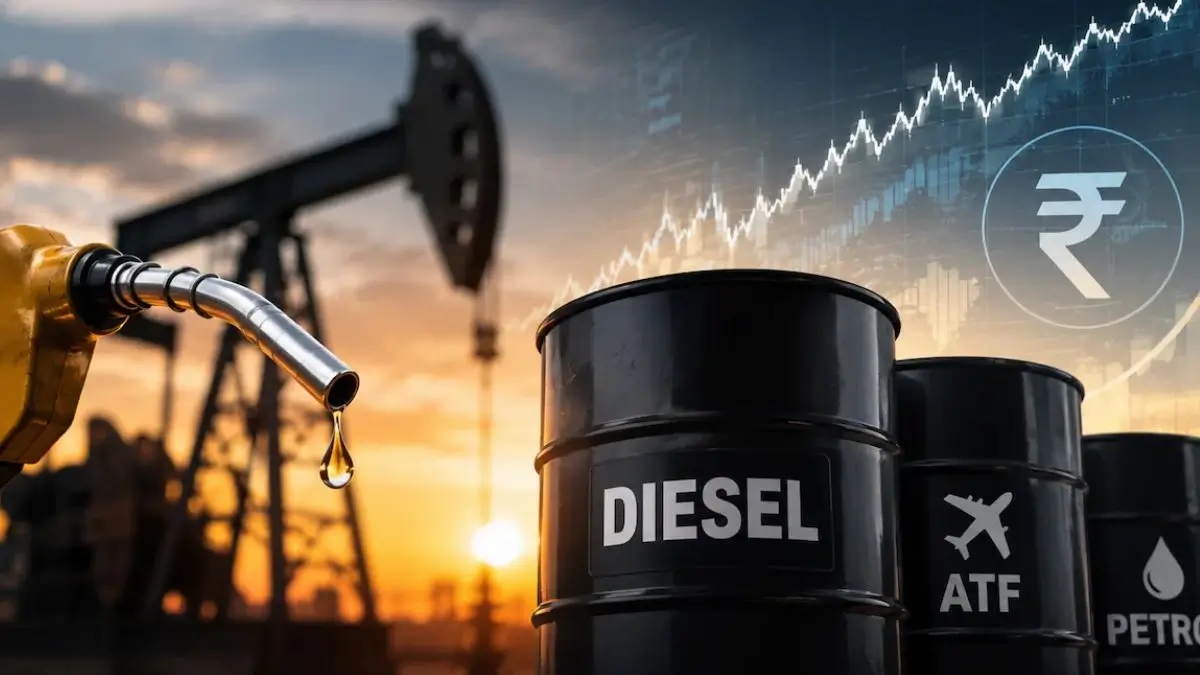
The Special Additional Excise Duty (SAED),which is popularly known as the windfall tax on exports of petroleum products, has been modified by the Government of India and is now effective from the start of the fortnight commencing from July 16, 2026. An announcement released by the Ministry of Finance states the imposition of a higher export duty on diesel and ATF exports, while at the same time, the levy has been reduced on petrol. The purpose of this decision is to maintain adequate fuel supply in the country and deter unwarranted exports due to the ongoing conflict in the West Asian region that has kept the prices of oil high across the world.
What Are the Revised Windfall Tax Rates?
The government has made the following changes to the Special Additional Excise Duty (SAED) which will be effective from July 16, 2026
| Petroleum Product | Old SAED | New SAED |
| Diesel (Exports) | ₹8.5 per litre | ₹15.5 per litre |
| Aviation Turbine Fuel (ATF) | Exports ₹7.5 per litre | ₹14.5 per litre |
| Petrol (Exports) | ₹4 per litre | ₹2.5 per litre |
The Revised rates will stay in place until the next fortnightly review by the government.
What is the Windfall Tax?
The Windfall Tax is also known as Special Additional Excise Duty (SAED) and it is a tax that is imposed on the export of petroleum products when the price of crude oil in the global market rises tremendously.
The tax is meant to have the following objectives,
- Ensuring that there is enough fuel supply domestically.
- Discouragement of exports at times when prices in the international market are high.
- Ensuring that exporters do not make huge profits due to the difference in the domestic prices of crude oil and the international price.
- Ensuring stability in the fuel availability in the domestic market.
These tax rates are reviewed and changed by the government every 15 days based on the fluctuations in global oil prices and market conditions.
Government’s Reason for Changing Tax
The change has occurred in the context of the ongoing geopolitical tensions in West Asia that introduced fluctuation in the global oil market.
The revised duties have been placed in order to,
- Safeguard domestic energy resources.
- Take action against excessive exports amid the high prices.
- Prevent windfall revenues for energy exporters.
- Preserve the current state of the energy industry in the country.
The changes represent the government’s ongoing attempts to strike the balance between exporting oil and ensuring the country’s energy security.
Background: Why was the Windfall Tax Introduced?
The introduction of the export duty on petroleum products was the immediate response of India to soaring oil prices.
As the Finance Ministry has stated,
- The export duty was introduced on March 27, 2026 for diesel and ATF.
- Since then, the duty rates were modified on a regular basis.
- On May 16, 2026, the duty was introduced for petrol as well.
The tax has been imposed to reduce exports at the times of price and supply uncertainty on the world oil market.
No Alteration in Domestic Fuel Duty
Though the rates for export duties were modified, the authorities made it clear that:
There is no change in excise duty applicable to petrol and diesel used for domestic purposes.
This suggests that the users, purchasing petrol or diesel in India, will not be directly affected by the recent amendment concerning SAED.
The amended duty concerns the petroleum products exported from India.
Effects of the Revised Windfall Tax
The recent amendment is expected to change a lot in the governing energy sector.
Guarantees Domestic Fuel Supply
The increased export duty will not encourage too many exports, thus enabling a sufficient amount of fuel in the country.
Limits Windfall Profits
This tax will limit the extraordinary gains obtained by exporters in the times of high fuel prices.
Assures Energy Security
This program will help India to provide for the energy needs of the country in times of geopolitical issues.
Decreases Export Incentives for Diesel and ATF
The increased tax on export is likely to make the export of diesel and aviation fuel less profitable.
Promotes Balanced Market Conditions
The lower rate of taxation applied to petrol exports is evidence of the government’s well-thought control over market.








 World Bank Raises India’s GDP Growth F...
 Centre to Borrow ₹7.86 Trillion Throug...
 India Records Record FDI of $94.53 Billi...