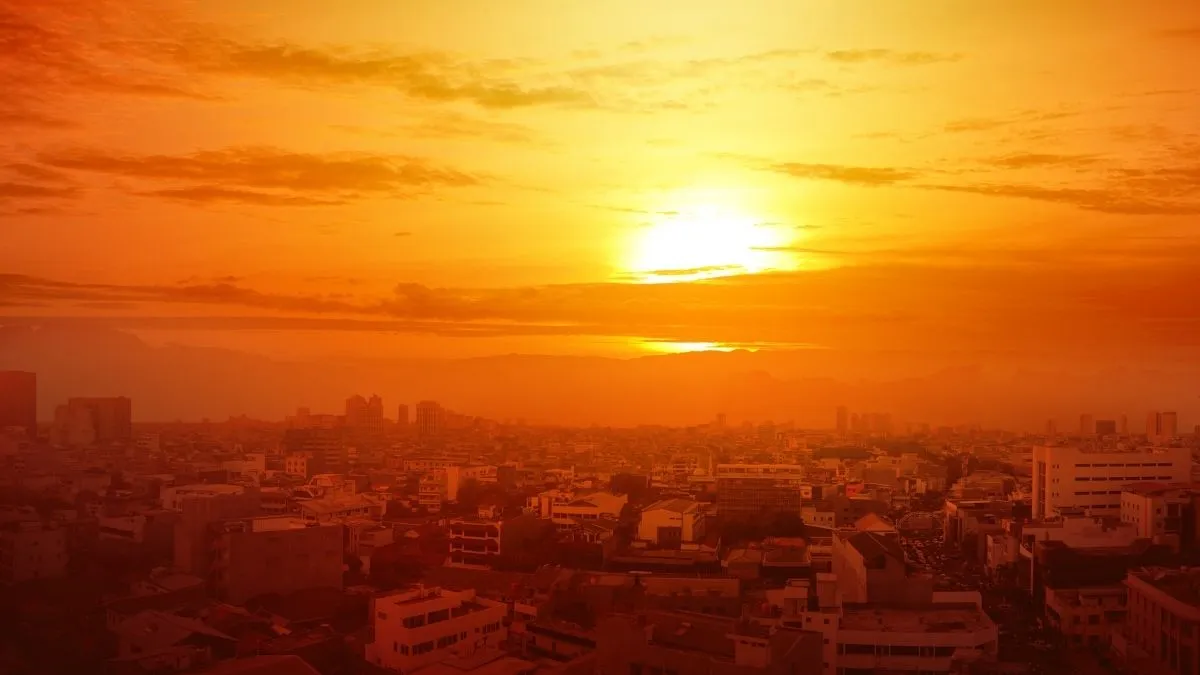
Trying to get a peaceful night’s sleep has become increasingly difficult across urban India lately. Even after midnight, many cities continue to feel wrapped in a blanket of hot air, offering little relief from the intense daytime heat.
According to recent weather observations, several Indian cities have recorded unusually high minimum night temperatures, with readings crossing 33°C in some areas. While Indians are familiar with scorching summer afternoons, meteorologists say this persistent heat, even after sunset, is linked to a phenomenon known as a heat dome.
Simply put, a heat dome traps hot air near the Earth’s surface, preventing the natural cooling that usually happens at night. This is why many cities are experiencing uncomfortable and unusually warm nights.
But what exactly is a heat dome, and why is it affecting Indian weather even after dark? Let’s understand.
What is a Heat Dome?
A heat dome is a weather phenomenon where a strong high-pressure system settles over a region and traps heat close to the ground.
Think of it as an invisible lid placed over the atmosphere.
Normally, warm air rises and escapes upward. But under a heat dome, that rising air gets pushed back toward the surface, causing temperatures to rise further and remain elevated for longer periods.
How Does a Heat Dome Work?
A heat dome develops through an intense cycle of atmospheric pressure and heat accumulation:
- Changes in global air circulation allow a strong high-pressure system to settle over a region.
- During the day, heated air naturally rises upward through convection.
- Under a heat dome, the pressure system acts like a cap, preventing the hot air from escaping.
- The trapped air sinks back downward.
- As the air compresses, it becomes even hotter, further increasing surface temperatures.
This process creates prolonged periods of intense heat that can continue through both day and night.
Why Nights Are No Longer Cooling Down
Under normal conditions, the Earth releases accumulated daytime heat back into the atmosphere after sunset. This natural process lowers nighttime temperatures.
However, when a heat dome develops:
- The trapped hot air remains near the surface.
- Heat cannot escape efficiently.
- Even late at night, temperatures remain unusually high.
As a result, nights feel nearly as uncomfortable as daytime.
Why Indian Cities Are Facing Warm Night Warnings
Although heat domes form high above the atmosphere, their effects become stronger in urban environments.
1. Urban Heat Island Effect
Cities are filled with materials like concrete, asphalt, steel, and glass.
These surfaces absorb large amounts of heat during the day and slowly release it at night, keeping surrounding temperatures elevated.
2. High Humidity Levels
Coastal and river-basin cities experience an additional challenge.
Moisture trapped under the high-pressure system combines with heat, increasing humidity levels. Since sweat evaporates less efficiently in humid conditions, temperatures feel much hotter than actual readings.
For example, a 34°C night may feel closer to 40°C because of humidity.
3. Changing Climate Patterns
Scientists also point toward global warming and climate change as factors contributing to more frequent and prolonged heat events.
Heat domes are gradually becoming less rare and more common during summer seasons.
Why Warm Nights Can Be Dangerous
Nighttime cooling is important because the human body uses cooler temperatures to recover from daytime heat stress.
When nights remain hot:
- Risk of heat exhaustion increases.
- Dehydration becomes more common.
- Cardiovascular stress rises.
- Sleep quality declines significantly.
Continuous exposure to high night temperatures can become a serious public health concern.
How Can Cities Adapt?
Experts suggest that adapting to warmer nights requires long-term urban planning and public awareness.
Some important solutions include:
- Expanding urban green spaces
- Promoting cool-roof technologies
- Increasing tree cover
- Reducing heat-absorbing construction materials
- Following official weather alerts and heat advisories
As Indian summers continue to evolve, understanding heat domes may become essential not just for comfort—but for public health and safety.
Final Thoughts
The heat dome phenomenon reminds us that climate impacts are no longer limited to daytime heatwaves. Warm nights are becoming a growing challenge across Indian cities, affecting health, sleep, and daily life.
As extreme weather patterns become more frequent, awareness and preparedness will play a crucial role in staying safe.








 Guava Capital of India: Which Place Is K...
 7 Most Beautiful Train Stations in the W...
 World Architecture Day 2026: 8 Clever Fe...