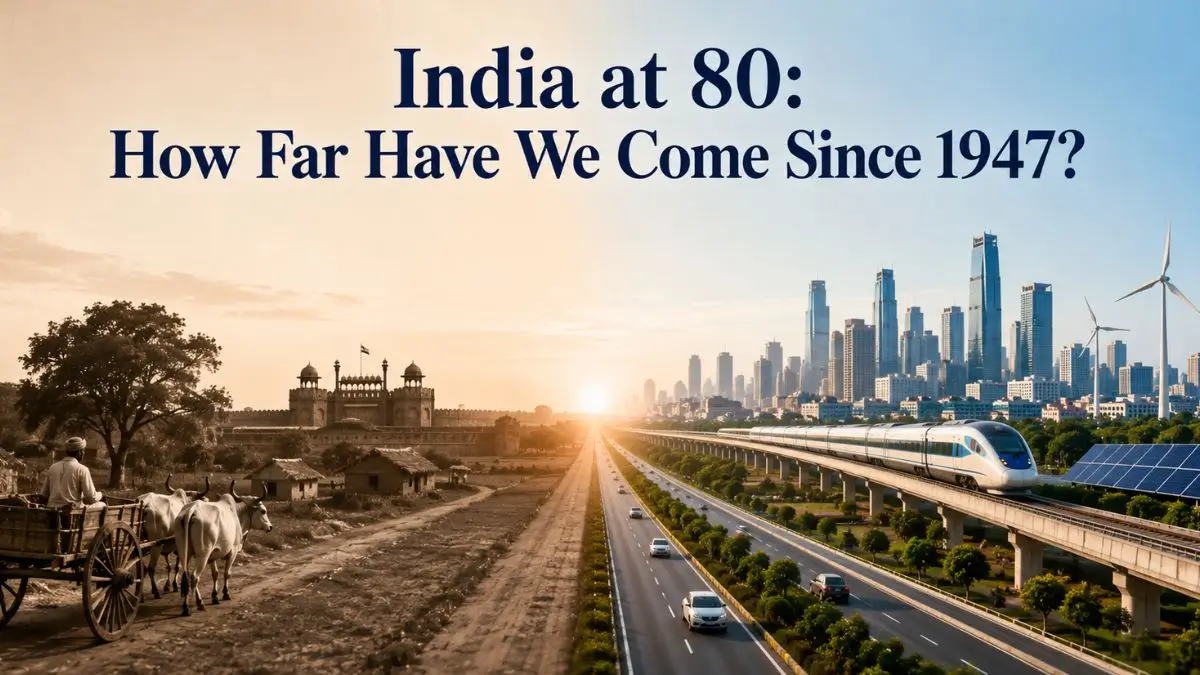
India’s history since its Independence is a unique story of economic and social development. At the time of Independence, the country suffered from widespread poverty, illiteracy, insufficient industrialization, poor infrastructure, and agrarian economy.
In the course of eighty years, India has become a completely different country. Now, it is one of the leading economies, has established one of the biggest foreign-exchange reserves, connected hundreds of millions of people to the Internet and has increased life expectancy and literacy rates.
This change is especially evident in the numbers. From economic development, foreign exchange, health care, to education, and internet penetration – these 10 indicators prove the extent of India’s development since 1947.
10 Transformation Story Since Independence
1. GDP: From a Developing Economy to an Economic Giant
Since its Independence, India’s economic output has grown significantly. During the first decades after 1947, the country had a modest level of economic output, and there were various reasons behind slow economic growth such as low levels of productivity, industrialization, and infrastructure development.
Nowadays, India is one of the biggest economies in the world by nominal GDP, and even larger by purchasing power parity. The changes in the economy can be explained by economic reforms initiated after 1991, as well as by development of services, manufacturing, infrastructure, and domestic demand.
The development of IT sector, telecommunications, pharmaceutical industry, automobile industry, and financial services has greatly changed the structure of the Indian economy.
2. Foreign Exchange Reserves: From Scarcity to Abundant Buffer
Foreign exchange reserves form yet another crucial measure of India’s economic transformation.
While at Independence, India’s foreign exchange reserves were extremely scarce, today India boasts of huge reserves which act as a big cushion against any global economic shocks or any other external pressure.
India now holds in its foreign exchange reserves over $600 billion dollars. The increase in the foreign exchange reserves is due to better performance in exports, services, remittances, and more integration into the world economy.
3. Literacy: Education for Millions More Indians
There has been an immense progress in literacy levels since 1947.
At Independence, the literacy rate of India was below 20%, which meant that most of the Indian population was illiterate and did not know how to read and write. Years of efforts on account of investing in schools and adult education, universal education campaigns and more accessibility to education have made a lot of difference.
Today, India’s literacy rate is over 75% and stands among the greatest social achievements after India’s Independence.
With literacy and education becoming much more accessible, India has become able to produce a bigger number of skilled laborers.
4. Life Expectancy: Indians Have Much Higher Life Expectancy Now
Life expectancy might be one of the best indicators of change in people’s living conditions.
Back around India’s Independence period, average life expectancy in India stood at about the mid-30s. This was due to high infant mortality rates, prevalence of infectious diseases, poor medical care and sanitation.
Today, life expectancy in India is around 70 years old. Improved vaccination, better healthcare facilities, nutrition, better sanitation and maternal and child health services have all contributed to such a result.
5. Internet Users: From Zero to a Digital India
Clearly, there were no internet users in India in 1947. However, digital connectivity has now entered into the daily lives of several hundred million Indians.
Mobile telephony, affordable data, telecom networks, and rapid rise in smartphone ownership has led to this change.
India is fast becoming one of the biggest markets for the internet.
Digital platforms have affected how Indians learn, earn, shop, communicate, consume news, and access public services.
Digital payments, especially through UPI, have added another dimension to this revolution.
6. Food Production: From Shortage to Agriculture Powerhouse
Another achievement of great significance in the post-independence period has been the growth of food security in India.
In the first few decades after independence, India was facing severe food shortages and was importing food.
The Green Revolution starting from the 1960s has revolutionised Indian agriculture especially production of wheat and rice.
With the help of new varieties of seeds, irrigation, fertiliser use, better cultivation methods, and institutional support, foodgrains production in India grew enormously.
India has gone from being a country that could not feed its people to a country that is among the world’s major agricultural powers.
7. Urbanisation & Infrastructure: A Connected India
In 1947, India was mainly a rural country. With the passage of time, urbanisation has gained pace as cities have come up as industrial, service, education, and employment centres.
Large metropolitan cities have become bigger and faster development has taken place in roads, air transport, railroads, ports, metro transport, and digital infrastructure in India.
This change is evident in the way India’s transport system, highway network, and urban infrastructure have developed over time.
8. Electricity: From Limited Availability to Widespread Electrification
The access to electricity has also undergone significant changes.
At the time of Independence, most of the electrical power was available in cities and very few villages had any form of access to it. Since then, the various electrification programs have extended the grid in all parts of the country.
Now, India boasts of nearly universal access to electricity by households as well as huge increase in its electricity generation capacity.
There is another major change taking place in India as renewable energy forms an increasingly important part of its energy basket.
9. Mobile Telecommunications: From a Luxury to a Necessity
The Indian revolution in the sphere of communications is hard to imagine from the point of view of 1947.
Telephones were rare during the early years after Independence and long waits were required for obtaining a fixed line connection. The advent of mobile telecommunication technologies has completely altered this equation.
Now, there are millions of Indians who use their mobile phones for communications, financial transactions, learning, entertainment, conducting business and for availing government services.
A smartphone combined with affordable internet connectivity can be considered as a gateway to the digital economy.
10. Poverty and Living Conditions: Social Revolution Spanning Many Decades
Apart from economic progress, there has been a major decline in the number of people living in poverty in India.
At the time of Independence, a very large number of Indians lived in conditions of extreme poverty and lacked access to necessities. Various factors like economic growth, agricultural development, employment, social welfare programs, infrastructure development and service availability have helped improve living standards.
But the story does not end here. India still faces problems related to inequality, malnutrition, job quality, regional differences and access to healthcare and education.








 Dussehra 2026: Top 30 Most Important GK ...
 Dussehra and UNESCO: Ramlila, Durga Puja...
 Mysuru Dasara 2026: History, Jamboo Sava...