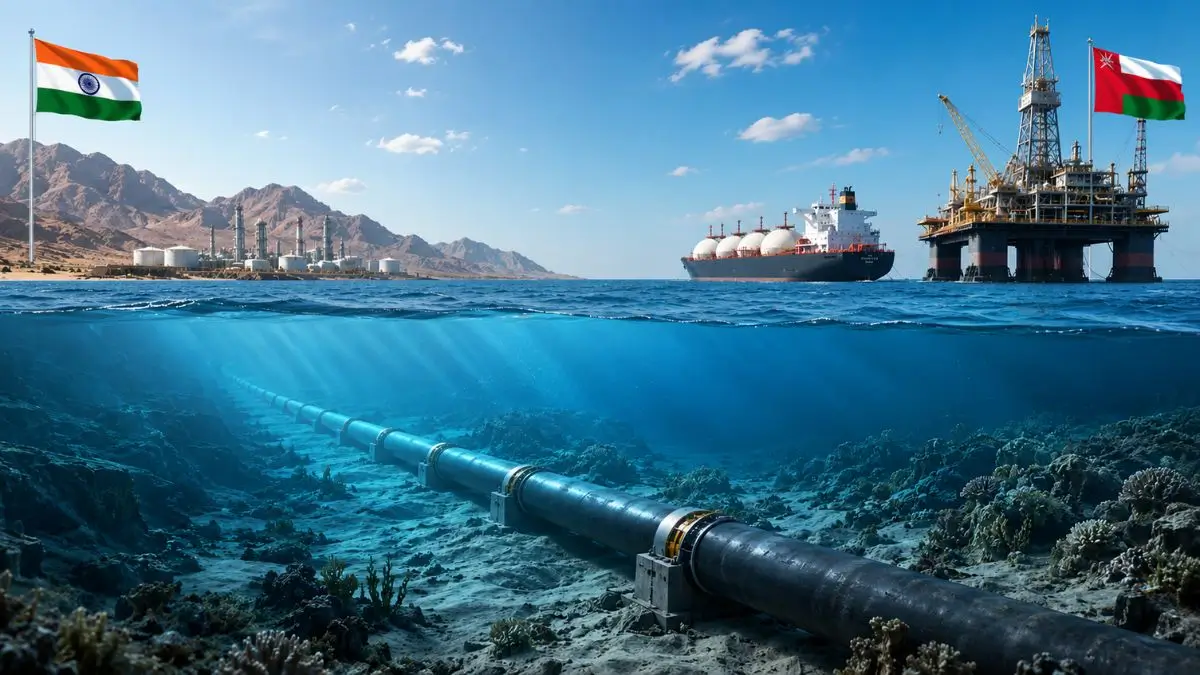
India is planning to construct a massive ₹40,000 crore subsea gas pipeline from Oman to Gujarat. This decision comes at that time when Strait of Hormuz crisis disrupted global energy flows in 2026. The central government directed major PSUs to prepare a feasibility report for this ambitious project. If this project implemented it will take 5 to 7 years for construction.
Why India Is Planning the Oman-Gujarat Pipeline
The major reason behind this decision is the 2026 Hormuz crisis which have exposed the India’s heavy dependence on a single maritime route.
Nearly 88% of the India’s crude oil imports and significant share of LNG supplies pass through the Strait of Hormuz.
When Iran disrupted the route in the Month of March 2026, India faced the supply chain interruptions, shipping risks and the massive financial losses.
This situation forced policymakers to rethink about energy transport routes and reduce dependency on vulnerable chokepoints.
Project Overview: Key Details You Should Know
The proposed pipeline is the deep-sea infrastructure project which connecting Oman directly to Gujarat.
Key Highlights
- Estimated Cost: ₹40,000 crore
- Length: 2,000 km
- Route: Oman → Arabian Sea → Gujarat
- Timeline: 5-7 years after approval
- Expected Completion: Around 2033–2035
- Depth: Over 3,000 metres (deepwater route)
The pipeline is designed to completely bypass the Strait of Hormuz and ensuring the uninterrupted energy supply.
Major Companies Involved in the Project
The Indian government has assigned key roles to major public sector companies of India
- GAIL – Lead operator and feasibility planner
- Engineers India Limited – Technical feasibility
- Indian Oil Corporation – End-user and participant
Among these PSUs GAIL plays a crucial role as it already controls over the 70% of India’s gas transmission network.
Economic Impact of Hormuz Crisis
The financial damage from the Hormuz crisis has been severe for the India.
Country faced around ₹62,500 crore losses in just 6 weeks.
Nearly ₹1.98 lakh crore under recoveries in Q1 2026.
And also daily losses of ₹1,600-1,700 crore for oil companies.
To protect the Indian consumers, the government kept fuel prices stable but this increased the fiscal burden significantly.
India vs China: The Infrastructure Gap
India’s decision is also influenced by the global competition and specially with China.
| Metric | India | China |
| Pipeline Network | 16,800 km | 90,000+ km |
| Gas Share in Energy | 6% | 9% |
| Storage Capacity | Minimal | Extensive |
India’s low gas usage and weak infrastructure highlight the need for the rapid expansion and diversification.
Private Sector Angle: SAGE Pipeline Project
A similar project by South Asia Gas Enterprise (SAGE) already exists.
Key Points
- Cost: $5 billion
- Capacity: 31 mmscmd
- Potential savings: ₹7,000 crore annually
The government may integrate or leverage this existing work to avoid any delays and duplication.
Strategic Importance of the Pipeline
This project is more than just infrastructure and it is a long term national strategy.
Key Benefits of This Project
- Will reduces dependency on the Hormuz Strait
- Ensures the stable gas supply
- Cuts LNG import costs
- Strengthens energy security
- Supports industrial growth
It also signals the India’s shift towards resilient and diversified energy routes.








 Which US States Have Passed Year-Round D...
 Bangladesh Names Asad Siam as New Envoy ...
 US, Denmark and Greenland Sign New Arcti...