
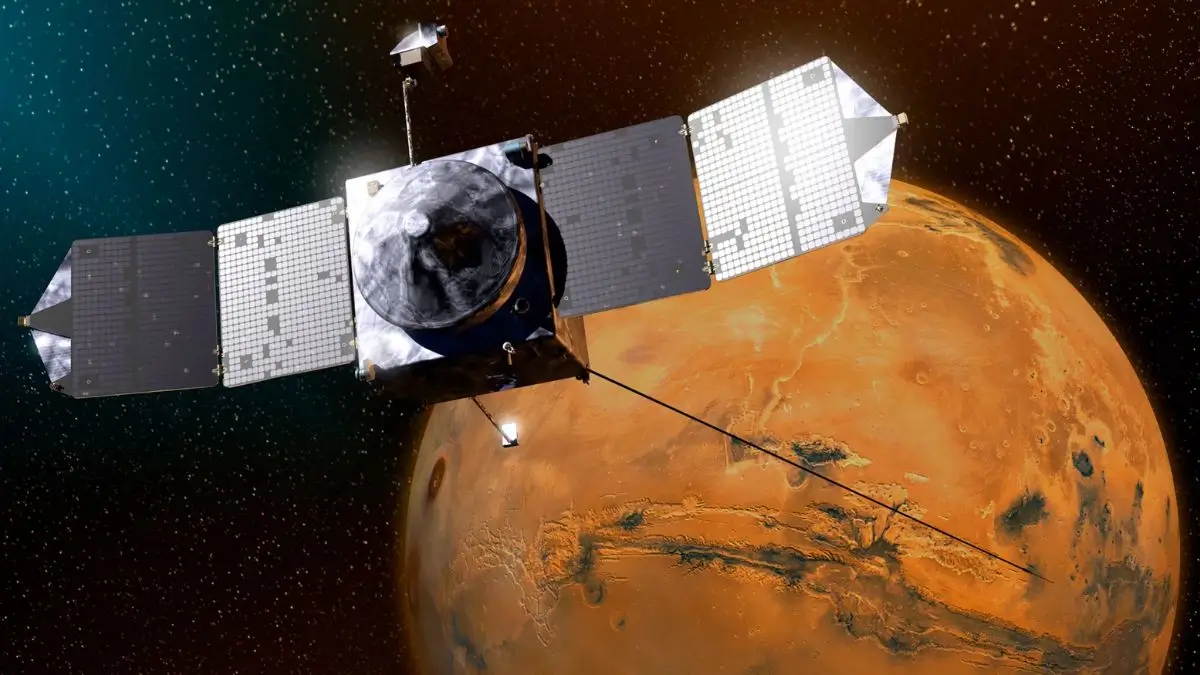
After more than a decade of the pioneering scientific discoveries around the Mars, NASA has officially concluded the MAVEN (Mars Atmosphere and Volatile Evolution) mission. It was launched in 2013 and it operating around Mars since the year 2014 and MAVEN became the first spacecraft dedicated to studying the Mars’s atmosphere and its interaction with the Sun. Although the mission was designed for the one year but it continued operations for over eleven years before losing the communications in December 2025.
NASA Officially Concludes the MAVEN Mission
NASA has announced that the MAVEN spacecraft is no longer recoverable following an unexpected loss of communication in the December 2025. This spacecraft was last heard from on 6 December 2025 after it passed behind the Mars.
Also there are subsequent attempts to re-establish contact but it turned unsuccessful.
Following the extensive investigations and recovery efforts, NASA’s anomaly review board concluded that the MAVEN had entered an unrecoverable state and could no longer perform its scientific or communication functions.
The agency has now begun the formal process of mission with decommissioning and data archiving.
What Happened to MAVEN?
Before disappearing the MAVEN’s telemetry indicated that all the systems were functioning normally.
However, after emerging from behind Mars, NASA’s Deep Space Network (DSN) failed to detect any signal from the spacecraft.
Preliminary Findings
- Spacecraft entered into safe mode
- Unexpected high-rate rotation occurred
- Orbital trajectory disruption suspected
- Batteries became depleted
- Communication systems lost power
Investigators believe that the excessive rotation prevented solar panels from adequately charging the spacecraft and leading to battery depletion and permanent communication loss. NASA continues to investigate the root cause of the anomaly of MAVEN.
What is the MAVEN Mission?
MAVEN was launched in the November 2013 and entered into Mars orbit in September 2014.
The mission was designed to study the,
- Mars upper atmosphere
- Ionosphere
- Solar wind interactions
- Atmospheric escape processes
Its primary objective was to understand how the Mars transformed from a potentially habitable planet with the liquid water into the cold, dry world observed today. It was originally planned for one year and MAVEN operated successfully for more than eleven years.
Understanding How Mars Lost Its Atmosphere
One of MAVEN’s most significant achievements was explaining how the Mars gradually lost much of its atmosphere. Scientists have discovered that the solar wind that is a continuous stream of charged particles emitted by the Sun steadily strips away atmospheric particles from Mars.
Unlike the Earth, Mars lacks a strong global magnetic field which capable of protecting its atmosphere from solar activity.
Major Discovery
MAVEN showed that atmospheric loss increases dramatically during the,
- Solar storms
- Coronal mass ejections
- Enhanced space weather events
These findings also helped to explain the long-term climate transformation of Mars.
Discovery of Unique Martian Auroras
MAVEN’s one of most fascinating discoveries was the identification of the multiple forms of auroras on Mars. Unlike Earth, where auroras are usually confined to the polar regions, Mars experiences auroras across much larger areas.
MAVEN’s Auroral Discoveries
- Proton auroras
- Diffuse auroras
- Global atmospheric glow events
These discoveries has provided the important insights into the interaction between the solar particles and the Martian atmosphere.
Scientific Legacy of MAVEN
The mission had generated an enormous scientific impact.
Key Achievements
- Over 800 scientific publications were published
- More than 11 years of the observations
- First dedicated study of a Martian atmospheric evolution
- Improved understanding of planetary habitability
- Enhanced knowledge of space weather effects
Scientists expect that the MAVEN’s dataset to remain valuable for decades.








 World Bank Ranks India Among Top 10 Emer...
 Elon Musk to Rename SpaceXAI as SpaceXSI
 Kerala Develops AI-Based Dengue Early Wa...










