
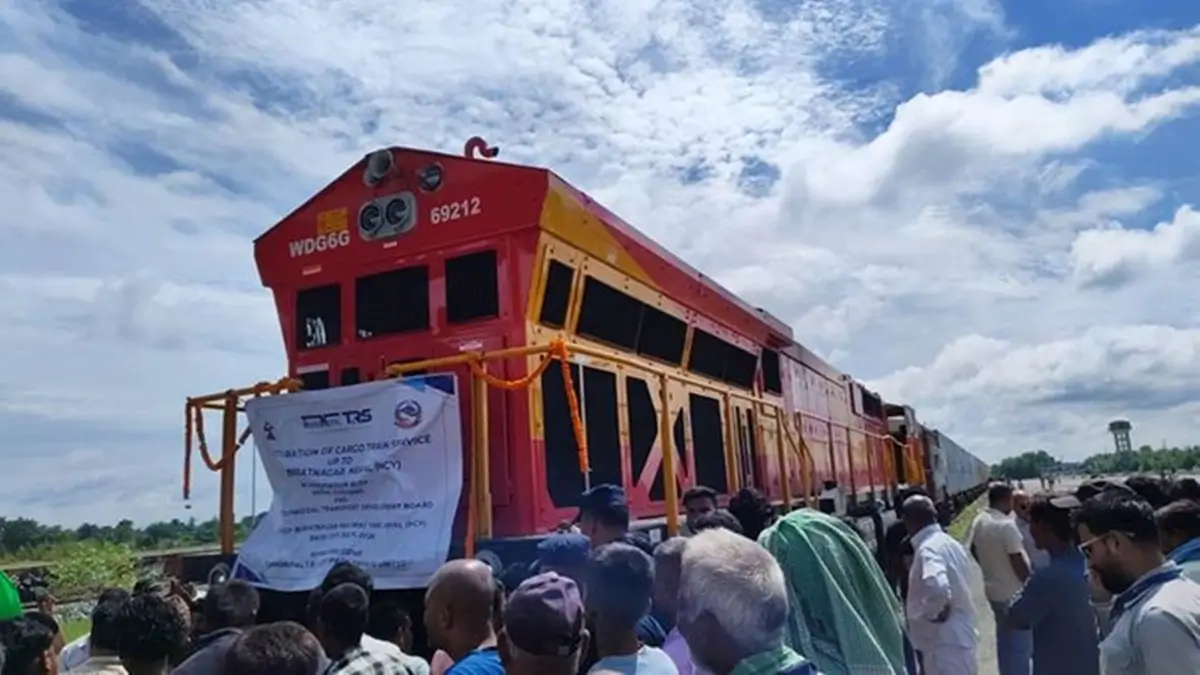
India achieved a major milestone in regional connectivity and cross-border trade as its first-ever direct commercial container freight train reached Nepal carrying a consignment of canola. The historic journey was completed under the revised India–Nepal Rail Transit Protocol, enabling seamless rail movement of containerized cargo from Kolkata Port to Biratnagar without transshipment at the border.
The initiative is expected to significantly reduce transit time, logistics costs, and cargo handling while strengthening economic and trade ties between India and Nepal.
India’s First Direct Commercial Freight Train to Nepal
The Railway Ministry announced the successful operation of India’s first direct commercial container freight train to Nepal.
The train comprised 40 wagons carrying a consignment of canola, marking the beginning of a new era in rail-based cross-border freight transportation between the two neighbouring countries.
This landmark movement demonstrates the growing focus on improving regional connectivity through efficient and sustainable transport infrastructure.
Key Features of the Freight Service
The newly launched freight service introduces several operational improvements.
Highlights
- First-ever direct commercial container freight train between India and Nepal.
- Operated under the revised India–Nepal Rail Transit Protocol.
- Consisted of 40 wagons carrying canola.
- Direct movement from Kolkata Port (India) to Biratnagar (Nepal).
- Eliminates the need for transshipment at the border.
What is the Revised India–Nepal Rail Transit Protocol?
The revised India–Nepal Rail Transit Protocol facilitates smoother movement of goods between the two countries by allowing direct rail transportation of containerized cargo.
Under the revised arrangement:
- Cargo can move directly from Indian ports to inland destinations in Nepal.
- Border transshipment requirements are eliminated.
- Customs and logistics processes become more efficient.
- Supply chain reliability is improved.
The protocol is aimed at enhancing bilateral trade and strengthening regional economic integration.
Benefits of the Direct Freight Service
The new freight corridor is expected to bring multiple benefits for both India and Nepal.
Faster Transportation
Direct rail movement will reduce overall transit time, ensuring quicker delivery of goods.
Lower Logistics Costs
The elimination of border transshipment will reduce transportation and handling expenses.
Improved Supply Chain Efficiency
Fewer handling points will minimize delays and reduce the risk of cargo damage.
Environmentally Sustainable Transport
Rail transport is considered more fuel-efficient and environmentally friendly than road transport, supporting sustainable logistics.
Boost to India–Nepal Trade
The Railway Ministry stated that the direct freight service is expected to significantly enhance the movement of both import and export cargo between India and Nepal.
The initiative will benefit:
- Exporters
- Importers
- Logistics service providers
- Manufacturing industries
- Agricultural traders
- Supply chain operators
By improving connectivity and reducing operational costs, the service is expected to increase the competitiveness of cross-border trade.
Significance of the Development
The launch of India’s first commercial freight train to Nepal represents a major step toward strengthening regional connectivity under India’s neighbourhood-first policy. It reflects the growing emphasis on multimodal transport, trade facilitation, and efficient logistics infrastructure.
The initiative is expected to deepen economic cooperation between India and Nepal while promoting sustainable and cost-effective cargo transportation.








 World Health Summit 2026: Key Initiative...
 Putin Ratifies India–Russia Agreement ...
 India Hosts First BIMSTEC Home Ministers...










