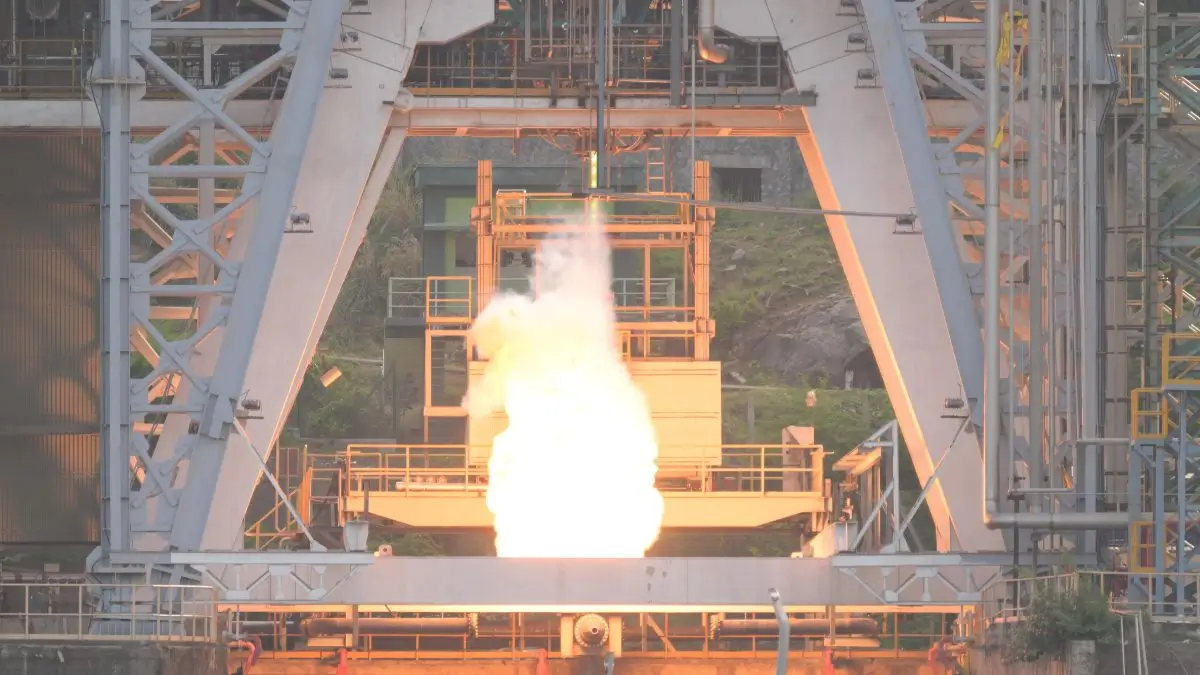
Indian Space Research Organisation (ISRO) has performed the successful hot test of the Semi-Cryogenic Engine Power Head Test Article (PHTA) at a thrust level of 175 Tonne at the ISRO Propulsion Complex (IPRC), Mahendragiri , Tamil Nadu on 24th June 2026. The test marks the crucial milestone in the development of SE2000 cryogenic engine. This is the 8th test in a series of hot tests using the PHTA.
What Happened in ISRO’s Latest Semicryogenic Engine Test?
ISRO has successfully completed the eighth hot test of the Power Head Test Article (PHTA) as part of the ongoing development of the its indigenous semicryogenic propulsion system.
The Power Head Test Article includes nearly every major subsystem of the engine except the thrust chamber.
This configuration enables the engineers to validate critical engine performance while reducing the complexity during development.
The latest test achieved 175 tonnes of thrust which is equivalent to approximately 88% of the engine’s designed maximum capacity of 200 tonnes.
The test also demonstrated the stable engine operation and successful functioning of the main turbopumps which have generated outlet pressures of 400 bar and 500 bar.
According to ISRO’s observations, all engine parameters remained within the expected limits throughout the test.
Key Highlights of the Hot Test
- It was successfully conducted on 24 June 2026
- Performed at ISRO Propulsion Complex (IPRC), Mahendragiri
- Achieved a 175-tonne (88%) thrust level
- Eighth successful hot test of the Power Head Test Article
- Demonstrated stable steady-state engine operation
- Main turbopumps operated successfully at 400 bar and 500 bar outlet pressures
- Boosts confidence for the upcoming 200-tonne full-thrust demonstration
What Is a Semicryogenic Engine?
A semicryogenic engine is a rocket propulsion system that uses the one cryogenic propellant and one liquid hydrocarbon fuel.
In the ISRO’s design, the engine burns the,
- Liquid Oxygen (LOX) as the oxidizer
- Purified Kerosene (Isrosene) as the fuel
This combination offers the multiple advantages over traditional liquid engines while being simpler and more economical than fully cryogenic propulsion systems.
The engine under development is known as the SE2000, and it is capable of producing around 2,000 kilonewtons (2000 kN) of thrust.
Understanding the Power Head Test Article (PHTA)
The Power Head Test Article is the essential intermediate testing configuration during the engine development.
It includes the,
- Pre-burner
- Turbopumps
- Propellant feed systems
- Valves
- Control systems
- Engine plumbing
The only one component is excluded and that is thrust chamber.
Testing the power head separately allows ISRO engineers to thoroughly validate the engine cycle, fuel flow, pressure generation, ignition sequence and turbomachinery performance before it integrating into the complete engine.
Why the Semicryogenic Engine Matters
The semicryogenic engine is ISRO’s one of the most ambitious propulsion projects.
Once it gets fully operational, it will replace the current L110 liquid core stage of the LVM3 launch vehicle with the new propulsion stage known as SC120.
This upgrade offers several strategic advantages such as,
- Higher Payload Capacity
- Improved Fuel Efficiency
- Cleaner Propellants
- Stronger Indigenous Capability
The Role of SC120 in LVM3
The SC120 Semicryogenic Propulsion Stage is being designed as the future core stage of the LVM3 launch vehicle.
LVM3 is currently serves as the India’s most powerful operational launch vehicle and it has been used for the,
- Chandrayaan missions
- Commercial satellite launches
- Communication satellites
- Human spaceflight preparations under Gaganyaan
It replaced the L110 stage with SC120 and it is expected to improve the launch efficiency while supporting the heavier scientific and commercial payloads.








 Weekly Current Affairs One Liners (5th t...
 Weekly Current Affairs One Liners (28th ...
 Weekly Current Affairs One Liners (21st ...