
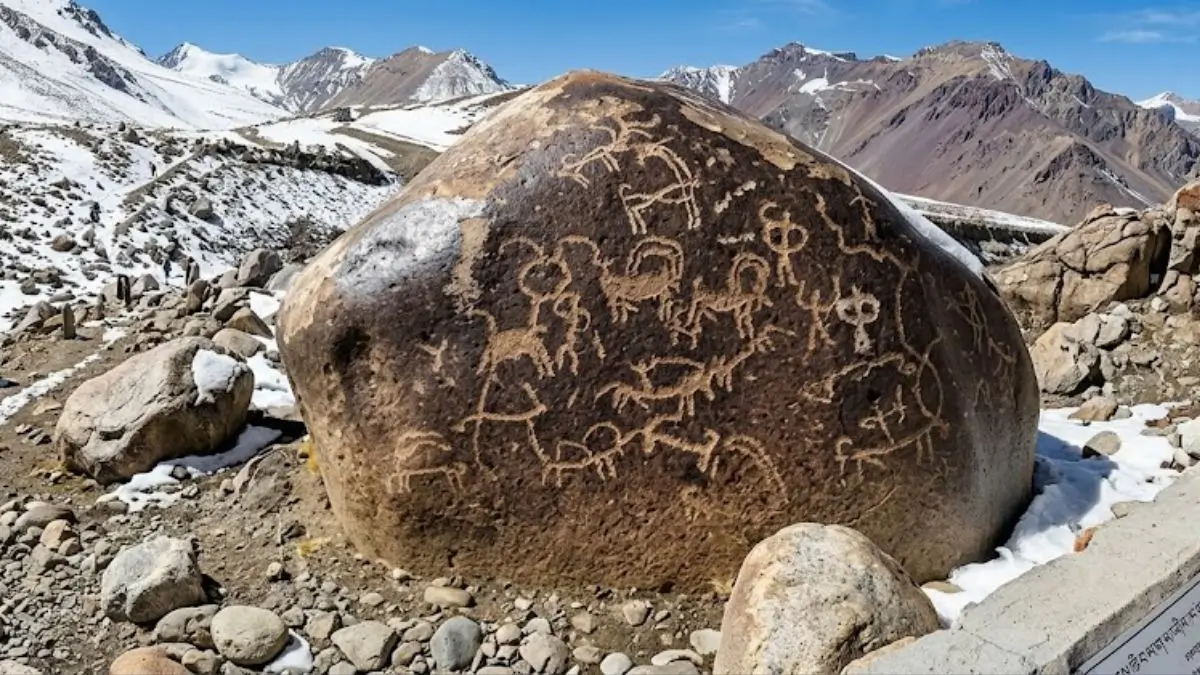
India’s first Petroglyph Conservation Park is set to be developed at the Sindhu Ghat in Ladakh. The foundation stone was laid on the April 18th, 2026 and the event coinciding with World Heritage Day and it was laid by Vinai Kumar Saxena. This initiative aims to protect the centuries-old rock carvings which is known as petroglyphs. As they are under threat from the environmental factors and human activities and marks the significant step to preserving the India’s ancient cultural legacy.
India’s First Petroglyph Conservation Park
The proposed Petroglyph Conservation Park will serve as the dedicated space to conserve and display the prehistoric rock carvings which are found across Ladakh. These carvings are etched onto the rocks thousands of years ago and they provide the valuable insights into early human life, culture and beliefs.
This park will,
Protect endangered petroglyphs and relocate the vulnerable artefacts from isolated locations and also create the educational and curated environment for visitors.
This initiative positions Ladakh as the key centre for the archaeological and cultural heritage conservation in India.
What Are Petroglyphs and Why Are They Important?
Petroglyphs are the prehistoric images and symbols carved directly onto the rock surfaces. They represent the one of earliest forms of the human expression and communication.
In the Ladakh these carvings depict,
Scenes of hunting in where the animals such as ibex and snow leopards and later Buddhist symbols like stupas and inscriptions.
They also include the inscriptions in ancient languages such as Chinese, Arabic and Sanskrit and also reflects the cultural exchanges and historical transitions over centuries.
These rock carvings act as the open-air museums which offers the continuous record of human civilization from the Palaeolithic Age to later historical periods.
Threats to Ladakh’s Petroglyphs
Despite they holds the historical significance the petroglyphs in the Ladakh face serious threats.
Natural factors such as the weathering and climate change gradually erode these carvings.
However the human activities pose even the greater risks.
Also the unregulated tourism, road construction and infrastructure development specially along the Indus and Zanskar river banks and they are damaging these fragile artefacts.
Out of nearly 400 petroglyph sites in the Ladakh many are scattered and isolated and makes them difficult to monitor and protect.
Collaboration for Conservation & ASI Partnership
To ensure the effective preservation a Memorandum of Understanding (MoU) has been signed between the local administration and the Archaeological Survey of India.
This collaboration will,
Facilitate the scientific conservation methods along with ensure proper documentation of artefacts and to promote the sustainable heritage management.
Such partnerships are important for integrating the modern conservation techniques with traditional knowledge.
Ladakh The Repository of Ancient Heritage
Ladakh is considered as one of the richest regions in the prehistoric rock art in South and Central Asia.
Important sites include the,
Domkhar, Dah Hanu, Alchi, Chilling and Tangtse. In where petroglyphs are found in to the clusters and along ancient trade routes.
These carvings provide insights into,
Migration patterns, trade networks, ecological conditions and the spiritual beliefs of ancient communities.








 Ayodhya Ram Temple Receives FSSAI’s â€...
 Ambaji Mohanthal Gets GI Tag: Gujarat’...
 Noida International Airport to Be Named ...










