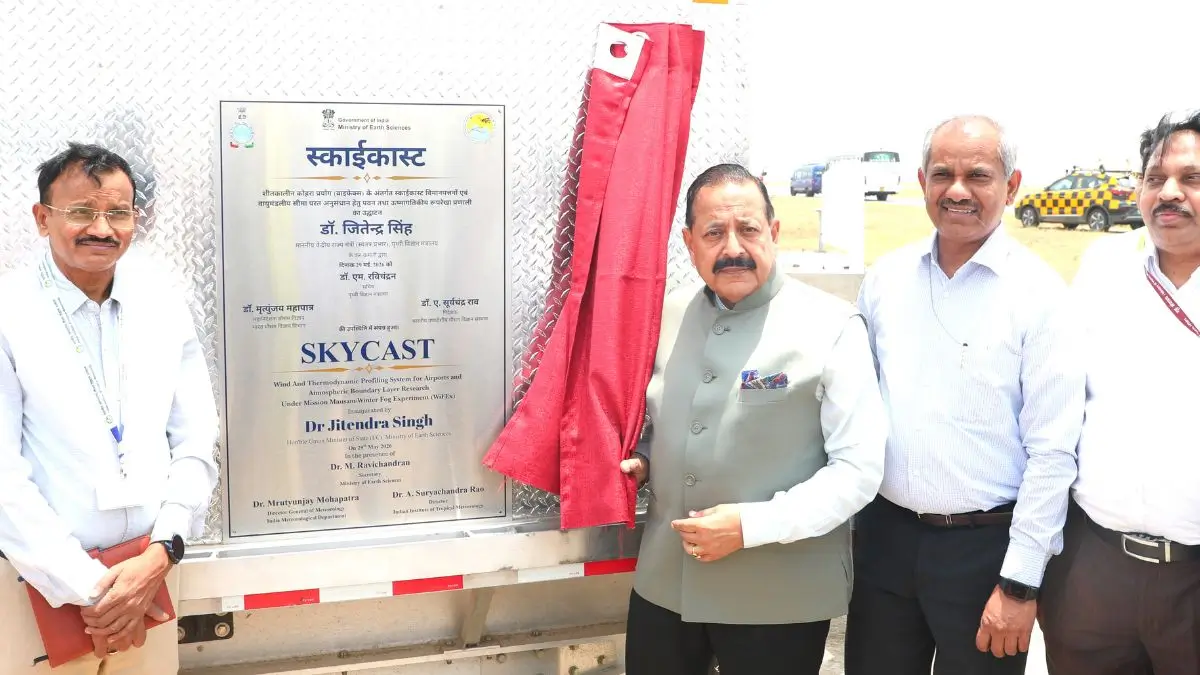
For the aviation safety and weather forecasting India has launched the SkyCast System at Indira Gandhi International (IGI) Airport in the National capital. It was inaugurated by respectable Union Minister Dr. Jitendra Singh and this advanced aviation weather monitoring system is designed to provide the real time atmospheric intelligence, helping the pilots and airport operators manage challenging weather conditions more effectively. It was developed under the ambitious Mission Mausam and it will significantly reduce the flight disruptions caused by fog, turbulence and poor visibility.
What is the SkyCast System?
SkyCast is the advanced aviation weather intelligence platform which integrates multiple the atmospheric monitoring technologies into a single system.
It continuously monitors the atmospheric conditions around airports and provides real-time information on to the,
- Fog formation
- Visibility levels
- Wind speed and direction
- Turbulence
- Moisture content
- Atmospheric temperature
- Aerosol concentration
This data allows the pilots, air traffic controllers and airport authorities to make better operational decisions during the critical phases of flight and specially take-offs and landings.
How SkyCast Will Benefit Air Travel
One of the biggest challenges faced by the Indian aviation and particularly during winter is the dense fog and sudden weather changes.
SkyCast is expected to significantly reduce the flight delays, flight diversions, flight cancellations, operational disruptions and also the safety risks during landing and take-off
The system can provides the short-term weather alerts several hours in advance and helping the airlines and pilots prepare for adverse weather conditions before they become critical.
Advanced Technologies Behind SkyCast
SkyCast combines the some of the world’s most advanced atmospheric observation technologies.
Key Technologies Used Are.
- Radar Wind Profiler
- SODAR (Sonic Detection and Ranging)
- Microwave Radiometer
- Ground-based Fog Aerosol Spectrometer (GFAS)
- CL61 Lidar-based Ceilometer
Together, these instruments provides the detailed picture of atmospheric conditions up to nearly 3 kilometres above the airport and this integrated system enables the comprehensive monitoring of weather phenomena which directly affect aviation operations.
Understanding the Core Components
Radar Wind Profiler
The Radar Wind Profiler is considered as the heart of the SkyCast system.
It continuously measures the,
- Wind speed
- Wind direction
- Turbulence
- Vertical air movement
- Boundary-layer dynamics
This information is crucial for the aircraft approaching airports during landing operations.
Ground-Based Fog Aerosol Spectrometer (GFAS)
The GFAS instrument studies the,
- Fog droplets
- Aerosol particles
- Visibility reduction
- Pollution-fog interactions
This is particularly important for the cities like Delhi where pollution in the winter can intensify fog conditions.
Lidar-Based Ceilometer
The Ceilometer monitors the,
- Fog depth
- Cloud layers
- Vertical visibility
- Atmospheric structure
This will help the aviation authorities assess real-time runway visibility conditions.
Developed Under Mission Mausam
The initiative is part of the Government of India’s flagship Mission Mausam program ,as it aims to modernize the India’s weather forecasting infrastructure through,
- Advanced observation networks
- Artificial intelligence-based forecasting
- Improved weather models
- High-resolution monitoring systems
The program also seeks to improve the weather prediction accuracy and strengthen resilience against weather-related disruptions across multiple sectors.





 India’s Internet Subscribers Cross 1.1...
 JOSH Campaign Launched to Support Indiaâ...
 PM GatiShakti Completes Five Years: Obje...