
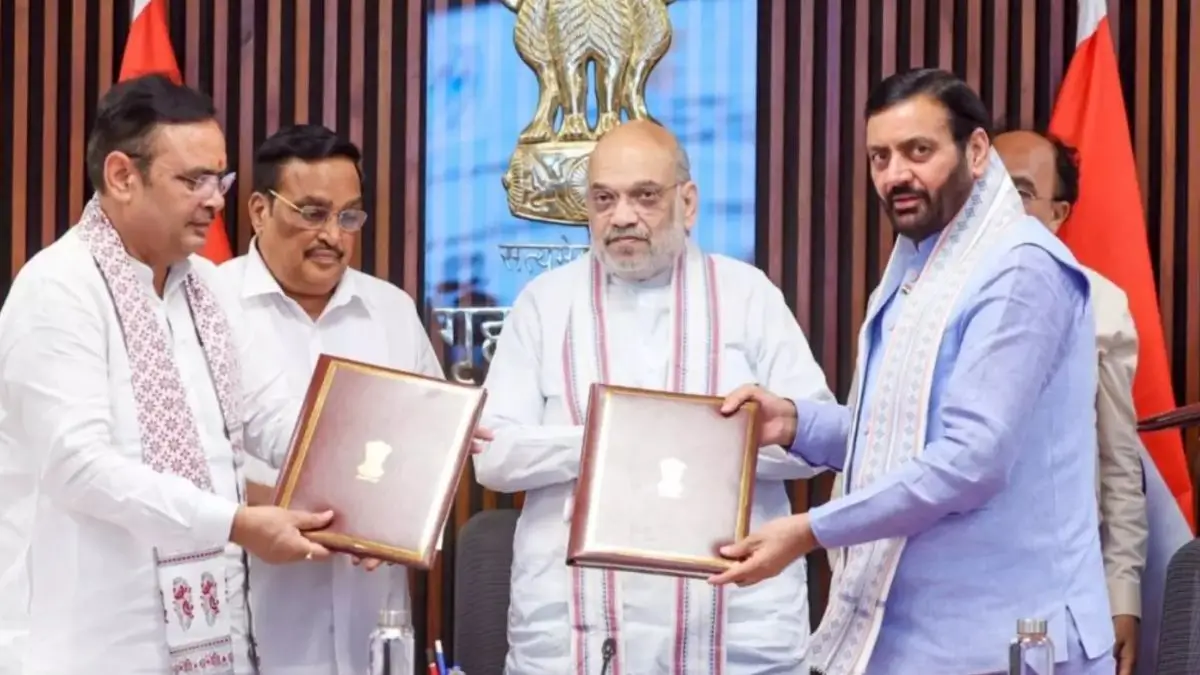
The State Governments of Rajasthan and Haryana signed an agreement for the construction and implementation of the Yamuna Water Project on 29th June, 2026 in New Delhi. This agreement was signed in the presence of the Respectable Union Home Minister Amit Shah, and it is expected to bring the end of nearly 30-year-old water dispute and it will significantly improve the drinking water availability in water-scarce regions of the both states.
What Is the Yamuna Water Project?
The Yamuna Water Project is the inter-state water infrastructure initiative which is designed to transport Rajasthan’s allocated share of the Yamuna River water through an underground pipeline network.
The project will draw water from the Western Yamuna Canal and it deliver to Rajasthan by using a modern pipeline system and enabling the state to utilize its share of water allocated under the 1994 Memorandum of Understanding (MoU) on the Sharing of the Utilisable Surface Waters of the Upper Yamuna Basin.
The initiative also benefits Haryana by improving regional water management and ensuring a reliable drinking water supply.
Why Was This Agreement Needed?
Although Rajasthan was allocated the share of the Yamuna waters under the 1994 Upper Yamuna Basin agreement, the absence of adequate infrastructure prevented the effective utilization of this allocation.
For nearly three decades, this issue remained unresolved because of the technical, financial and administrative challenges.
The newly signed agreement establishes the comprehensive framework covering the,
- Water allocation
- Infrastructure development
- Financial responsibilities
- Cost sharing
- Water release protocols
- Operation and maintenance
- Monitoring mechanisms
- Dispute resolution procedures
This framework is also intended to ensure the smooth implementation and long-term cooperation between the two states.
Key Features of the Yamuna Water Project
The project includes the several major engineering and water management components.
Underground Pipeline System
Approximately 580 Million Cubic Metres (MCM) of Yamuna water will be conveyed from the Western Yamuna Canal to Rajasthan via three underground pipelines.
Large-Diameter Pipelines
Each pipeline will have a diameter of more than 3.6 meters enabling efficient transportation of the large volumes of water.
Seasonal Water Supply
Water will be supplied during the July to October period which coincides with the monsoon season when river flows are relatively higher.
Scientific Water Management
The agreement includes provisions for the,
- Transparent monitoring systems
- Infrastructure maintenance
- Water release protocols
- Long-term operational planning
- Robust dispute resolution mechanisms
Which Areas Will Benefit?
The project is expected to provide the reliable drinking water to several water-stressed districts.
Rajasthan
The primary beneficiary districts such as,
- Sikar
- Churu
- Jhunjhunu
These districts often face acute drinking water shortages due to their arid and semi-arid climate.
Haryana
The project will also improve water availability in the areas like,
- Bhiwani
- Fatehabad
Millions of the residents in these regions are also expected to benefit from the more dependable drinking water supply.
Environmental and Water Conservation Benefits
Apart from supplying drinking water, this project has significant environmental advantages.
Earlier, the substantial quantity of the rainwater flowed unused and was not effectively stored or utilized.
Under the new arrangement,
- Excess water will be stored in the large ponds.
- Groundwater recharge will improve.
- Water wastage will be reduced.
- Sustainable water management practices will be promoted.
These measures are also expected to strengthen long-term water security in drought-prone regions.
Role of the Central Water Commission
The Central Water Commission (CWC) played the important technical role in designing the agreement.
Its contributions included the,
- Technical planning
- Water allocation framework
- Infrastructure design support
- Monitoring mechanisms
- Long-term operational guidelines
The CWC’s involvement is also expected to ensure the scientific implementation and transparent water management.








 Ambaji Mohanthal Gets GI Tag: Gujarat’...
 Noida International Airport to Be Named ...
 Nameri Tiger Reserve Gets CA|TS Approved...










