
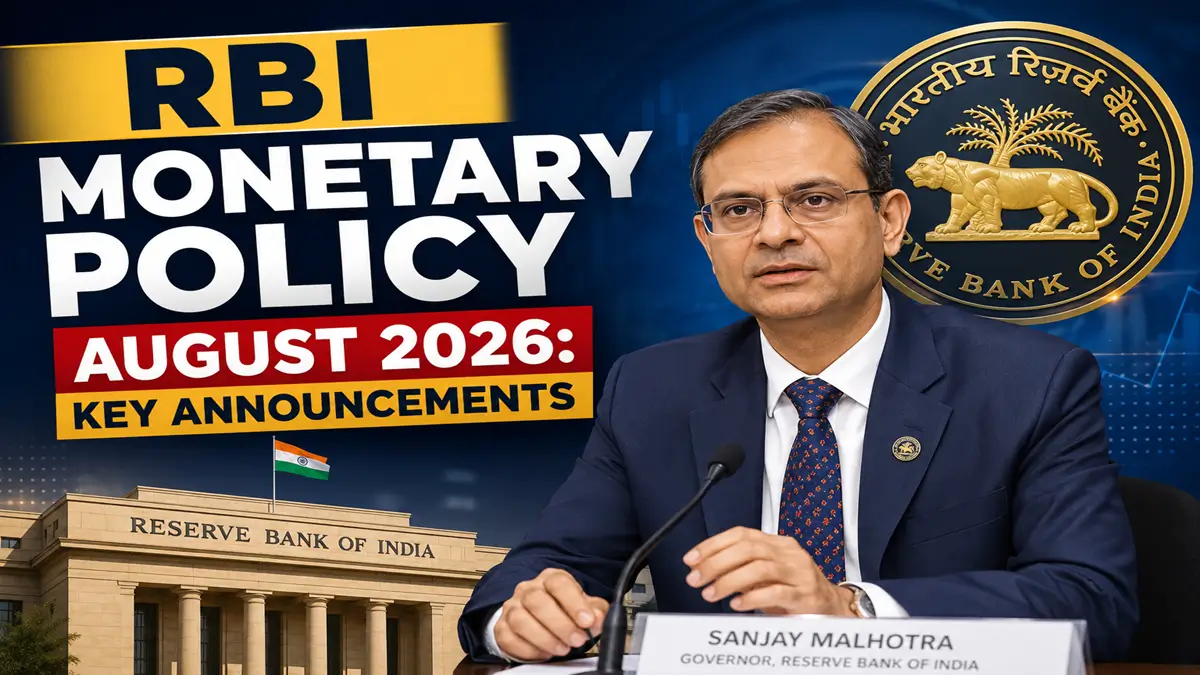
The Reserve Bank of India (RBI) announced its August 2026 Monetary Policy on August 5, 2026, following the 62nd meeting of the Monetary Policy Committee (MPC) held from August 3 to 5, 2026 under the chairmanship of RBI Governor Shri Sanjay Malhotra. In line with market expectations, the MPC unanimously decided to keep the policy repo rate unchanged at 5.25% while retaining the ‘Neutral’ monetary policy stance.
The central bank highlighted that although inflation has risen above the target due to food and fuel prices, the underlying inflation remains moderate. At the same time, India’s economy continues to display resilience despite global uncertainties.
RBI Monetary Policy August 2026: Key Highlights
- Repo Rate: Unchanged at 5.25%
- Standing Deposit Facility (SDF): 5.00%
- Marginal Standing Facility (MSF): 5.50%
- Bank Rate: 5.50%
- Policy Stance: Neutral
- MPC Decision: Unanimous
- Real GDP Growth Forecast (FY 2026-27): 6.7%
- CPI Inflation Forecast (FY 2026-27): 5.0%
- Next MPC Meeting: October 5–7, 2026
RBI Keeps Repo Rate Unchanged at 5.25%
The Monetary Policy Committee unanimously voted to maintain the repo rate at 5.25% under the Liquidity Adjustment Facility (LAF).
Accordingly:
| Policy Rate | August 2026 |
|---|---|
| Repo Rate | 5.25% |
| Standing Deposit Facility (SDF) | 5.00% |
| Marginal Standing Facility (MSF) | 5.50% |
| Bank Rate | 5.50% |
The RBI also retained its Neutral stance, allowing flexibility to respond to evolving inflation and growth conditions.
Why Did RBI Keep the Repo Rate Unchanged?
According to the MPC, several factors influenced the decision:
- Inflation has increased primarily due to food and fuel prices, not because of widespread demand pressures.
- Core inflation remains relatively moderate.
- India’s economic growth continues to remain resilient but faces external risks.
- Global geopolitical tensions, volatile crude oil prices, El Niño conditions, and uncertainty in global trade require caution.
- The RBI wants greater clarity on inflation trends before making any policy rate adjustments.
India’s Growth Outlook for FY 2026-27
The RBI maintained a positive outlook on India’s economy despite global challenges.
GDP Growth Projection
| Quarter | Growth Forecast |
| Q1 FY27 | 7.0% |
| Q2 FY27 | 6.4% |
| Q3 FY27 | 6.5% |
| Q4 FY27 | 6.8% |
| FY 2026-27 Overall | 6.7% |
| Q1 FY28 | 7.3% |
Factors Supporting Growth
- Strong domestic consumption
- Healthy investment activity
- Robust services sector
- Infrastructure spending by the government
- Continued bank credit growth
- Rising exports supported by recent trade agreements
- Stable employment conditions
Inflation Outlook
Retail inflation increased to 4.4% in June 2026, crossing the RBI’s target after remaining below it for 16 consecutive months.
The increase was mainly driven by:
- Rising food prices
- Higher fuel prices
- Increase in restaurant charges due to higher input costs
However, core inflation (excluding food and fuel) remained stable at 3.9%, while core inflation excluding precious metals remained between 2.3% and 2.5%, indicating that demand-side inflationary pressures remain contained.
RBI’s CPI Inflation Forecast
| Quarter | Inflation Forecast |
| Q2 FY27 | 4.7% |
| Q3 FY27 | 5.9% |
| Q4 FY27 | 5.5% |
| FY 2026-27 Overall | 5.0% |
| Q1 FY28 | 5.3% |
The RBI expects inflation to rise in the near term before moderating later in the financial year.
Global Economic Outlook
The RBI noted that the global economy remains uncertain due to several factors:
- Continuing geopolitical tensions in West Asia
- Volatile crude oil prices
- Sticky inflation across major economies
- Higher global interest rates
- Strengthening US Dollar
- Volatile equity markets driven by AI-related investments
- Weak public finances in advanced economies
These developments continue to pose downside risks to global and domestic growth.
Domestic Economic Assessment
The RBI observed that India’s economy remains one of the strongest among major economies.
Positive indicators include:
- Strong private consumption
- Healthy manufacturing activity
- Continued infrastructure investment
- Resilient construction sector
- Strong services exports
- Recovery in merchandise exports
- Robust bank credit growth
However, the central bank cautioned that:
- Uneven southwest monsoon
- El Niño conditions
- Supply chain disruptions
- Rising energy prices
could affect agricultural output and rural demand.
Why RBI Retained the Neutral Stance
The Monetary Policy Committee retained the Neutral stance because:
- Inflation is expected to rise temporarily due to supply-side factors.
- Core inflation remains under control.
- Growth is likely to moderate compared to the previous year.
- The evolving domestic and global environment requires flexibility in future policy decisions.
The RBI stated that future policy actions will depend on how inflation and growth evolve over the coming months.
Current Members of the RBI Monetary Policy Committee (2026)
RBI Internal Members
| Member | Designation |
| Shri Sanjay Malhotra | Governor, RBI (Chairperson) |
| Dr. Poonam Gupta | Deputy Governor (Monetary Policy) |
| Shri Indranil Bhattacharyya | RBI Nominee |
Central Government Appointed Members
| Member | Designation |
| Dr. Nagesh Kumar | Economist |
| Shri Saugata Bhattacharya | Economist |
| Prof. Ram Singh | Director, Delhi School of Economics |
Note: External members are appointed by the Central Government for a fixed term of four years and are not eligible for reappointment.
Next RBI Monetary Policy Meeting
The RBI announced that the next Monetary Policy Committee meeting will be held from October 5 to October 7, 2026.








 Weekly Current Affairs One Liners (19th ...
 Weekly Current Affairs One Liners (12th ...
 Weekly Current Affairs One Liners (5th t...










