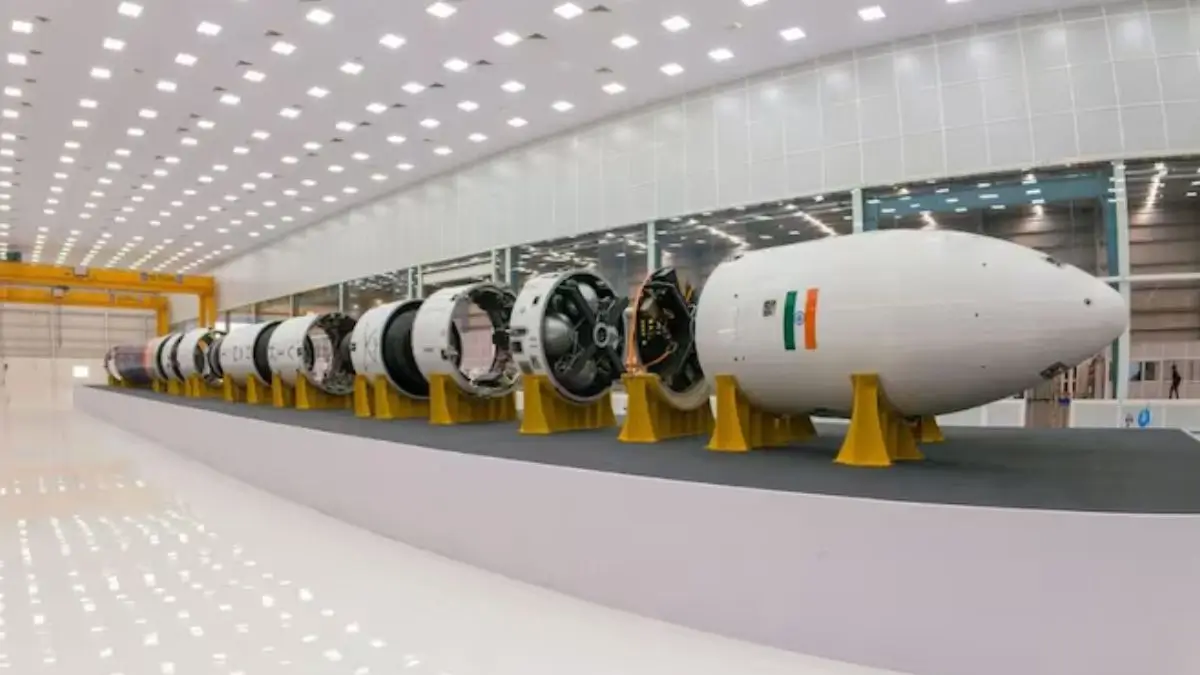
India marked the major milestone in the space journey as Skyroot Aerospace’s Vikram-1 which is the country’s first privately built orbital rocket was flagged off from the campus site in Hyderabad to the Sriharikota. This event indicates the new era where the private players are actively participating in the India’s space sector. It also aims to provide the affordable and on-demand satellite launch services in the rapidly growing market in the world.
Vikram-1 Moves Closer to Launch from Sriharikota
This rocket was ceremonially flagged off by the CM of Telangana A. Revanth Reddy from the Skyroot’s Max-Q campus in Hyderabad.
Its payload fairing the essential structure which will be protecting satellites during flight and it has now been transported to the Satish Dhawan Space Centre which is the India’s primary spaceport.
With this it marks the completion of critical pre-flight testing. Meanwhile the rocket’s propulsion stages are already stationed at the launch site and it setting the the stage for final integration and launch operations.
A Game-Changer for India’s Private Space Sector
The launch of Vikram-1 is expected to position the Skyroot Aerospace as the first private Indian company to attempt the orbital launch.
This is important shift from the India’s traditionally government-led space missions and they are dominated by Indian Space Research Organization.
The mission is being to be conducted under the authorization of IN-SPACe which regulates the private sector participation with the technical oversight from ISRO.
This collaboration showcases the India’s evolving public-private partnership model in space exploration.
What Makes Vikram-1 Special?
Vikram-1 is designed as the multi-stage orbital launch vehicle which is tailored for the growing small satellite market.
Key highlights includes the,
- It has ability to carry up to 350 kg payload to the Low Earth Orbit (LEO).
- It was built using all-carbon composite structures for the lightweight efficiency,
- It is powered by the 3D-printed engines and high-thrust solid fuel boosters.
- And also designed for on-demand and the cost-effective satellite launches.
The structure was standing as tall as a seven-storey building and the Vikram-1 represents the cutting-edge innovation which is developed entirely within India’s private sector.
Telangana’s Vision for Aerospace Growth
During the flag-off event honorable Chief Minister A. Revanth Reddy have emphasized the Telangana’s ambition to become a global aerospace hub.
The state government is focusing on to the,
- Skill development in the aerospace technologies.
- Also the partnerships with the global universities and industry leaders.
- And building the strong innovation ecosystem.
Question
Q. Consider the following statements regarding IN-SPACe.
- It is an autonomous agency under the Department of Space.
- It acts as an interface between ISRO and private space entities.
- It is responsible for launching satellites independently.
Which of the statements given above is/are correct?
A. 1 and 2 only
B. 2 and 3 only
C. 1 and 3 only
D. 1, 2 and 3







 Elon Musk Shows Tesla Roadster Performin...
 TRISHNA Satellite Mission 2027: ISRO-Fra...
 World Bank Ranks India Among Top 10 Emer...