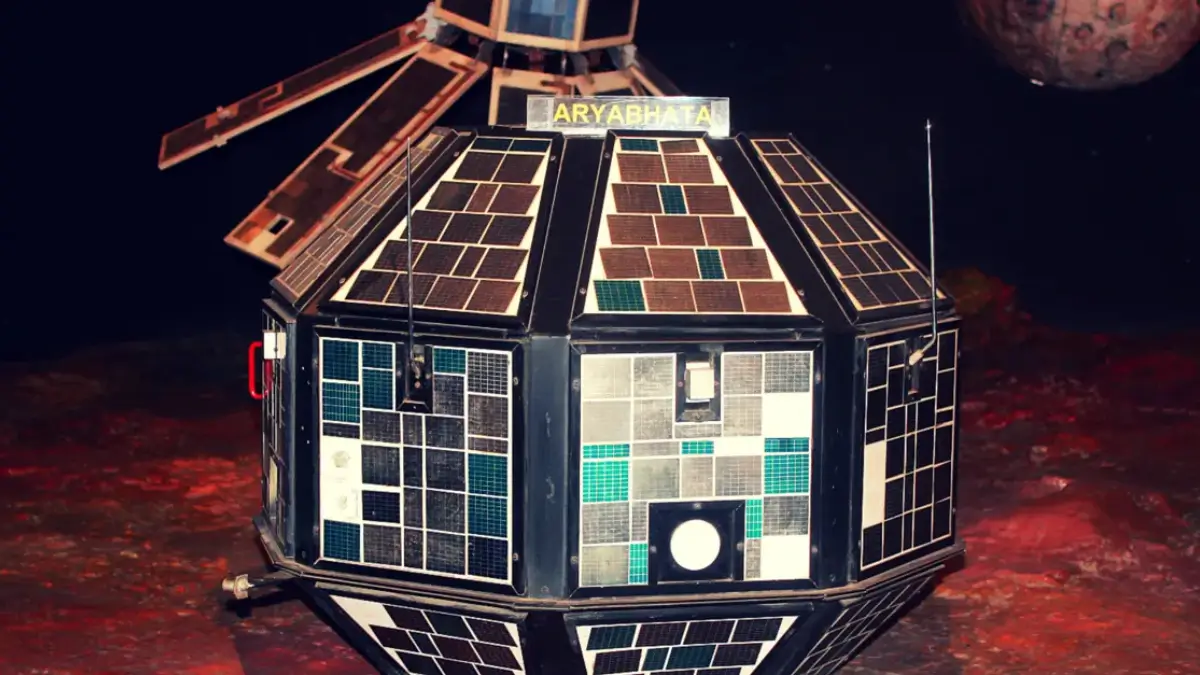
India has made great progress in space science, but every big journey begins with a small step. The launch of Aryabhata was one such important step. It was India’s first satellite and marked the country’s entry into space research. This mission helped Indian scientists learn many new things and laid the foundation for future space achievements.
Where was India’s First Satellite Aryabhata Launched From?
India’s first satellite, Aryabhata, was launched from Kapustin Yar, a space launch center in Russia (then part of the Soviet Union). The launch took place on 19 April 1975 using a Kosmos-3M rocket.
At that time, India did not have its own launch facilities, so the Soviet Union helped by launching the satellite under a cooperative program.
Why was Aryabhata Launched?
Aryabhata was not just a symbol of pride; it had scientific goals. It was designed to study:
- X-rays coming from space
- The Earth’s upper atmosphere
- The Sun and its activities
These studies helped scientists understand space better.
Design and Features of Aryabhata
The satellite had a unique shape and simple design:
- It looked like a multi-sided (26-sided) structure.
- Its surface was covered with solar panels to generate power.
- It weighed about 360 kg.
- It used a battery system to store energy.
This design was advanced for its time and completely built by Indian scientists.
What Happened After Launch?
After launch, Aryabhata faced some problems:
- It started rotating in an uncontrolled way.
- Some instruments stopped working.
- Within 4-5 days, its experiments stopped due to power failure.
Even though the mission ended early, scientists gained valuable experience.
How long Did it Stay in Space?
- The satellite stopped sending signals after a few days.
- However, it remained in orbit for many years.
- It finally re-entered Earth’s atmosphere on 10 February 1992.
Legacy of Aryabhata
Aryabhata holds a special place in India’s space history:
- It was named after the famous ancient mathematician Aryabhata.
- Its image was printed on Indian Rs.2 notes for many years.
- It gave confidence to Indian scientists to build more satellites.








 Weekly Current Affairs One Liners (5th t...
 Who Is Navi Pillay? Nobel Peace Prize 20...
 Vande Bharat vs Amrit Bharat Express: Ke...