
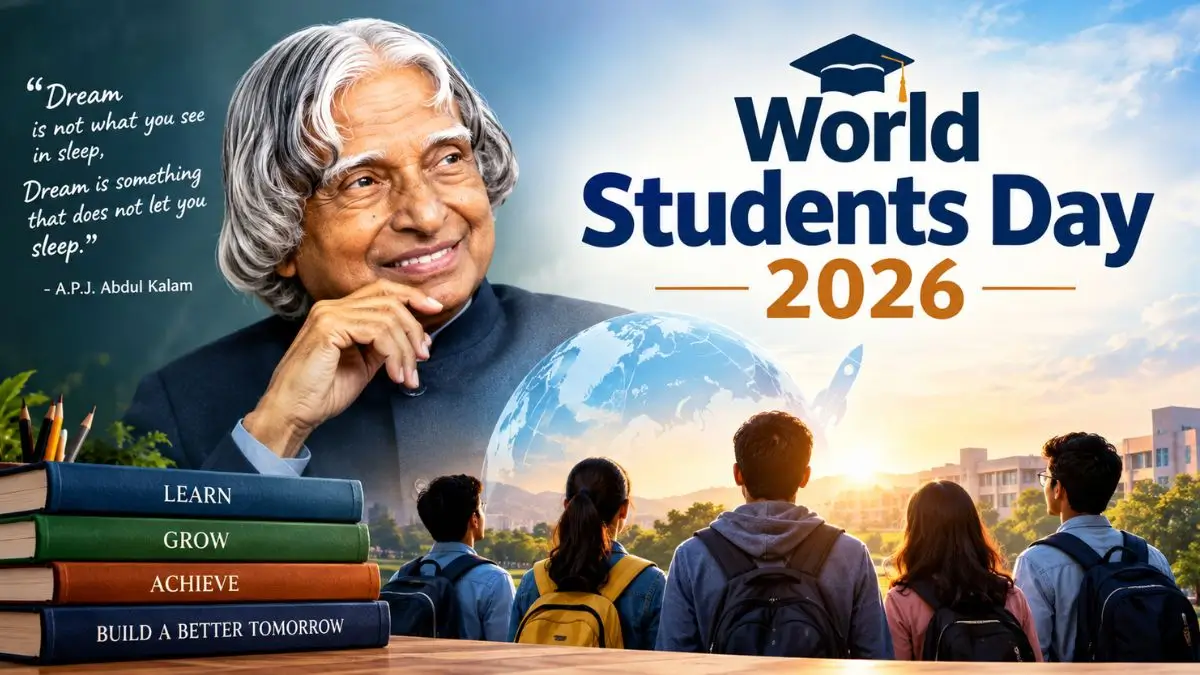
World Students’ Day is celebrated on 15 October in relation with the birthday of Dr. A. P. J. Abdul Kalam, former President of India and an eminent scientist working in the field of aerospace. Kalam, who was born in 1931, inspired many generations through his work in space research, missile research, education and development of the country. His 95th birthday will be celebrated on 15 October 2026. While World Students’ Day is celebrated at many educational institutions, it is not officially recognized as an international day by the United Nations.
World Students’ Day 2026
World Students’ Day 2026 celebrated worldwide on Thursday, 15 October 2026. The commemoration is associated with the birth of Dr. Kalam and his dedication towards education, scientific temper and empowerment of youth.
The theme of World Students’ Day 2026 has not been declared by any authority on a global scale. Various educational institutions celebrate World Students’ Day through the conduct of seminars, debates, science fairs and interactive sessions promoting creativity, independent thinking and leadership.
It should be noted that World Students’ Day is not one of the officially recognized international days by the UN. According to General Assembly Resolution 62/136 of 2007, 15 October has been declared by the UN as the International Day of Rural Women.
Who was Dr. APJ Abdul Kalam?
Dr. Avul Pakir Jainulabdeen Abdul Kalam was born on 15 October 1931 in Rameswaram, Tamil Nadu.
He was one of the leading aerospace scientists in India and served as the President of the country from 25 July 2002 till 25 July 2007. He was also known as ‘The People’s President’ owing to his approachable nature and interaction with youth.
Kalam studied physics in St. Joseph’s College, Tiruchirappalli, before choosing for the field of the aeronautical engineering in Madras Institute of Technology.
He later went on to work with the DRDO and ISRO, thereby making significant contributions towards India’s space program and native defence technologies.
He was honoured with Bharat Ratna, which is India’s highest civilian award in the year 1997. Kalam continued with his teachings and interaction with students after his presidential tenure. Kalam passed away on 27 July 2015 while delivering a lecture at IIM Shillong, Meghalaya.
Major Contributions of Dr. APJ Abdul Kalam
1. Space Research and SLV-III
- Kalam worked as Project Director of the first indigenously developed Satellite Launch Vehicle of India named SLV-III.
- It was successfully launched in July 1980 by putting the Rohini satellite into the near Earth orbit. This was an important achievement in the space programme of India. Kalam was also involved in the development of ISRO’s Launch Vehicle Programme.
2. Missile Development Programme
- Kalam was the Project Director of Integrated Guided Missile Development Programme (IGMDP) in DRDO. He helped in developing indigenous missile systems like Agni and Prithvi.
- For his involvement in missile development of India, he became known as “Missile Man of India.”
3. Pokhran II Nuclear Tests
- Kalam made a very important contribution scientifically and organisationally in the Pokhran II nuclear tests of India in May 1998 along with the Department of Atomic Energy.
4. Technology Vision 2020
- As TIFAC chairman, Kalam contributed to the creation of Technology Vision 2020, which served as a plan of how to develop India into a developed country.
- This vision was focused on increased agricultural output, technical advances, better healthcare, good quality education and national self-sufficiency. This is in accordance with his belief that science must help to improve people’s standard of living and development.
5. Healthcare and Rural Development
- Moreover, Kalam believed in the use of technology for healthcare and rural development. Together with a cardiologist B. Soma Raju, Kalam took part in the invention of Kalam-Raju Stent and Kalam-Raju Tablet, which were aimed at making cardiac treatment cheaper and accessible.
- His idea of Providing Urban Amenities to Rural Areas (PURA) involved better infrastructure, communications, services and economy of rural areas to balance development between rural and urban populations.
6. Education and Literary Contributions
- Most of his later years Kalam dedicated to teaching and working with students. His aim was to encourage youth to be scientific, think independently and unite their ambition with the development of the country.
Dr. APJ Abdul Kalam Awards and Honours
- Bharat Ratna (1997)
- Padma Bhushan (1981)
- Padma Vibhushan (1990)
- Indira Gandhi Award for National Integration
- Veer Savarkar Award
- Honorary Doctorates





 Mahila Kisan Diwas 2026 to Highlight Wom...
 International Day for Disaster Risk Redu...
 National Human Rights Commission to Mark...