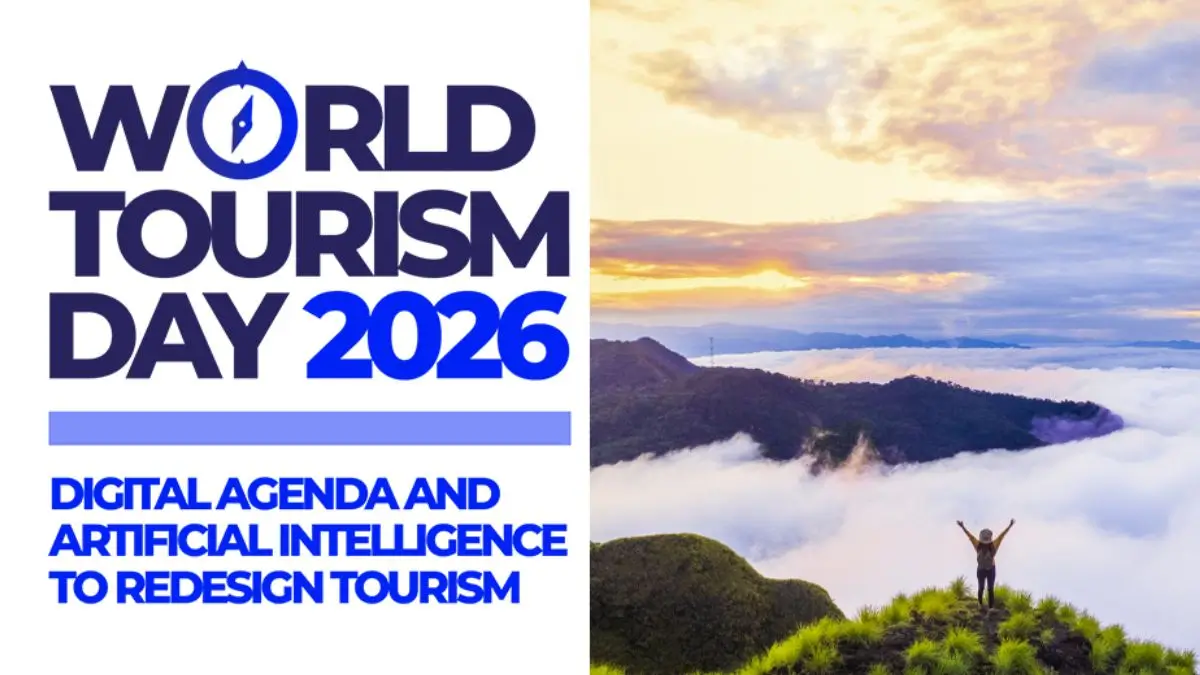
World Tourism Day is marked every year on September 27, and in 2026, the theme of the day will be ‘Digital Agenda and Artificial Intelligence to Redesign Tourism’. In 2026, the world celebration of the day is taking place in El Salvador. The theme signifies the rising importance of digital technologies and Artificial Intelligence (AI) in tourism. The Ministry of Tourism in India has been leveraging digital technology, AI-based solutions and destination development initiatives for tourism expansion.
World Tourism Day: History
World Tourism Day marks the adoption of the Statutes of the World Tourism Organization in 1970. The first-ever World Tourism Day was marked in 1980.
The day focuses on the contribution of tourism to the economy, society and culture, and its link to sustainable development and the SDGs. The former United Nations World Tourism Organization (UNWTO) is now known as UN Tourism.
- Day: World Tourism Day
- Observation Date: September 27
- First celebrated Year: 1980
- Reason for celebration: Adoption of WTO Statutes in 1970
- Theme in 2026: Digital Agenda and Artificial Intelligence to Redesign Tourism
- Destination in 2026: El Salvador
- International body: UN Tourism
The Role of the Tourism Sector in India’s Economy
Tourism is becoming increasingly significant as an economic activity in India. As per the latest Tourism Satellite Account figures provided by the Ministry of Tourism, the tourism sector added up to 5.22% of India’s GDP in 2023-24.
Moreover, tourism employment has risen from 6.94 crore in 2019-20 to 8.46 crore in 2023-24. Tourism accounts for about 13.3% of total employment in 2023-24 according to government data.
India Tourism: Key Numbers
| Indicator | Number |
| Tourism’s contribution to the GDP | 5.22% |
| Tourism Employment 2023-24 | 8.46 crore |
| Domestic Tourist Visitations 2025 | 428.55 crore |
| Foreign Tourist Visitations 2025 | 2.53 crore |
| Foreign Exchange Earned through Tourism 2025 | ₹2,76,831 crore |
According to the 2026 PIB backgrounder, the number of domestic tourist visitations stood at 428.55 crore in 2025, and the number of foreign tourists’ visitations stood at 2.53 crore, and foreign exchange earned through tourism stood at ₹2,76,831 crore.
Artificial Intelligence and Digital Tourism in India
The 2026 theme ensures that AI becomes the key element of the evolving tourism environment. AI can assist in travel planning, destination identification, personalized suggestions, real-time information and tourism-related decision-making.
The Incredible India Digital Platform (IIDP), which has been revamped, makes use of an AI-based tool for personalization of visitor experience. The features include provision of information and virtual experience on topics including culture, heritage, adventure, food, health and wellness, arts and crafts, and rural tourism. At the same time, it helps tourists in connecting with stakeholders involved in the tourism industry and booking facilities.
The features provided by the platform include real-time weather information, exploring the city, essential services and, most importantly, the provision of information on registered tourism service providers through NIDHI.
Electronic Visa: Easing International Travel through Technology
The e-Visa scheme of India, launched in 2014, has seen immense growth since then. As per the government backgrounder of 2026, this scheme can be used by citizens of 172 countries and can be availed via 88 identified ports.
The electronic visa program has been considered as a vital step taken by the Indian government for making international traveling easy. As per the claim of the government, 78% of the visas have now become electronic, while 95% of the e-Visa applications have been sorted within 72 hours.
NIDHI+: National Integrated Database of Hospitality Industry
NIDHI+ is an acronym for National Integrated Database of Hospitality Industry which acts as a platform for digital registration, recognition, and classification of tourism and hospitality service providers.
This platform includes categories like accommodation units, convention centers, food business operators, online travel aggregators, among others. It also facilitates e-delivery of services and unique NIDHI ID for registered entities.
As at September 23, 2026, the government had recorded 63,740 accommodation units, 54 convention centers, 215 food business operators, 1,450 online travel aggregators and 15,531 tourism service providers under NIDHI+.
Digital Tourism Initiative between India & Google
An agreement has been signed by the Ministry of Tourism of India with Google India in the month of June 2026 for promoting digital tourism in India.
The collaboration will focus on areas such as digital technology, artificial intelligence, data analytics and capacity building. The other areas that will be covered are digital marketing, content creation and campaign optimization.
Important Government Initiatives for Tourism
In India, tourism growth involves transformation through technology and destination infrastructure along with cultural tourism and skill development.
Swadesh Darshan 2.0
Swadesh Darshan is an initiative taken up by the Ministry of Tourism in 2014-15 for developing tourism circuits based on themes that have been identified.
Swadesh Darshan 2.0 follows a more destination-centric and tourist-centric approach with a focus on responsible and sustainable tourism, good experience and improvement in destination infrastructure.
PRASHAD
PRASHAD means Pilgrimage Rejuvenation and Spiritual, Heritage Augmentation Drive. This scheme was initiated in 2014-15 to improve the tourism infrastructure and facilities in identified pilgrimage and heritage destinations.
Some of the types of interventions under this scheme include visitor facilities, accessibility, cleanliness, safety and other destination infrastructure.
Skill Development for Tourism
Tourism development requires skilled professionals in hospitality, transport, guiding, food services and other allied sectors. The Capacity Building for Service Providers (CBSP) initiative under the Ministry helps in skill development, upgradation and reskilling.
The Paryatan Mitra/Paryatan Didi scheme also aims to skill up local service providers in areas like hospitality, cleanliness, safety and sustainability.
Various Types of Tourism in India
The tourism scenario in India goes beyond the ordinary. Some of these are,
- Pilgrim and religious tourism: Ayodhya, Varanasi, Bodh Gaya, Amritsar, Tirupati and Puri.
- Buddhist tourism: Bodh Gaya, Sarnath and Kushinagar.
- Heritage and culture tourism: Forts, palaces, temples, heritage, museums, crafts and festivals.
- Wellness tourism: Yoga, Ayurveda and indigenous system of medicines.
- Nature and wildlife tourism: National parks, tiger reserves, wetlands, forests and nature trails.
- Community and rural tourism: Homestay, village experience, local cuisine and crafts.
- Cruise tourism: Coastal and inland waterways tourism.
- Meetings, Incentives, Conferences & Exhibitions (MICE).
This diversification of tourism activities helps in going beyond the conventional destinations and cities.
Tourism, Sustainability, and Connectivity
Digital transformation is being linked with physical infrastructure and destination development. Programs like Swadesh Darshan 2.0, PRASHAD, and other destination development programs are working towards enhancing tourist infrastructure and at the same time helping local communities.
Connectivity is yet another critical aspect. Enhanced air, road, rail, and water connectivity will help integrate new destinations into the tourism sector and will provide local business opportunities to artisans, hospitality service providers, and local communities.
Therefore, the tourism policy of the government includes all these different aspects of tourism rather than focusing on any one thing.





 World Food Day 2026: Theme, History, Sig...
 Mahila Kisan Diwas 2026 to Highlight Wom...
 World Students’ Day 2026: Date, Signif...