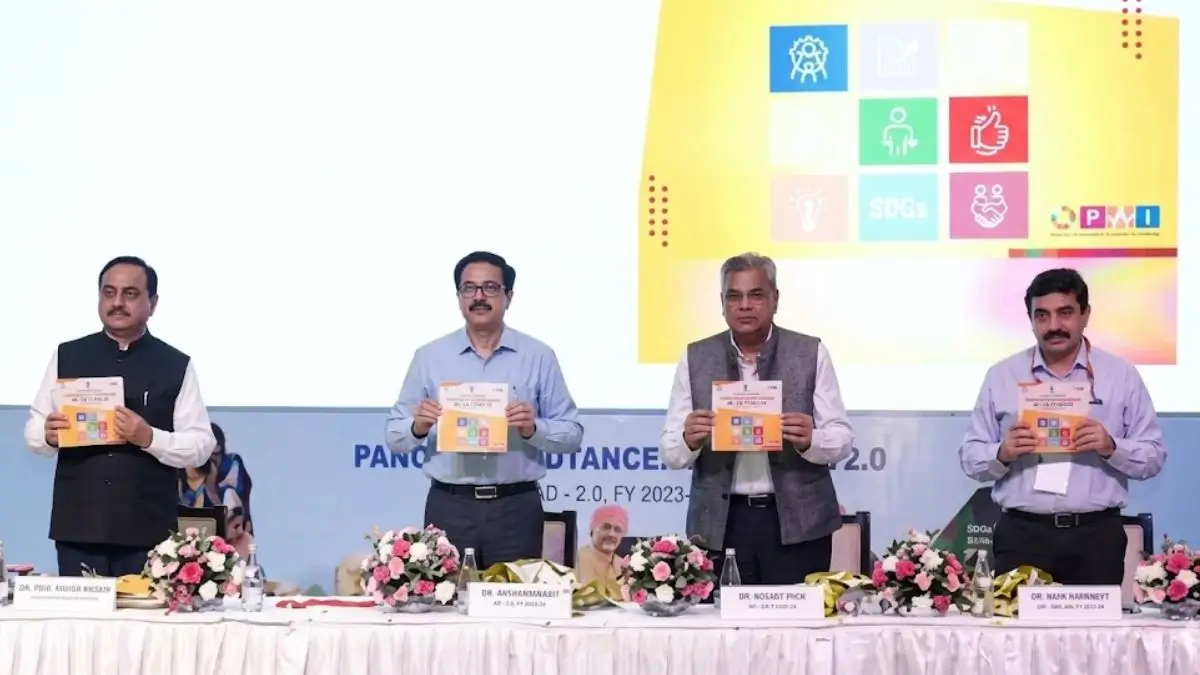
The Ministry of Panchayati Raj had released the Panchayat Advancement Index (PAI) 2.0 Report on the National Panchayati Raj Day (24th April). This report highlights the strong improvements in rural development with the 3,635 Gram Panchayats emerged as the Front Runners. With the record 97.3% participation from across the country the India PAI 2.0 serves as the comprehensive performance report card and showcasing the progress in the several key areas like livelihoods, health, governance and social development at the grassroots level.
PAI 2.0 Report: Key Highlights
The Panchayat Advancement Index 2.0 provides the detailed assessment of the rural governance performance across India. It covers over the 2.59 lakh Gram Panchayats across 33 States and Union Territories in India and making it as one of the largest data-driven governance exercises in country.
Out of the total participating Panchayats,
- Total 3,635 Gram Panchayats are categorized as the Front Runners (A Grade).
- Nearly 1,18,824 Panchayats (45.72%) fall under the Performer category (B Grade).
- The remaining Panchayats are classified under the Aspirant and Beginner categories.
This classification will helps to identify the high-performing Panchayats and those needing targeted support.
Record Participation and Improved Framework
PAI 2.0 achieved the impressive 97.30% participation rate which is the major improvement from the 80.79% in PAI 1.0. The total of 2,59,867 Gram Panchayats submitted the validated data.
The updated version introduces the several important improvements,
- The single integrated data entry system.
- Mandatory Gram Sabha validation for the transparency.
- Real-time dashboards for the better monitoring.
- And data integration from national portals.
- Also the support for the vernacular languages.
These changes have made the system more efficient, transparent and the user-friendly.
Top Performing Areas: Livelihoods and Health
The report highlights the strong performance in the key development themes under the Localization of Sustainable Development Goals (LSDGs).
Poverty-Free and Enhanced Livelihoods
Under this theme the total 3,313 Gram Panchayats achieved A+ grade which is indicating the significant progress in the,
- Poverty reduction
- Employment generation
- The economic development at the village level
Healthy Panchayats
A total of around 1,015 Panchayats secured A+ grade in this category which signals the improvements in,
- Preventive healthcare
- Nutrition awareness
- Sanitation and hygiene
- Community participation
What is Panchayat Advancement Index (PAI)?
The Panchayat Advancement Index is the India’s first nationwide data-driven framework to assess the performance of Gram Panchayats in the India.
It evaluates the Panchayats based on the,
- 150 indicators
- 230 data points
- 9 key themes which includes the poverty, health, water, infrastructure, governance and the women’s empowerment.
Compared to PAI 1.0 which had over the 500 indicators the PAI 2.0 has been simplified for better usability and sharper focus.
Performance Categories Explained
Based on the composite scores these Panchayats are classified into five categories.
- Achiever (A+): Score 90 and above
- Front Runner (A): Score 75–90
- Performer (B): Score 60–75
- Aspirant (C): Score 40–60
- Beginner (D): Below 40
This grading system encourages the healthy competition and helps to governments identify the areas needing improvement.
State-Wise Insights and Trends
The report highlights the wide participation across the states like Uttar Pradesh, Maharashtra, Gujarat, Tamil Nadu and Andhra Pradesh which contributed the large number of Panchayats.
States like the Kerala and Tripura showed strong performance in higher categories which indicating the effective local governance models.
However some of the regions still have the higher number of Panchayats in the Aspirant and Beginner categories and it shows the need for targeted interventions.








 India Plans Mandatory Automatic Emergenc...
 India Notifies New Telecom Rules for Tes...
 MeitY Forms Special Team to Investigate ...