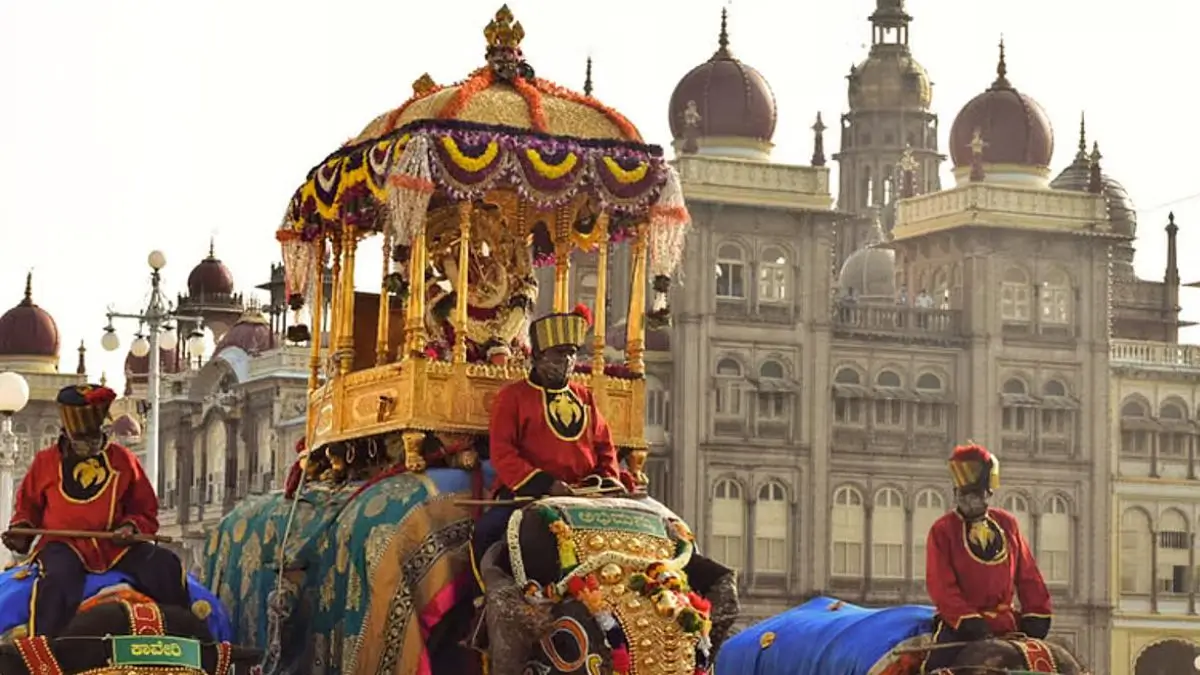
Mysuru Dasara, also referred to as Nada Habba in Karnataka, is an annual event that encompasses various traditions in Hinduism, regal lineage, and Karnataka culture. This festival marks the victory of the goddess Chamundeshwari over the demon Mahishasura and ends with the famous Jamboo Savari procession on Vijayadashami. This tradition of celebrating the Mysuru Dasara began in 1610 with the initiation by Raja Wadiyar I. In 2026, the 11 days long Mysuru Dasara is planned for October 11 to October 21.
History of Mysuru Dasara: From Vijayanagara to the Wadiyars
The history of Mysuru Dasara dates back to over four hundred years ago. The rituals associated with the celebration are related to the Mahanavami rituals of the Vijayanagara Empire where royal rituals, parades, wrestling, music, and other public performances were held.
Following the fall of the Vijayanagara Empire in 1565, rulers of various regions upheld traditions of similar festivals in their regions. For instance, Raja Wadiyar I celebrated the festival in Srirangapatna in 1610 which is seen as the origin of the Mysuru Dasara tradition. Srirangapatna was the capital of the Wadiyars at that time.
In the ensuing centuries, the festival was celebrated under the rule of the Wadiyar dynasty. Royal performances and Durbar became significant aspects of the festival while later kings made it a grand festival comprising of public performances.
Currently, the Government of Karnataka and Mysuru district administer Dasara as the state festival.
Religious Importance: Goddess Chamundeshwari and Mahishasura
Religiously speaking, the origin of Mysuru Dasara lies in the mythological story of Goddess Chamundeshwari, an avatar of Goddess Durga, defeating Mahishasura. According to Hindu mythology, Mahishasura was an important personality who had the ability to take the form of a buffalo. Defeating Mahishasura by the Goddess means overcoming evil by good.
This legend is directly linked to Chamundi Hills, which overlook Mysuru and host the Sri Chamundeshwari Temple. The city’s name itself is related to Mahishasura while the Goddess is worshipped as the presiding deity of the city.
The legend is also associated with the religious importance of Navratri and Vijayadashami. As per Shakta tradition, the victory of the Goddess is celebrated on the tenth day following nine days of worship.
Chamundeshwari Temple and the Start of the Festival
The Sri Chamundeshwari Temple in the Chamundi Hills is important for starting the festival processions. People come to pray and get blessings from this place. Ceremonies related to the Goddess begin the festival.
Moreover, the festival includes royal ceremonies like the Durbar that have to do with the Mysuru Palace. The traditions mentioned above help to keep the link between the public festival today and the Wadiyar dynasty.
So, the Mysuru Dasara processions are not about one procession only.
The Jamboo Savari – The Great Vijayadashami Parade
The main event of Mysuru Dasara is the Jamboo Savari parade that will take place on Vijayadashami, which falls on October 21, 2026. The idol of the Goddess Chamundeshwari will be placed in a golden howdah on top of the elephant.
The parade begins from Mysuru Palace and ends five kilometres away in Bannimantap. Elephants, folk artists, traditional musicians and tableaux participate in the parade, making the historical streets of Mysuru a place of celebration of Karnataka culture.
In addition to that, tableaux depicting various topics including the culture of region and the accomplishments of the citizens of Karnataka can be seen during the parade.
What is a Golden Howdah?
A howdah is a seat or platform built for use on top of an elephant. At the Jamboo Savari parade, the idol of the goddess Chamundeshwari is carried in a golden howdah.
Panjina Kavayathu: Torchlight Parade
The grand finale of the festival is the torchlight parade called “Panjina Kavayathu,” which takes place in Bannimantap. There are some ceremonial performances that mark the end of the day’s festivities.
The parade is one of the important traditions in terms of the connection of the celebration to the military and royalty. Both Jamboo Savari and Torchlight Parade are the most popular traditions of Vijayadashami in Mysuru.
Other Activities at Mysuru Dasara
This Dasara 2026 program offers something more than just the procession itself with more than 100 activities to be organized across various locations. They include both traditional activities and entertainment for the public.
Activity/Attraction and It’s Importance
- Illumination of palace: The famous palace of Mysuru is illuminated during the festival period.
- Cultural program: Cultural programs such as music, dance, folklore, etc., are organized during the event.
- Aahara Mela: Food festival is organized at Mysuru Dasara festival.
- Flower Show: Flowers also contribute to making this festival a popular attraction.
- Kambala: Buffalo race is an important feature of this 2026 program.
- Dasara Exhibition: A popular attraction in this festival.




 Dussehra Celebrations Across India: 12 U...
 Ravana in the Ramayana: 10 Facts About t...
 History of Student Protests in France: F...