
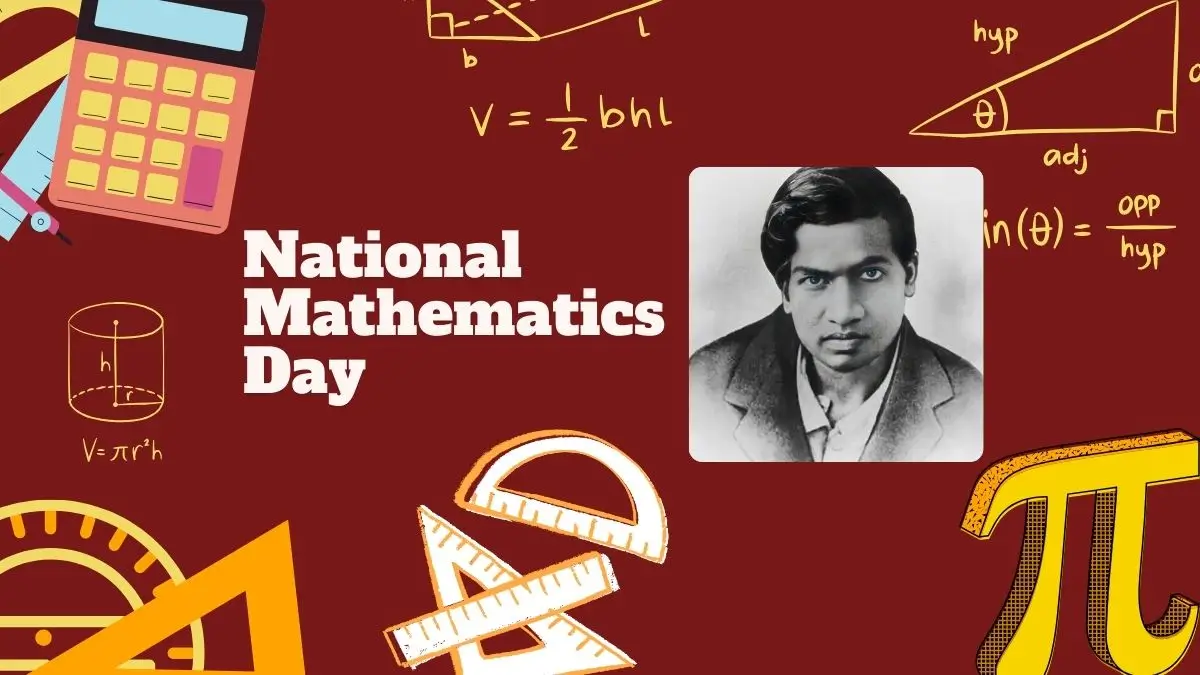
National Mathematics Day is celebrated every year on December 22 across India. The day marks the birth anniversary of Srinivasa Ramanujan who was one of the greatest mathematicians India has ever produced. In 2025, schools, colleges, research institutions, and academic bodies are once again observing this day to underline the importance of mathematics in education, science, technology, and daily life.
Purpose of National Mathematics Day
National Mathematics Day is not just a tribute to Ramanujan. It has broader educational and social goals. The main purpose of the observance is to,
- Encourage students to take interest in mathematics
- Promote scientific thinking and problem-solving skills
- Highlight the role of mathematics in technology, space science, economics, and daily life
- Recognise India’s long and rich mathematical heritage
Educational institutions organize lectures, workshops, quizzes, and exhibitions to make mathematics more approachable and engaging.
Why December 22 Is Observed as National Mathematics Day?
- December 22 is the birth date of Srinivasa Ramanujan, born in 1887.
- His work continues to influence modern mathematics even more than a century later.
- The Government of India formally declared December 22 as National Mathematics Day in 2011.
- The decision was taken to recognize Ramanujan’s extraordinary and original contributions to mathematics, many of which were far ahead of their time.
- To further promote mathematical learning 2012 was celebrated as the National Mathematics Year across the country.
India’s Ancient and Rich Mathematical Tradition
India has a deep rooted history in mathematics, dating back several thousand years. As per the official records cited by the Press Information Bureau, India’s mathematical contributions can be traced to as early as 1200–1800 BCE.
Some of the most important concepts that originated in India include,
- The decimal number system
- The concept of zero
- Early ideas of negative numbers
Between the 4th and 16th centuries, often referred to as the classical and medieval periods of Indian mathematics, scholars such as Aryabhatta, Brahmagupta, Varahamihira, and Bhaskara II made major contributions to arithmetic, algebra, geometry, and trigonometry.
National Mathematics Day also helps place Ramanujan within this long and continuous intellectual tradition.
Srinivasa Ramanujan: Life and Contributions
- Srinivasa Ramanujan is remembered for his groundbreaking work in number theory, infinite series, continued fractions, and mathematical analysis.
- Despite having very limited formal education, he independently discovered nearly 3,900 mathematical results, many of which were later proven to be both original and deeply significant.
- Ramanujan’s approach to mathematics was highly intuitive.
- Many of his formulas and ideas initially puzzled mathematicians but later became central to modern research.
- Today, his work finds applications in theoretical physics, computer science, cryptography, and advanced mathematics.
His life story continues to inspire students by showing how talent, curiosity, and perseverance can overcome difficult circumstances.
Relevance of National Mathematics Day Today
In today’s world mathematics plays a key role in areas such as,
- Artificial Intelligence and Data Science
- Space research and engineering
- Economics and financial systems
- Climate modelling and medical research
By celebrating National Mathematics Day India reinforces the importance of mathematics as a foundation for innovation and national development. The day also supports efforts to improve mathematical literacy and research capacity in the country.
Key Takeaways
- National Mathematics Day is observed on December 22 every year
- It marks the birth anniversary of Srinivasa Ramanujan (1887–1920)
- The day was declared in 2011 by the Government of India
- 2012 was celebrated as the National Mathematics Year
- Ramanujan made major contributions to number theory and infinite series
- India has a long mathematical tradition, including the invention of zero and the decimal system
Question
Q. National Mathematics Day was declared by the Government of India in which year?
A. 2005
B. 2011
C. 2012
D. 2020








 International Day for Disaster Risk Redu...
 National Human Rights Commission to Mark...
 World Arthritis Day 2026: Date, Theme, H...










