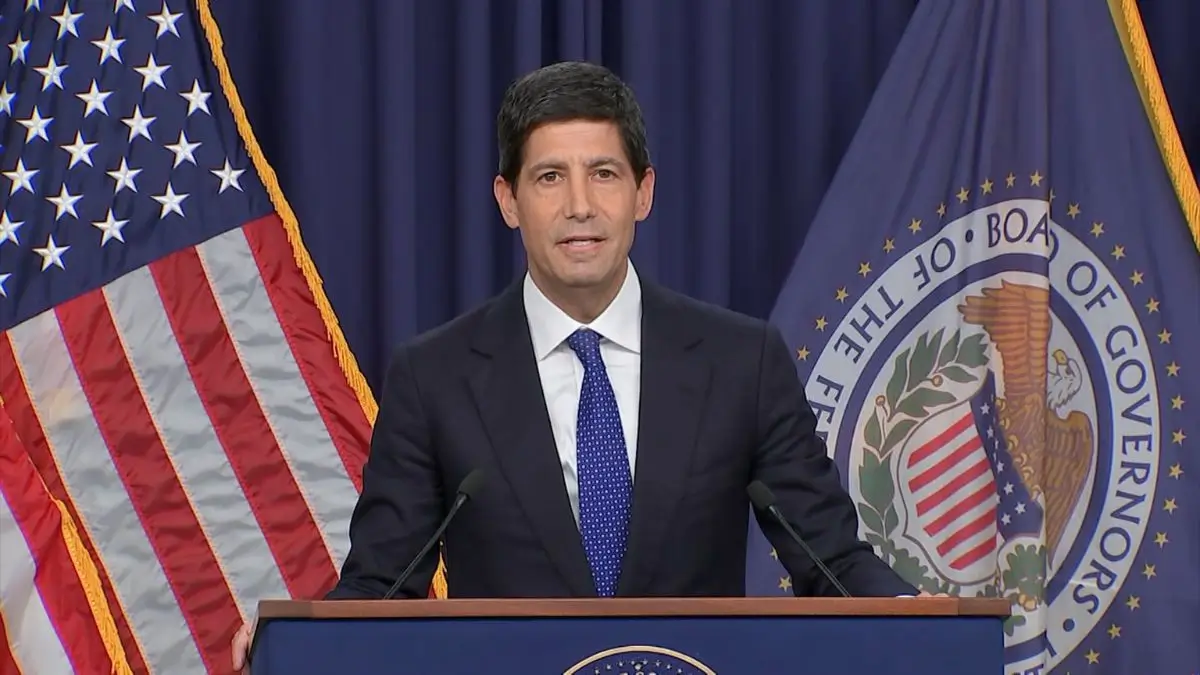
The US Federal Reserve increased the its federal funds rate by 25 basis points on Wednesday, 16th September, 2026. This increased the federal funds target range up to 3.75%-4%. The unanimous decision marked the first rate hike since July 2023 and the first policy move of Fed Chairman Kevin Warsh, who assumed office in May. Revised projections suggested that the policymakers viewed further rate hikes as feasible by year-end, including another quarter-point increase.
Why Did the Federal Reserve Raise Rates?
In an FOMC statement, economic activity was seen growing at a moderate pace with robust domestic demand and good productivity gains, even as inflation remained elevated, thus necessitating an increase in borrowing costs.
Policymakers were concerned about rising inflation that required inflation readings to show sustained moves toward the Fed’s 2% objective.
Rising energy prices, geopolitical uncertainties, and other persistent price pressures have caused worries over rising inflation levels. According to Reuters, policymakers were becoming concerned about energy price increases affecting inflation expectations.
Signs of an Additional Rate Rise in 2026 by the Fed
The new projections of the Fed show the potential for the Fed to raise the rate again this year. Sixteen out of 18 policymakers expressed their views that another rate rise by a quarter percentage point would be suitable by the end of 2026, according to the projections provided in the supplied articles. Warsh did not project any rate.
The federal funds rate is expected to remain at 4%-4.25% towards the end of 2026, while the policymakers are generally optimistic that the rate will remain at this level in 2027.
Projections for Inflation and Economic Activity
The Fed increased its inflation rate projections for 2026, where the personal consumption expenditures (PCE) inflation rate stood at 3.7%. According to the latest projections of the Fed, the inflation rate will go back to the 2% target of the Fed in 2029.
US economic growth forecasts have been revised upwards to 2.3%, while the unemployment rate stands at around 4.1%.
The combination of economic activity and inflation gives policymakers some room to keep monetary policy tight amid new data being released.
Is Other Central Banks Are Increasing Interest Rates Too?
In the wake of the above Fed’s move, there has been a re-evaluation of monetary policies in several other countries, with the central banks of the UAE and Bahrain increasing their key rates by 25 basis points each.
Similarly, the European Central Bank too has been responding to the resurgence in inflationary pressures, while the Bank of Japan is concerned about imported inflation and the weakening of the yen.
This shows that global inflation can be caused by things other than domestic demand, including energy prices, exchange rates, supply shocks and geopolitical risks.
Will the RBI Increase the Repo Rate?
While the RBI did not follow up with an interest rate hike post the Fed’s decision, its next MPC meeting is scheduled from October 5 to October 7, 2026. At its last meeting, the RBI left the repo rate unchanged at 5.25%.
However, with the emergence of renewed inflationary pressures, expectations of a rate hike have gone up. SBI Research has recommended a 25-basis point rate hike in October, followed by another 25-basis point rate hike in December on account of several factors including rising crude oil
Why Does Inflation Matter for the RBI?
The monetary policy of the RBI is focused on controlling inflation based on the Consumer Price Index (CPI) at 4%, with a range of 2% to 6%.
If there is an increase in inflation, the purchasing capacity of the consumers will get affected, which can make it hard for the central bank to keep prices stable. An increase in interest rates would make borrowing costlier and help in controlling inflation.
But on the other hand, the RBI needs to keep the economic growth in mind because an increase in interest rates would make borrowing expensive.
Effect of Interest Rates of US Federal Reserve on Indian Economy
An increase in US interest rates will affect India through multiple means.
1. Flow of Foreign Investments
An increase in the interest rates of the US will make the investments in the US attractive. Global investors might shift their investments away from emerging markets such as India.
2. Indian Rupee
An increase in US interest rates can result in an appreciation in the US dollar. If the US dollar appreciates relative to the Indian rupee, then the Indian currency will be under the threat of depreciation.
3. Imported Inflation
Depreciation in the value of rupee will have the effect of increasing the price of imports in India. This is especially true for commodities like oil, along with other machinery and electronics.
4. Indian Stock Market
US monetary policy changes will affect global risk sentiments along with portfolio flows. Thus, higher US interest rates can cause volatility in the Indian stock market.
5. Bond Markets
An increase in interest rates of US Treasuries could lead to a comparison of return on emerging market bonds, which can put Indian government bonds under pressure.
6. RBI Monetary Policy
Reserve Bank of India (RBI) looks at inflation and growth conditions domestically as well as global financial conditions when it sets its policies. Any change in interest rates in the US is thus one aspect of an overall external environment in which RBI works.
7. Economic Growth
Rising global cost of borrowing and reduced capital flows can create problems in investments and economic activity. The effects of this on India will depend on many factors such as demand, inflation, financial condition, among others.
8. IT and Exports
Monetary policy in the US can affect the economy and spending habits in the US. Changes in US demand will have a bearing on IT firms and exports among others in India.
Fed Interest Rate Hike vs Fed Interest Rate Cut
| Basis | Fed Interest Rate Hike | Fed Interest Rate Cut |
| Borrowing Cost | Increases | Decreases |
| Consumer Spending | Usually falls | Usually rises |
| Business Investment | May decline | May increase |
| Inflation | Helps control inflation | May increase inflationary pressure |
| Economic Growth | May slow growth | Supports economic growth |
| Employment | May reduce hiring over time | Can support job creation |
| US Dollar | May strengthen | May weaken |
| Global Capital Flows | Can attract capital to US assets | Can reduce the attractiveness of US assets |
| Indian Economy | May cause capital outflows and pressure on the rupee | Can support capital inflows and reduce pressure on the rupee |








 Russia Suspected Plague Case: Nearly 200...
 India’s Russia-Ukraine Ceasefire Propo...
 COP31 2026: Venue, Dates, President, Key...