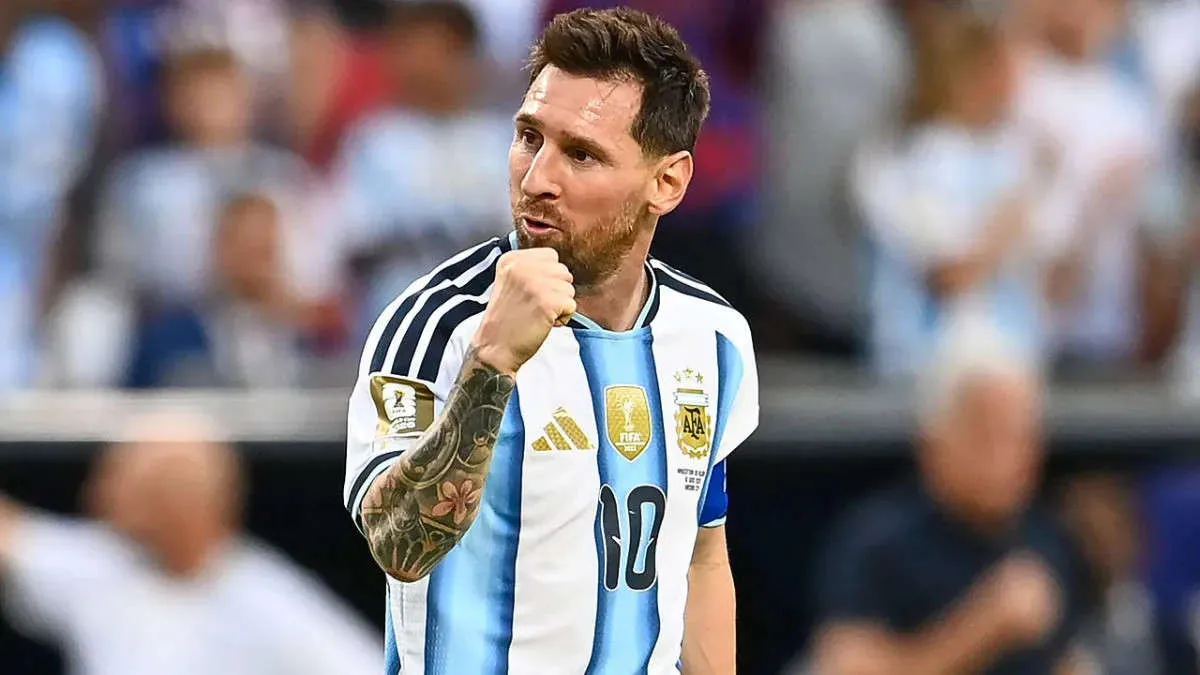
The FIFA World Cup 2026 has added another historic moment to football’s biggest stage as Argentina captain Lionel Messi became the highest goal scorer in FIFA World Cup history. During the ongoing tournament hosted across the United States, Canada and Mexico, Messi surpassed Germany’s legendary striker Miroslav Klose and reached a record tally of 18 World Cup goals.
At the same time, France’s Kylian Mbappé has intensified the race by reaching 16 goals, equalling Klose’s previous benchmark and emerging as the strongest contender to challenge Messi’s newly created record.
With an expanded 48-team format and more fixtures than previous editions, the 2026 FIFA World Cup has created a platform for players to redefine football history. While team success remains the ultimate objective, individual milestones such as the all-time goal-scoring record continue to capture worldwide attention.
Lionel Messi Creates New World Cup History
Lionel Messi’s World Cup journey represents one of football’s most remarkable examples of longevity and consistency.
Making his FIFA World Cup debut in 2006, Messi entered the tournament as a young talent and gradually transformed into Argentina’s captain and leader. Across six editions of the tournament, he continued to adapt his style while maintaining elite performance.
His World Cup goal progression reflects that evolution:
| World Cup | Goals |
|---|---|
| 2006 | 1 |
| 2010 | 0 |
| 2014 | 4 |
| 2018 | 1 |
| 2022 | 7 |
| 2026 | 5 |
| Total | 18 |
Messi’s performances across different football eras make his record significant. Unlike earlier decades when attacking football produced higher scores, modern tournaments involve more tactical discipline and stronger defensive structures.
By reaching 18 goals, Messi has established a new milestone in international football.
Kylian Mbappé Emerges as Messi’s Biggest Challenger
While Messi currently occupies the top spot, Kylian Mbappé has rapidly built one of the strongest World Cup records in history.
The French forward reached 16 goals in only three editions of the tournament—2018, 2022 and 2026.
Mbappé first announced himself globally during France’s title-winning campaign in 2018. He later strengthened his reputation in 2022 with another high-scoring tournament and continued his momentum in 2026.
His progression:
| World Cup | Goals |
| 2018 | 4 |
| 2022 | 8 |
| 2026 | 4 |
| Total | 16 |
Considering his age and scoring rate, many observers believe Mbappé could potentially challenge the all-time record in future editions.
Miroslav Klose: The Record Holder Who Defined Consistency
Before Messi’s achievement, Miroslav Klose held the record for over a decade.
The German striker scored 16 goals across four World Cups and became famous for his positional intelligence and clinical finishing.
His World Cup performances included:
- 2002 – 5 Goals
- 2006 – 5 Goals
- 2010 – 4 Goals
- 2014 – 2 Goals
Klose achieved his landmark goal during Germany’s memorable semifinal victory against Brazil in the 2014 FIFA World Cup before eventually lifting the trophy.
Although overtaken in 2026, Klose remains one of the greatest tournament performers in football history.
Top 10 FIFA World Cup Goal Scorers (All-Time)
| Rank | Player | Country | Goals | Matches |
| 1 | Lionel Messi | Argentina | 18 | 28 |
| 2 | Kylian Mbappé | France | 16 | 16 |
| 2 | Miroslav Klose | Germany | 16 | 24 |
| 4 | Ronaldo Nazário | Brazil | 15 | 19 |
| 5 | Gerd Müller | West Germany | 14 | 13 |
| 6 | Just Fontaine | France | 13 | 6 |
| 7 | Pelé | Brazil | 12 | 14 |
| 8 | Jürgen Klinsmann | Germany | 11 | 17 |
| 9 | Sándor Kocsis | Hungary | 11 | 5 |
| 10 | Gabriel Batistuta | Argentina | 10 | 12 |
Football Legends Behind the Numbers
The all-time goal list also tells the story of football’s changing styles.
Players like Just Fontaine and Sándor Kocsis played in an era where attacking football created higher-scoring games. Fontaine’s 13 goals in a single World Cup remains one of football’s most extraordinary records.
Modern stars such as Messi, Klose and Mbappé have achieved success in more tactical and defensively organized environments.
Brazilian legends Pelé and Ronaldo helped shape football history through dominance across generations, while Gabriel Batistuta became famous for maintaining a remarkable scoring ratio for Argentina.
FIFA World Cup 2026: What Makes This Edition Different?
The FIFA World Cup 2026 is historic for multiple reasons:
- First World Cup jointly hosted by three countries
- Expanded from 32 teams to 48 teams
- Increased number of matches
- Greater opportunity for emerging nations
- More records expected across goals, appearances and participation
The expanded structure has created conditions for players to accumulate more appearances and potentially challenge long-standing records.








 Pramod Bhagat and Bhavina Patel Named In...
 Lionel Messi’s Argentina Farewell: Wor...
 Lionel Messi International Career: Stats...