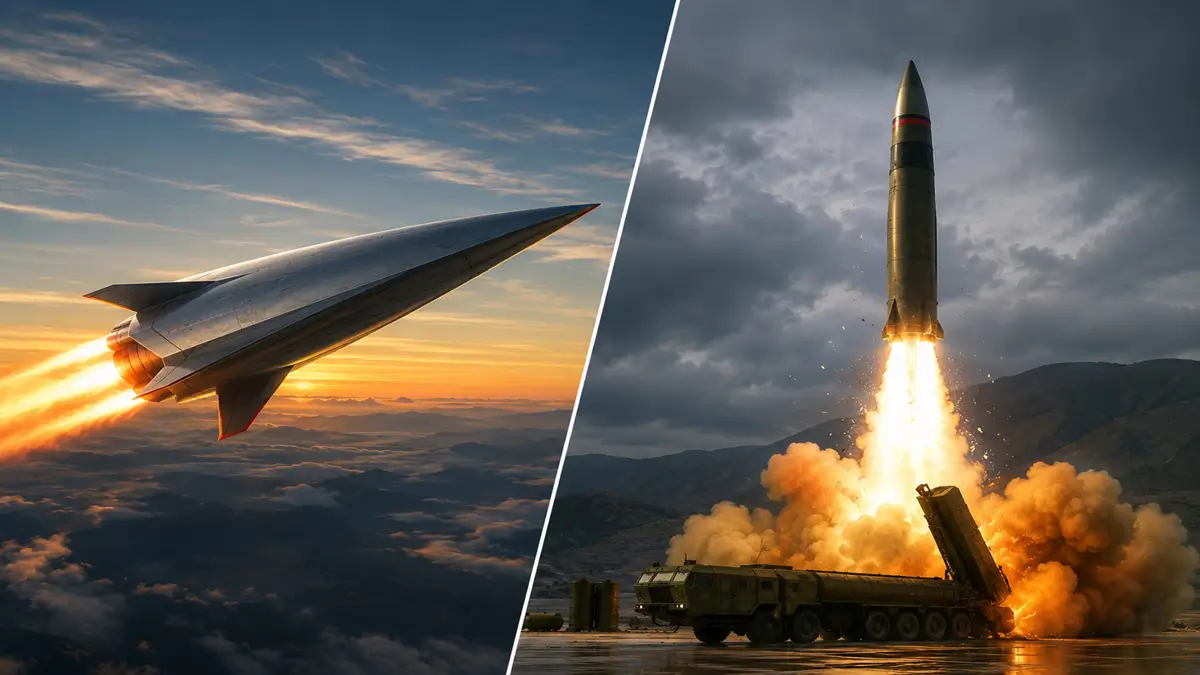
Modern warfare is changing rapidly, and missiles are becoming faster, smarter, and more difficult to stop. Among the most talked-about weapons today are hypersonic missiles and ballistic missiles. Both are designed to strike targets at extremely high speeds, but the way they travel, maneuver, and evade defense systems is very different.
Countries like United States, China, Russia, and India are heavily investing in these advanced missile technologies because they play a crucial role in future warfare.
Let’s understand the major differences between hypersonic and ballistic missiles in simple terms.
What is a Ballistic Missile?
A ballistic missile is a missile that follows a fixed curved path after launch. It is powered during the initial phase, and once it reaches high altitude, gravity mainly controls its trajectory.
Think of it like throwing a cricket ball into the air. Once released, the ball follows a predictable path. Ballistic missiles work in a similar way, although at much higher speeds and over much longer distances.
Key Features of Ballistic Missiles
- Travels in a high arc trajectory
- Reaches outer space or near-space altitude
- Mostly follows a predictable path
- Extremely fast during re-entry
- Can carry conventional or nuclear warheads
Examples of Ballistic Missiles
- Agni-V
- DF-41
- Minuteman III
- RS-28 Sarmat
What is a Hypersonic Missile?
A hypersonic missile travels at speeds greater than Mach 5 — that means more than five times the speed of sound. However, speed alone is not what makes these missiles dangerous.
The biggest advantage of hypersonic missiles is their ability to maneuver during flight. Unlike ballistic missiles that follow predictable paths, hypersonic missiles can change direction mid-air, making them extremely difficult to detect and intercept.
Key Features of Hypersonic Missiles
- Travels at Mach 5 or higher
- Can maneuver during flight
- Flies at lower altitudes
- Harder to track with radar
- Reduces enemy reaction time
Examples of Hypersonic Missiles
- BrahMos-II
- Avangard
- DF-ZF
- Dark Eagle
Why Hypersonic Missiles Are Considered More Dangerous
Military experts believe hypersonic missiles could change the balance of global power because they combine:
- Extreme speed
- Precision targeting
- Unpredictable movement
Traditional air defense systems are designed mainly to stop ballistic missiles. Since hypersonic missiles fly lower and maneuver constantly, current defense systems often struggle to track them effectively.
This is why many countries are now racing to develop both hypersonic weapons and anti-hypersonic defense systems.
Can Ballistic Missiles Carry More Power?
Yes. Ballistic missiles, especially intercontinental ballistic missiles (ICBMs), are still among the most powerful weapons ever built. Many are capable of carrying nuclear warheads over thousands of kilometers.
They remain a key part of nuclear deterrence strategies used by major powers around the world.
India’s Position in Hypersonic Technology
Defence Research and Development Organisation (DRDO) has been actively working on hypersonic technologies. India successfully tested the Hypersonic Technology Demonstrator Vehicle (HSTDV), marking a major step toward indigenous hypersonic missile development.
India is also developing advanced versions of the BrahMos missile system, which could eventually evolve into hypersonic variants.








 Indian Navy to Commission Indigenous Mul...
 Indian Army Launches Bharat Rice for Tro...
 INS Sahyadri Arrives in Russia for India...