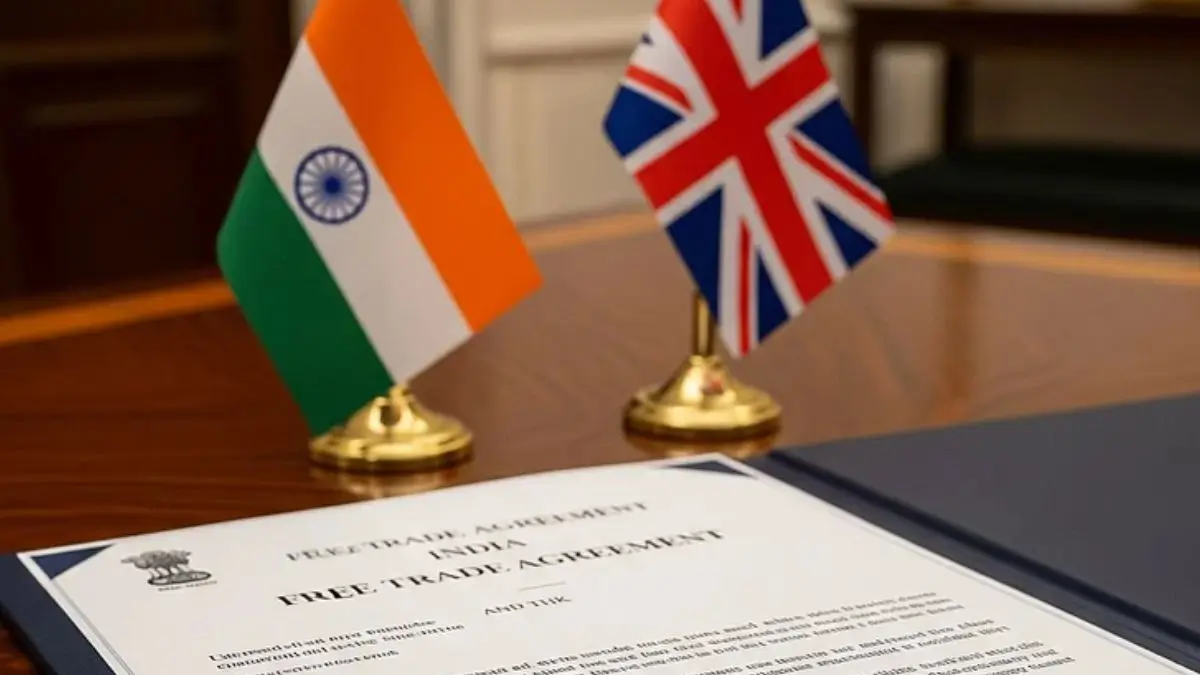
The Comprehensive Economic and Trade Agreement (CETA) was implemented between the India and the UK from July 15, 2026, it marks a new chapter in the economic relations between the both nations. With the aim of increasing two-way trade to USD 100 billion by 2030 from approximately USD 55-60 billion now, the agreement includes zero-duty access in several banned categories of Indian exports.
India and the United Kingdom’s CETA Takes Effect
The Comprehensive Economic and Trade Agreement (CETA) will officially take effect on July 15, 2026, becoming one of the most important bilateral trade agreements for the Indian government in recent times.
According to the Ministry of Commerce, this agreement aims to,
- Increase bilateral trade and investment.
- Improve market entry for the companies involved.
- Develop supply chain collaboration.
- Create new jobs.
- Ensure long-term economic cooperation.
Rajesh Agarwal, Secretary of Commerce, has said that the agreement will help increase bilateral trade to USD 100 billion within the next three or four years.
Current Trade Between India-UK
The ongoing trade between India and the United Kingdom has already shown a consistent growth trend.
Quick Overview of Bilateral Trade
- Total trade (goods and services): Around USD 55 to 60 billion.
- Trade in goods (FY 2025-2026): USD 25.12 billion.
- Trade in services (2024): USD 35.44 billion.
This new agreement aims to increase this momentum by removing obstacles and stimulating cooperation between businesses.
Important Benefits for Indian Exporters
Zero duty access has to be seen as one of the key benefits of CETA agreement.
Which sectors will benefit most from it?
- Textiles and apparel
- Leather goods
- Footwear
- Precious stones and jewelry
- Plastics
- Other labor-oriented fields of production
Such Zero tariff access will improve the competitiveness of the Indian exports and contribute to the market share in the UK market.
Protection to India’s Automobile Industry
This is true that even though the deal opens up several avenues for trade, it has taken care of the sensitive domestic industries of India as well.
Important Safeguards
- EVs get no tariff reductions during the first five years.
- There are no concessions in respect of Hybrid Vehicles.
- Concessions are not applicable to the Hydrogen-powered Vehicles.
- Sensitive areas for Internal Combustion Engine Vehicles remain safeguarded.
These measures are taken with the aim of giving protection to India’s nascent clean mobility ecosystem yet enabling local companies to enhance their technology and production capabilities.
Double Contribution Convention (DCC): Helping Indian Specialists
An important part that came with the trade agreement is the India-UK Double Contribution Convention (DCC).
What is DCC?
This convention guarantees that Indian staff working for a short time in the UK will not be obliged to pay any social security contributions in the UK for the next five years.
As of now, Indian specialists and their employers are obliged to pay around total 23% of the salary in the National Insurance system in the UK, even though they are usually unable to take full advantage of this system.
Key benefits
- Meeting the requirements and avoiding the double social security contributions.
- According to the estimates, this will lead to a saving of more than USD 600 million annually.
- More than 75,000 Indian professionals will benefit from this arrangement.
- More than 900 Indian employers operating in the UK will benefit from the Convention.
It is expected that this measure will reduce the costs of the businesses and make Indian firms more competitive in the market.








 Russia Suspected Plague Case: Nearly 200...
 India’s Russia-Ukraine Ceasefire Propo...
 COP31 2026: Venue, Dates, President, Key...