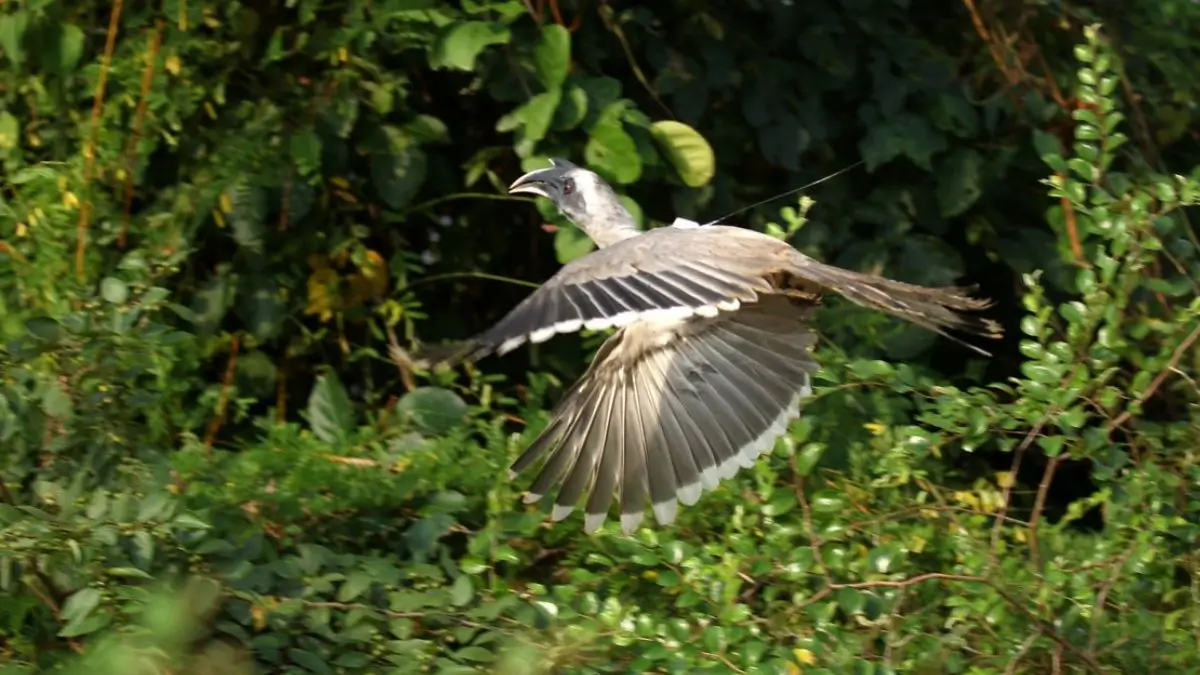
The Gujarat region’s Gir Forest has successfully rehabilitated the Indian Grey Hornbill, which had gone missing from the region over sixty years ago. The scientific evaluations have revealed that hornbills that were brought back via a precise conservation scheme have thrived, developed nesting locations, and reared young ones over four years. The success of this initiative ensures not just only the revival of a species that was locally believed extinct but will also improve Gir’s ecosystem with the involvement of the hornbills, which are important players in natural forest regeneration with their capacity to disperse their seeds across vast distances between the trees.
Indian Grey Hornbill Sighted in Gir after more than 60 years
The Indian Grey Hornbill was completely absent from the Gir’s environment between the 1950-1960s, which was mainly attributed to the hunting pressure.
After decades of wildlife preservation and extensive planning, the Gujarat forest department, along with its conservation partners, initiated the project of recovering the hornbill to its native habitat.
According to the Gujarat Chief Minister’s Office, the following were achieved,
- Survival of the birds in the wild.
- Possession of the territories on a permanent basis.
- Adaptation of the birds to the ecosystem of Gir.
- Offspring production in over four breeding seasons.
The programme stated is one of the most successful reintroduction programmes in India.
How the Reintroduction Project Was Carried Out
The Conservation programme has been carried out in stages with a total of 40 Indian Grey Hornbills being released into the Gir ecosystem.
Release Phases
- 2021-2022: 28 hornbills released
- 2023: 12 more hornbills released
11 male hornbills were equipped with satellite devices to track their,
- Movement patterns
- Habitat use
- Establishment of territory
- Nesting behaviour
- Breeding success
A thorough survey of the area proved that there are healthy populations present in the Gujarat’s Aravalli forests and that Gir can support the birds.
Four Years of Successful Breeding
The establishment of breeding of the reintroduced birds has been among the most positive results of the project put in place.
The study indicates,
- Only one breeding pair was able to produce solid eggs in their first year after the release.
- Three breeding pairs made solid nests in the second year.
- The evidence of breeding in subsequent years shows that the hornbills are beginning to create a population that can support itself.
Experts believe that this indicates that the species has adapted well to its restored environment.
Scientific Research Shows Successful Conservation Efforts
The results of the research have been published in the renowned peer-reviewed journal Birds.
The research is entitled as: “The Release of Indian Grey Hornbills in Gir, India: Observations on Ranging, Habitat Use, Nesting Behaviour and Behavioural Patterns.”
The research provides one of the most detailed evaluations of the release of birds in the Indian subcontinent covering the,
- Habitat choice
- Home range
- Daily movement
- Nesting behaviour
- Feeding ecology
- Long-term adjustment
The research indicates that currently Gir has created the comfortable ecological conditions for the persistence of the hornbills.
Satellite Tracking Gives Information on Successful Adaptation
Satellite tracking offered important data on how birds adapted to their new habitat.
Changes in Home Range
- Initial average home range – 61 sq km
- After adaptation – 5.7 sq km
Daily Movement
- Initial average movement – 4.3 km
- After adaptation – 1.4 km
These changes in movement mean that the birds have successfully defined stable territories and found enough sources of food and nesting places in Gir.
Importance of the Ecosystem of Indian Grey Hornbill
Indian Grey Hornbill is a prominent seed-disperser in forest ecosystems.
The species helps in to the,
- Regenerating forests naturally
- Encouraging plant diversity
- Promoting healthy forest ecosystems
- Restoring wildlife habitats
Observations show that they feed their chicks majorly on fruits of,
- Banyan
- Peepal
- Karamda
- Dhraman
Additionally, they consume the insects and other invertebrates, contributing to maintaining equilibrium in the ecosystem.








 Government Unveils 2026-2030 Strategy to...
 Health Ministry to Launch JOSH Teams for...
 PM Modi Completes 25 Years as Head of Go...